

IT and network costs keep climbing. Software subscriptions multiply, infrastructure becomes harder to manage, downtime becomes more expensive, and lean IT teams are expected to do more with less.
Many businesses assume cost reduction means cutting tools, delaying upgrades, or reducing support. In reality, the biggest savings often come from better network visibility, smarter vendor choices, automation, and more proactive infrastructure planning. A stronger network modernization strategy often reduces waste while improving reliability.
The goal is not to spend less at any cost. It is to remove inefficiencies, prevent avoidable disruptions, and make sure infrastructure decisions support both performance and long-term value.
Key Takeaways:
- IT costs rise from poor visibility, manual processes, reactive maintenance, vendor sprawl, and inefficient network planning.
- Cost-effective IT management depends on visibility, automation, optimization, and resilience to reduce waste without hurting performance.
- Automation, vendor consolidation, direct connectivity, and lifecycle planning lower labor, infrastructure, and downtime-related costs.
- Better network management improves uptime, issue detection, capacity planning, security, and long-term investment decisions.
Why IT and Network Costs Keep Rising

Businesses rarely overspend because of one major mistake. Costs usually rise from several smaller issues that build over time and become harder to control.
Lack of visibility into assets and network performance
Many organizations do not have a clear view of everything connected to their environment. Unknown devices, underused hardware, overlapping tools, and incomplete asset records create hidden waste.
When teams do not know what they own, what is being used, or where bottlenecks exist, they often buy more than they need. Poor visibility also makes it harder to spot unused licenses, redundant services, and aging equipment that still consumes budget and support resources.
Manual processes increase labor costs
Routine work still consumes a large share of IT time in many businesses. Monitoring systems manually, producing reports by hand, troubleshooting repetitive issues, and responding slowly to alerts all increase labor costs.
Manual work also reduces consistency. The more time teams spend on repetitive tasks, the less time they have for planning, improvement, and prevention.
Reactive maintenance leads to expensive downtime
Reactive IT management is one of the fastest ways to increase costs. Emergency fixes, unplanned outages, and rushed hardware replacement usually cost far more than planned maintenance. Businesses that invest in ongoing support coverage are often better positioned to avoid these costly disruptions.
A reactive model creates direct and indirect losses. There is the repair itself, but also lost productivity, service disruption, customer frustration, and pressure on internal teams.
Vendor sprawl and inefficient contracts
As environments grow, many businesses add tools and services without stepping back to simplify. The result is vendor sprawl: too many providers, overlapping subscriptions, inconsistent support, and inflated costs.
In some cases, businesses also pay more because services are being resold through multiple layers, each adding markup. Contracts may renew automatically even when usage has changed.
The Core Principles of Cost-Effective IT and Network Management
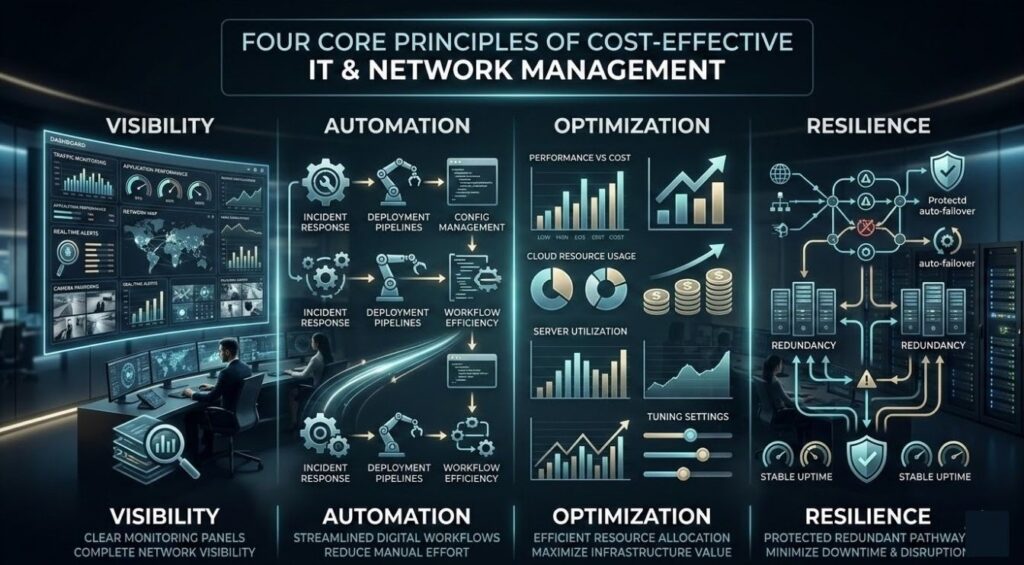
Reducing costs without hurting performance requires a clear operating model. Four principles usually drive the best results.
Visibility
Cost control starts with knowing what exists in the environment.
That means understanding:
- what hardware, software, and network services are in use
- which assets are underused or unnecessary
- where incidents happen most often
- which tools or contracts are creating the most cost
Without visibility, cost reduction becomes guesswork.
Automation
Automation reduces manual effort and improves consistency. It allows IT teams to manage more systems with fewer repetitive tasks.
Used well, automation helps with:
- monitoring and alerting
- backups
- patching
- configuration tracking
- reporting
- routine response workflows
The result is lower operational overhead and faster execution.
Optimization
Optimization is about removing waste and improving utilization. It means matching tools, services, and infrastructure to actual business needs rather than maintaining outdated setups by default.
This often includes right-sizing capacity, reducing overlap, eliminating unused tools, and improving resource allocation.
Resilience
The cheapest environment is not the one with the fewest safeguards. It is the one designed to avoid costly failures.
Resilience reduces long-term risk by preventing outages, supporting failover, and ensuring the network can continue operating when something goes wrong.
7 Practical Strategies to Reduce IT and Network Costs
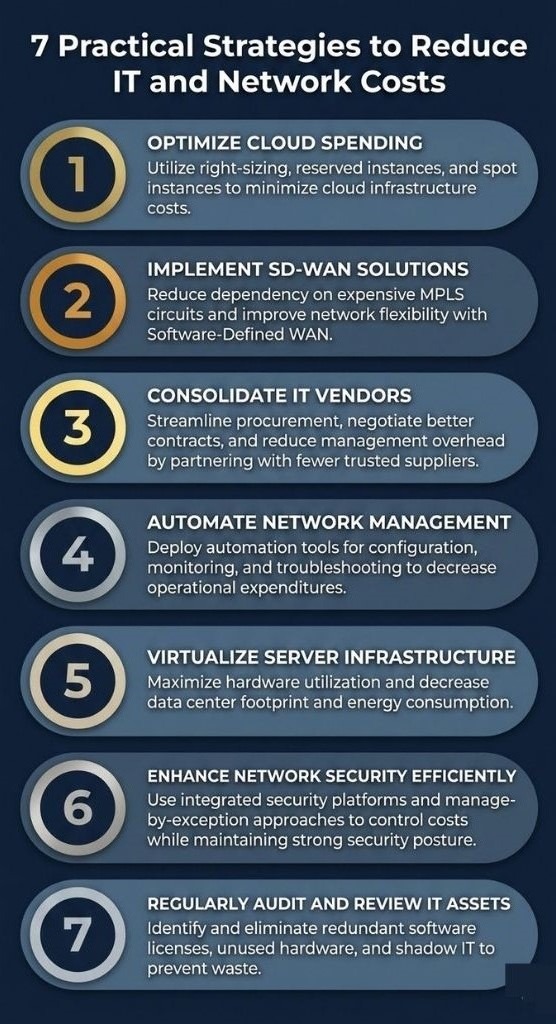
These strategies help businesses control spend while protecting service quality and uptime.
1. Automate routine IT and network management tasks
Routine operational work should not consume skilled engineering time when it can be standardized.
Common areas to automate include:
- system and network monitoring
- alert routing
- backups
- patch deployment
- configuration tracking
- compliance checks
- recurring reports
Automation lowers labor costs, reduces errors, and shortens response times. It also makes performance more predictable across sites and systems.
2. Use network visibility tools to identify waste
Visibility tools help businesses find costs that are otherwise easy to miss.
They can reveal:
- unused or outdated hardware
- bandwidth bottlenecks
- shadow IT
- duplicate services
- underused links
- recurring performance issues tied to specific assets
When teams can see how the environment is actually performing, they can remove waste with confidence instead of cutting blindly. Many of these savings become clearer through focused IT optimization planning.
3. Consolidate vendors and renegotiate contracts
Vendor consolidation is one of the simplest ways to reduce cost and complexity at the same time.
Review contracts for:
- duplicate software capabilities
- overlapping support agreements
- underused subscriptions
- unnecessary add-ons
- outdated pricing models
- indirect reseller markups
Fewer vendors usually means simpler support relationships, clearer accountability, and stronger negotiating leverage.
4. Choose direct connectivity where possible
Connectivity choices affect both cost and operational complexity. In simple terms, Type 1 connectivity usually refers to service delivered directly by the network owner or carrier, while Type 2 connectivity is typically resold through another provider.
A direct carrier relationship can offer benefits such as:
- fewer intermediaries
- less markup
- simpler fault resolution
- clearer service accountability
- better visibility into performance and support
This does not mean direct connectivity is always the right answer, but it often reduces cost and complexity where available.
5. Build smart redundancy instead of expensive overprovisioning
Redundancy matters, but many businesses overspend by adding more capacity than they actually need.
A smarter approach focuses on targeted resilience, such as:
- diverse carriers
- separate physical paths
- failover connectivity
- backup power for critical sites
- resilient core services
This reduces the risk of downtime-related losses without turning the network into an unnecessarily expensive environment.
6. Improve asset lifecycle and capacity planning
Poor asset planning creates cost at both ends. Replacing equipment too early wastes capital, while replacing it too late increases failure risk and support costs.
A stronger lifecycle approach helps teams:
- track age and condition of assets
- plan upgrades based on performance data
- avoid rushed replacements
- match future capacity to real demand
- prevent overbuying
Good planning shifts spending from emergency response to controlled investment. Businesses also gain flexibility when they combine refresh planning with hardware sourcing options that better match budget and performance requirements.
7. Strengthen cybersecurity to avoid hidden financial losses
Security failures are cost problems as much as technical problems. The financial impact of a breach, ransomware event, or prolonged vulnerability exposure can easily exceed the cost of prevention.
Important controls include:
- regular patching
- access control
- vulnerability management
- endpoint protection
- network segmentation
- security monitoring
Stronger security lowers the chance of business disruption, incident recovery costs, compliance exposure, and reputational damage.
Table 1: Cost Drivers vs Solutions
| Cost Driver | How It Increases Spend | Practical Solution |
| Poor asset visibility | Leads to unused devices, duplicate tools, and unnecessary purchases | Implement asset discovery, inventory control, and usage tracking |
| Manual monitoring and reporting | Consumes staff time and slows response | Automate alerts, reporting, and routine workflows |
| Reactive maintenance | Creates emergency repairs and unplanned downtime | Use proactive monitoring and scheduled maintenance |
| Vendor sprawl | Increases overlap, support complexity, and contract waste | Consolidate vendors and renegotiate agreements |
| Inefficient connectivity choices | Adds markup and complicates support | Use direct carrier relationships where practical |
| Overprovisioned redundancy | Raises recurring infrastructure cost | Design targeted failover and resilient paths |
| Weak lifecycle planning | Causes early replacement or costly late-stage failure | Use performance data for refresh and capacity planning |
| Weak cybersecurity controls | Increases risk of breach, recovery cost, and disruption | Strengthen patching, access control, and vulnerability management |
Cloud, Automation, and Managed Services: Where Savings Usually Come From
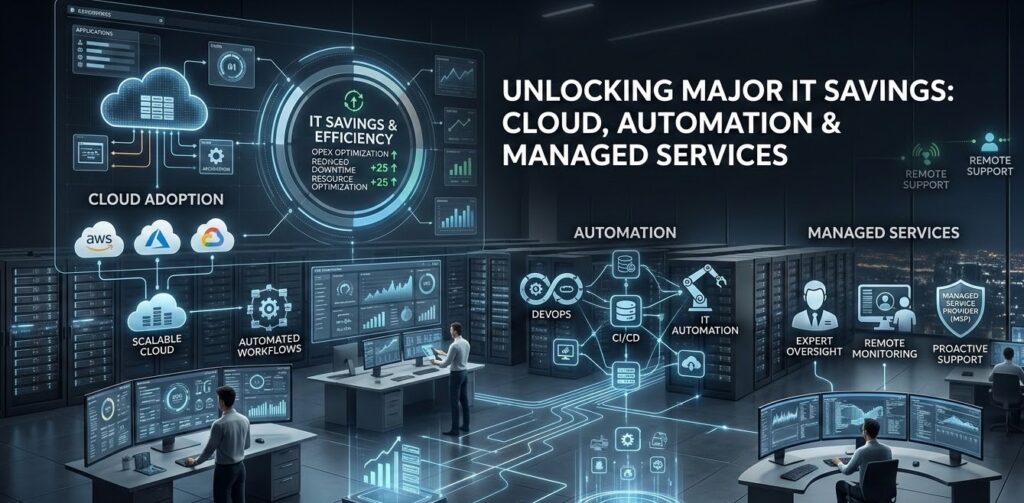
Businesses looking for meaningful savings often find them in three areas: cloud adoption, automation, and selective managed services.
Cloud adoption and infrastructure savings
Cloud adoption can reduce upfront hardware spend and lower the maintenance burden for internal teams. It also gives businesses more flexibility to scale infrastructure without major capital investment.
The best cost results usually come when cloud services are sized properly and managed carefully. Cloud can reduce waste, but only when usage is monitored and aligned to real demand.
Automation and manpower efficiency
Automation helps smaller IT teams support larger environments. It reduces dependency on manual work, lowers error rates, and speeds up incident response.
This improves productivity without requiring the business to expand headcount at the same rate as infrastructure growth.
Managed network services for specialized support
Managed services can be a strong option for businesses that lack deep internal expertise or operate across multiple sites.
They may help reduce:
- hiring costs
- training demands
- specialist resource gaps
- after-hours support pressure
- service delivery inconsistency
The key is using managed services selectively and measuring value over time.
How Better Network Management Improves Both Cost and Performance
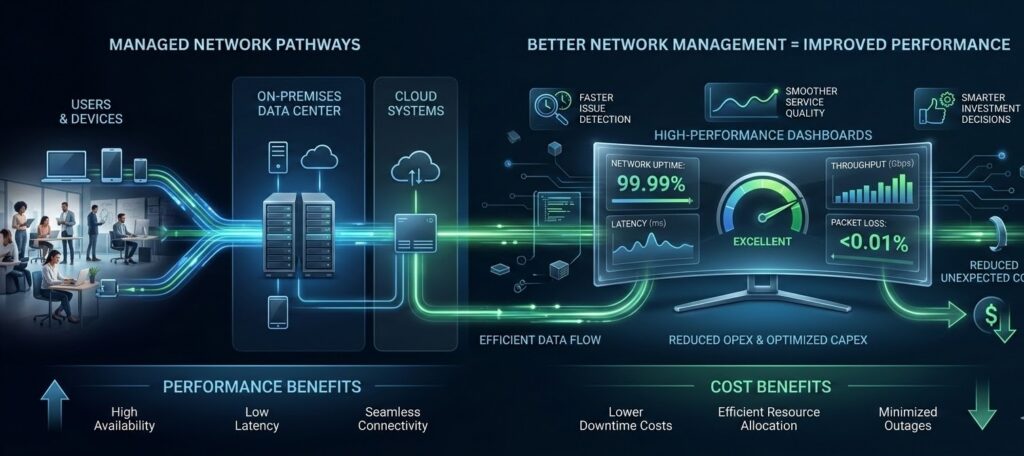
Cost reduction works best when it improves operating quality rather than simply cutting spend.
Better uptime reduces business disruption
Stable networks reduce lost productivity, service interruptions, and customer-facing issues. Even small uptime improvements can protect revenue and reduce support pressure.
Faster issue detection improves service quality
When issues are detected earlier, teams can respond before they become major incidents. This reduces impact, shortens recovery time, and improves the user experience.
Performance data supports smarter investment decisions
Clear performance data helps businesses invest where it matters most. Instead of guessing, teams can target upgrades, retire underused assets, and justify spending based on evidence.
Compliance and security monitoring reduce unexpected costs
Continuous oversight helps prevent compliance failures, security gaps, and operational surprises. That reduces the risk of penalties, incident response costs, and expensive remediation work.
Common Mistakes Businesses Make When Trying to Cut IT Costs

Cost reduction efforts often fail because they focus on the wrong targets.
Cutting tools without understanding usage
Removing tools before reviewing usage can create visibility gaps, increase manual work, or shift problems elsewhere.
Delaying upgrades for too long
Deferring upgrades may look efficient in the short term, but aging systems often become more expensive to support and more likely to fail. In some cases, extending value through refurbished equipment processes can be more effective than either premature replacement or waiting for failure.
Ignoring network redundancy
Trying to save money by removing resilience can backfire quickly when outages occur. The cost of downtime often exceeds the cost of planned redundancy.
Relying too much on manual processes
Manual processes may appear cheaper at first, but they increase labor hours, inconsistency, and delay.
Choosing the cheapest vendor instead of the best long-term value
Low headline pricing can hide weaker support, poor service quality, and higher long-term operating cost. The better decision is usually the vendor with the strongest overall value.
What to Measure When Evaluating IT Cost Reduction

Cost reduction should be measured with both financial and operational metrics. That is how businesses avoid lowering spend while damaging performance.
Operational cost metrics
Track the direct financial impact of IT management decisions, including:
- monthly IT spend
- cost per user
- cost per site
- support contract cost
- network support labor hours
- software and license utilization
Performance and reliability metrics
Track whether service quality is improving or declining.
Important measures include:
- downtime
- mean time to resolution
- service availability
- packet loss
- latency
- bandwidth utilization
- recurring incident rate
Efficiency metrics
These indicators show whether teams are operating more effectively over time.
Useful examples include:
- number of manual tasks eliminated
- asset utilization rate
- ticket volume reduction
- engineering time saved
- change success rate
- response time improvement
Best Tools and Technologies That Support Cost Reduction

The right tools help reduce waste, improve control, and support better decision-making.
Network monitoring tools
These tools improve visibility into performance, availability, utilization, and fault conditions. They help teams detect issues earlier and understand where capacity or service problems are increasing cost.
IT asset management platforms
Asset management platforms help businesses track devices, licenses, lifecycle status, ownership, and usage. This reduces duplicate purchases, improves refresh planning, and supports stronger inventory control.
Configuration and automation tools
Configuration and automation platforms reduce repetitive work, improve standardization, and make environments easier to manage at scale.
Security and vulnerability management tools
Security tools help identify weaknesses before they create financial loss. They also support patching, access governance, and risk reduction across the environment.
For businesses managing growing storage demands, more efficient enterprise storage planning can also reduce waste while supporting performance and resilience.
FAQs
How can businesses reduce IT costs without affecting performance?
Businesses can reduce IT costs by improving visibility, automating routine work, consolidating vendors, planning asset lifecycles properly, and strengthening resilience. The goal is to remove waste and prevent avoidable failures rather than simply cutting spending.
What is cost-effective network management?
Cost-effective network management means running the network in a way that controls spending while maintaining uptime, performance, and security. It focuses on visibility, optimization, automation, and smart resilience.
Does automation really reduce IT labor costs?
Yes. Automation reduces time spent on repetitive tasks such as monitoring, reporting, patching, and backups. That allows IT teams to manage more systems with less manual effort and fewer errors.
What is the difference between Type 1 and Type 2 connectivity?
Type 1 connectivity is typically delivered directly by the carrier that owns the network. Type 2 connectivity is usually resold through another provider. Direct carrier relationships may reduce markup, simplify support, and improve accountability.
Why is network visibility important for cost reduction?
Network visibility helps businesses identify unused assets, overlapping tools, bandwidth issues, and hidden inefficiencies. Without visibility, cost reduction decisions are often based on assumptions rather than evidence.
How often should businesses review IT assets and contracts?
Most businesses should review IT assets, software usage, and vendor contracts at least quarterly, with a deeper strategic review annually. Fast-changing environments may need more frequent checks.
Can cloud migration reduce network and infrastructure costs?
Yes, cloud migration can reduce upfront hardware costs, improve scalability, and lower maintenance demands. The savings depend on good planning, proper sizing, and ongoing usage control.
What are the biggest hidden costs in IT management?
The biggest hidden costs often include downtime, underused assets, duplicate subscriptions, manual labor, poor contract terms, emergency replacements, and security incidents.