


Enterprise cybersecurity is now a core business capability, not just a technical safeguard. Modern infrastructure spans hybrid cloud, distributed data centers, SaaS platforms, remote endpoints, and third-party integrations. As environments expand, risk exposure grows, making security architecture critical to operational continuity.
Traditional perimeter defenses were built for centralized networks. Today’s identity-driven environments allow credential abuse, lateral movement, and cloud misconfiguration to bypass static boundaries. Firewall-centric strategies alone are insufficient.
A resilient enterprise cybersecurity strategy unifies identity governance, zero trust, segmentation, endpoint visibility, monitoring, and ransomware recovery into a cohesive model that supports resilience and sustainable growth.
Strategic Overview
Enterprise cybersecurity in 2026 centers on resilience rather than perimeter control. Organizations operate across cloud platforms, distributed data centers, remote endpoints, and interconnected supply chains. Attack surfaces are dynamic and identity-driven.
Legacy network perimeter defenses cannot contain credential abuse, lateral movement, or cloud misconfigurations. Security must assume breach and focus on containment, visibility, and recovery.
A structured six-pillar model identity security, zero trust, segmentation, endpoint protection, SOC monitoring, and ransomware readiness aligns cybersecurity with infrastructure modernization and enterprise risk governance.
Key Takeaways
- Enterprise cybersecurity is identity-centric, replacing perimeter trust with continuous verification and least privilege enforcement.
- Zero trust and network segmentation reduce lateral movement and contain breaches in hybrid environments.
- Endpoint Detection and Response provides behavioral visibility beyond traditional antivirus protection.
- Ransomware resilience requires immutable backups, 3-2-1 architecture, and quarterly recovery testing.
What Is Enterprise Cybersecurity in 2026?
Enterprise cybersecurity is a strategic discipline that protects complex, distributed IT ecosystems. It integrates architecture, governance, monitoring, and recovery planning into a continuous lifecycle.
Unlike smaller environments, enterprises operate across hybrid cloud, remote workforces, SaaS ecosystems, and multi-site infrastructure. These environments often evolve through broader infrastructure modernization initiatives, which expand both opportunity and exposure.
Key Characteristics of Enterprise Environments
Before defining controls, leaders must understand structural complexity:
- Hybrid cloud and multi-cloud workloads
- SaaS-driven business processes
- API integrations and automation
- Distributed users and unmanaged networks
- Third-party vendor dependencies
Enterprise cybersecurity therefore focuses on systemic risk reduction rather than isolated tool deployment.
The Modern Enterprise Threat Landscape
Threat actors increasingly target identity systems, cloud workloads, and supply chain dependencies. The risk model has shifted from perimeter breach attempts to credential compromise and privilege escalation.
Primary Threat Categories
Ransomware
Ransomware attacks now include encryption, data exfiltration, and operational disruption. Attackers frequently target backup systems to prevent recovery.
Supply Chain Compromise
Third-party integrations and software updates create indirect exposure. Vendor credential compromise can bypass traditional security layers.
Credential Abuse
Phishing, token replay, and MFA fatigue attacks exploit identity gaps. Once authenticated, attackers often operate undetected.
Lateral Movement
Flat networks enable attackers to pivot between systems. East-west traffic frequently lacks sufficient inspection.
Cloud Misconfiguration
Public storage exposure and over-permissioned IAM roles remain common enterprise weaknesses.
The threat landscape reinforces the need for layered architectural controls rather than single-point defenses.
The 6-Pillar Enterprise Cybersecurity Framework
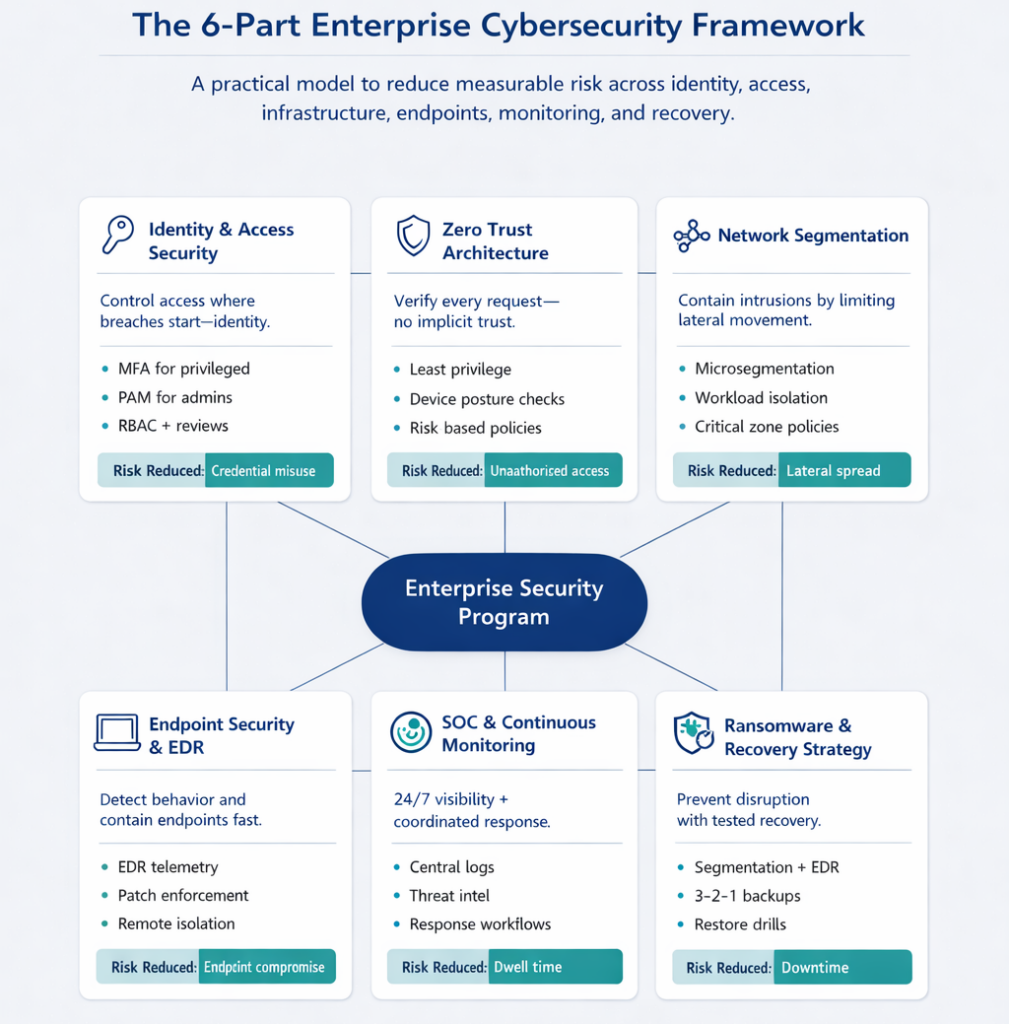
Enterprise leaders benefit from a structured model that aligns security investment with measurable risk reduction. The following six pillars create an integrated operating system for enterprise cybersecurity.
1. Identity & Access Security
Identity has replaced the network perimeter as the primary control plane. Most breaches now begin with credential compromise rather than firewall evasion.
A mature identity program should include governance, enforcement, and monitoring components working together.
Core Identity Controls
- Multi-factor authentication (MFA) across all privileged accounts
- Privileged Access Management (PAM) for elevated roles
- Role-based access control (RBAC)
- Conditional access policies
- Continuous authentication monitoring
Identity governance reduces attack surface by eliminating excessive permissions. It also strengthens audit readiness and compliance reporting.
Identity Risk Reduction Model
| Control Area | Risk Reduced | Strategic Benefit |
| MFA | Credential theft | Reduced unauthorized access |
| PAM | Privilege escalation | Controlled admin activity |
| Conditional Access | Compromised devices | Context-aware enforcement |
| Access Reviews | Orphaned accounts | Ongoing hygiene |
Identity security forms the foundation upon which zero trust operates.
2. Zero Trust Architecture
Zero trust enforces continuous verification across users, devices, and applications. It eliminates implicit trust based on network location.
Rather than trusting internal traffic, zero trust evaluates each access request dynamically.
Core Zero Trust Principles
- Never trust, always verify
- Least privilege enforcement
- Continuous telemetry analysis
- Micro-perimeter segmentation
Zero trust integrates identity validation, device posture, and policy enforcement across hybrid infrastructure.
A structured zero trust implementation roadmap helps organizations transition from perimeter-based security to continuous, identity-driven enforcement across hybrid environments.
Zero Trust vs Traditional Perimeter Model
| Traditional Model | Zero Trust Model |
| Trust internal network | Trust nothing by default |
| Perimeter firewall focus | Identity-centric enforcement |
| Static access rules | Dynamic, risk-based policies |
| Limited east-west control | Granular microsegmentation |
Zero trust is not a product purchase. It is an architectural evolution aligned with modern enterprise operations.
3. Network Segmentation
Network segmentation limits attacker movement after initial compromise. Without segmentation, breaches escalate quickly.
Segmentation is especially important within environments built on distributed data center architecture and hybrid cloud connectivity.
Why Flat Networks Fail
Flat networks allow unrestricted east-west traffic. Once attackers gain access, they can scan and pivot freely.
Segmentation Approaches
- VLAN-based isolation
- Application-level segmentation
- Policy-driven workload isolation
- Microsegmentation
Effective segmentation strategies require aligning workload isolation policies with asset criticality and regulatory exposure to reduce lateral movement risk.
Segmentation Risk Impact
| Environment Type | Without Segmentation | With Segmentation |
| Data Center | Rapid lateral spread | Contained breach zones |
| Cloud | IAM privilege pivot | Policy-restricted workloads |
| Hybrid | Cross-site compromise | Isolated trust boundaries |
Segmentation reduces blast radius and strengthens compliance alignment.
4. Endpoint Security & EDR
Endpoints remain high-risk entry points due to phishing, unmanaged networks, and user behavior.
Traditional antivirus solutions rely on signature detection and cannot identify behavioral anomalies. Modern enterprises require advanced detection capabilities.
Modern Endpoint Security Components
- Endpoint Detection and Response (EDR)
- Behavioral analytics
- Automated patch enforcement
- Device health validation
- Remote containment capability
Securing distributed users requires extending endpoint visibility, device compliance enforcement, and behavioral monitoring beyond traditional office boundaries.
Antivirus vs EDR Comparison
| Feature | Traditional Antivirus | EDR |
| Detection Type | Signature-based | Behavioral |
| Threat Visibility | Limited | Real-time telemetry |
| Incident Response | Manual | Automated containment |
| Lateral Movement Detection | Minimal | Advanced analytics |
Endpoint visibility must exceed 95% coverage to reduce blind spots.
5. SOC & Continuous Monitoring
Detection and response maturity determines the real-world effectiveness of enterprise cybersecurity controls.
Even well-designed architectures fail without continuous visibility and coordinated response capability.
SOC Core Capabilities
- 24/7 monitoring
- Centralized log aggregation
- Threat intelligence integration
- Incident triage workflows
- Response orchestration
Many enterprises align SOC operations with broader enterprise IT operations support to improve efficiency and scalability.
SOC Delivery Models
Selecting the right monitoring model requires evaluating staffing maturity, response expectations, and long-term scalability requirements.
| Factor | In-House SOC | Managed SOC |
| Staffing | Requires recruitment | External expertise |
| Cost Structure | High fixed cost | Predictable subscription |
| Tool Management | Internally maintained | Vendor-managed stack |
| Coverage | Often limited hours | 24/7 by design |
| Scalability | Headcount dependent | Elastic |
Hybrid models increasingly balance internal governance with external monitoring.
6. Ransomware & Recovery Strategy
Ransomware resilience requires layered prevention and reliable restoration capability. Prevention alone is insufficient without tested recovery procedures.
Prevention Controls
- MFA enforcement
- Email security filtering
- Network segmentation
- EDR behavioral blocking
Recovery Readiness Framework
The 3-2-1 backup model remains foundational:
- 3 copies of critical data
- 2 storage media types
- 1 immutable or offsite copy
A resilient ransomware program integrates layered prevention controls with tested recovery processes to minimize operational disruption.
Recovery Validation Matrix
| Control | Purpose | Testing Frequency |
| Immutable Backups | Prevent encryption | Quarterly |
| Restoration Drills | Validate recovery | Quarterly |
| Tabletop Exercises | Clarify roles | Biannual |
| Incident Runbooks | Reduce confusion | Annual review |
Testing reduces operational downtime and protects business continuity.
Building a Roadmap for Enterprise Cybersecurity
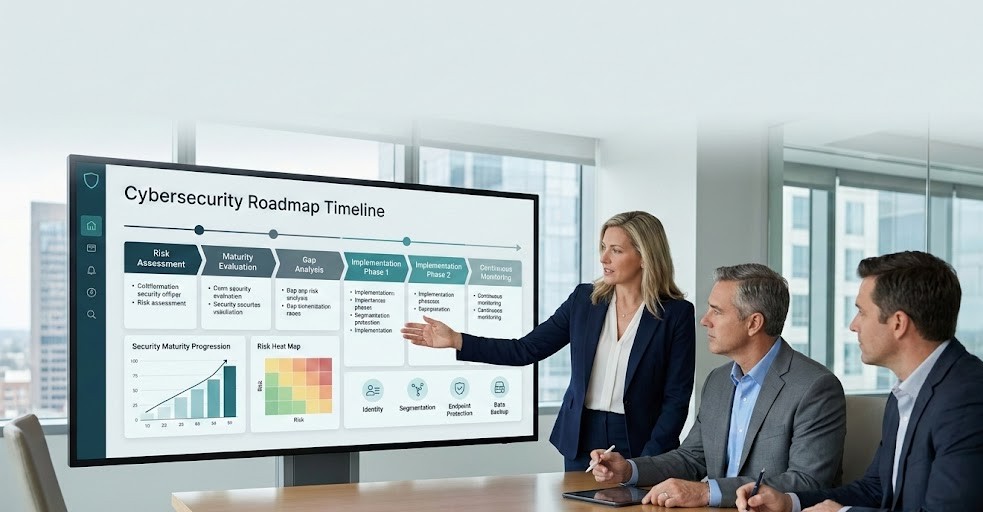
A successful enterprise cybersecurity roadmap is not a list of tools to purchase. It is a structured, multi-phase plan that aligns security controls with business risk, infrastructure strategy, and operational maturity.
For CIOs, CISOs, and IT directors, the roadmap must balance three priorities:
- Risk reduction
- Operational feasibility
- Budget alignment
A well-designed roadmap provides sequencing, governance clarity, and measurable outcomes.
Phase 1: Establish Executive Alignment
Before assessing tools or architecture, leadership alignment is essential. Security must be positioned as a business risk function, not solely an IT responsibility.
Key Actions
- Define enterprise risk tolerance
- Identify critical business services
- Clarify regulatory and compliance obligations
- Establish executive reporting structure
Security initiatives gain momentum when they are tied directly to revenue protection, operational continuity, and regulatory accountability.
Phase 2: Conduct Enterprise Risk Assessment
A structured risk assessment identifies where exposure is most concentrated. This step prevents misallocation of budget toward low-impact initiatives.
Focus Areas
- Critical applications and data repositories
- Identity systems and privileged accounts
- Cloud workloads and integrations
- Third-party dependencies
- Backup and recovery processes
Risk Evaluation Matrix
| Asset Category | Threat Likelihood | Business Impact | Priority Level |
| Identity Systems | High | Severe | Critical |
| Financial Systems | Medium | Severe | High |
| Collaboration Tools | High | Moderate | High |
| Legacy Applications | Medium | Moderate | Medium |
Risk scoring ensures roadmap sequencing is objective rather than reactive.
Phase 3: Assess Security Maturity Across the Six Pillars
After identifying risk exposure, evaluate current capabilities across the six enterprise cybersecurity pillars.
Maturity Assessment Areas
- Identity & Access Governance
- Zero Trust Implementation
- Network Segmentation
- Endpoint Coverage & EDR
- SOC & Monitoring
- Ransomware Recovery Readiness
Sample Maturity Model
| Level | Description |
| Level 1 | Reactive, fragmented controls |
| Level 2 | Basic controls, limited integration |
| Level 3 | Integrated controls, documented processes |
| Level 4 | Measurable, automated enforcement |
| Level 5 | Optimized, continuous improvement |
Most enterprises operate between Level 2 and Level 3. The roadmap should focus on advancing foundational maturity before pursuing advanced automation.
Phase 4: Perform Gap Analysis
Gap analysis bridges the difference between current maturity and desired risk posture. This step translates assessment findings into actionable initiatives.
Example Gap Mapping
| Control Area | Current State | Target State | Action Required |
| MFA Coverage | 70% | 100% | Expand enforcement |
| EDR Deployment | 85% | >95% | Complete rollout |
| Segmentation | Partial VLANs | Microsegmentation | Redesign network zones |
| Backup Testing | Annual | Quarterly | Implement test schedule |
Gap analysis should identify dependencies and sequencing constraints to avoid implementation bottlenecks.
Phase 5: Define Strategic Security Initiatives
Initiatives should be grouped into logical transformation waves rather than isolated projects.
Wave 1: Foundational Controls
Focus on high-impact, low-complexity improvements.
- Enforce MFA enterprise-wide
- Eliminate dormant privileged accounts
- Deploy centralized logging
- Validate backup integrity
Wave 2: Architectural Hardening
Strengthen structural resilience.
- Implement zero trust policies
- Deploy microsegmentation
- Expand EDR coverage
- Enhance identity governance
Wave 3: Advanced Detection & Optimization
Enhance automation and analytics.
- Integrate threat intelligence
- Implement behavioral analytics
- Automate response playbooks
- Improve executive risk dashboards
Phased execution prevents operational disruption and supports measurable progress.
Phase 6: Budget & Resource Alignment
Security roadmaps must align with realistic staffing and financial capacity. Underfunded initiatives create incomplete deployments and increased exposure.
Budget Planning Considerations
- Tool consolidation opportunities
- Managed vs in-house operations
- Licensing scalability
- Training and change management
Resource Planning Table
| Initiative Type | Internal Team Required | External Support | Timeline |
| MFA Expansion | Low | Minimal | 3 Months |
| Segmentation Redesign | Medium | Moderate | 6–9 Months |
| SOC Enhancement | High | Possible MSSP | Ongoing |
| Backup Modernization | Medium | Vendor Support | 4–6 Months |
Planning must include operational impact analysis to avoid disruption.
Phase 7: Implementation Governance
Without governance, roadmap initiatives stall or fragment. Structured oversight ensures continuity and accountability.
Governance Elements
- Executive steering committee
- Quarterly risk review meetings
- Defined KPIs for each pillar
- Formal change management processes
KPIs should include measurable risk indicators rather than technical activity metrics.
Phase 8: Continuous Monitoring & Optimization
Ongoing Optimization Actions
Enterprise cybersecurity is never complete. Threats evolve, infrastructure changes, and business priorities shift.
- Quarterly maturity reassessment
- Annual architecture review
- Continuous vulnerability scanning
- Incident trend analysis
- Policy updates aligned to new risks
Continuous Improvement Cycle
- Measure performance
- Identify gaps
- Adjust controls
- Report to leadership
- Reassess maturity
This cycle ensures cybersecurity remains aligned with enterprise transformation.
Measuring Success in Enterprise Security
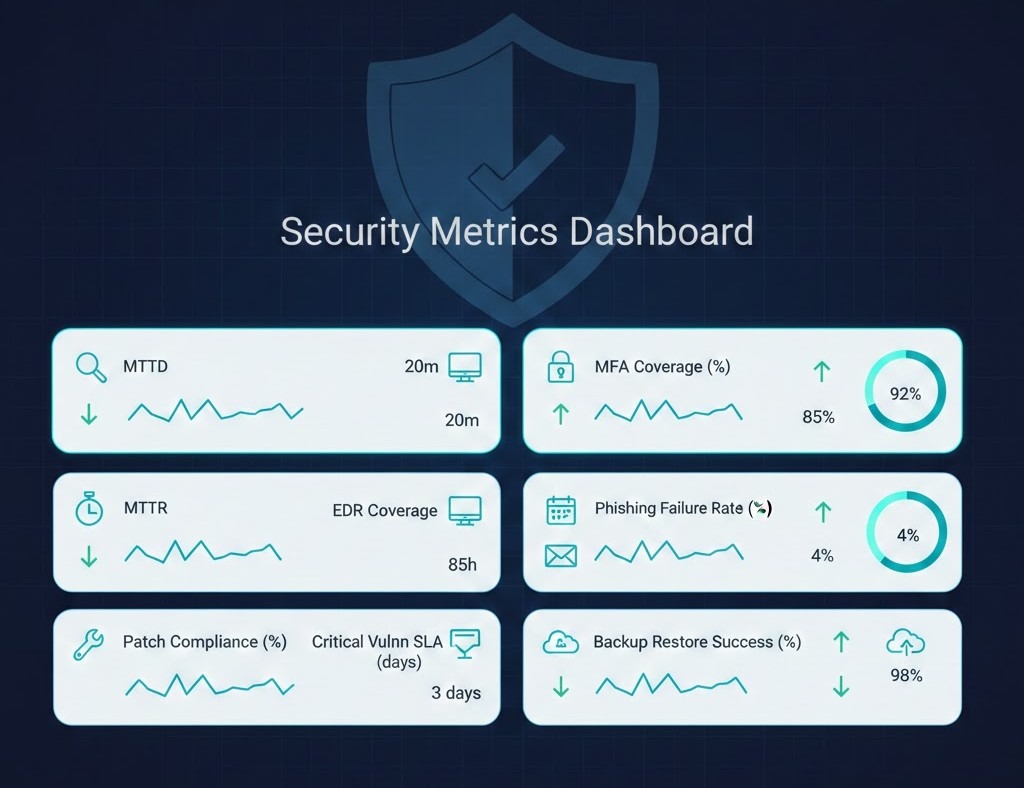
Compliance alone does not prove real security maturity. Enterprises must measure whether controls reduce risk, improve response speed, and strengthen operational resilience.
Clear KPIs help leaders identify gaps, justify investment, and drive continuous improvement. Metrics should connect directly to business impact, not just tool activity.
Core Security Metrics
Focus on measurable indicators across detection, response, hygiene, and user behavior.
| Metric | What It Indicates | Why It Matters |
| Mean Time to Detect (MTTD) | Time to identify threats | Shorter dwell time limits damage |
| Mean Time to Respond (MTTR) | Time to contain incidents | Faster recovery reduces disruption |
| Patch compliance rate | % patched within SLA | Reduces known vulnerability exposure |
| Endpoint coverage rate | % of assets reporting to EDR | Minimizes visibility gaps |
| Phishing report vs click rate | User awareness maturity | Reflects behavior change effectiveness |
| Backup restore success rate | Recovery validation results | Confirms operational resilience |
Common Measurement Mistakes
Metrics should reflect risk reduction, not reporting convenience.
- Tracking alert volume without resolution quality
- Reporting tool deployment instead of coverage
- Ignoring asset criticality when measuring performance
- Failing to baseline before setting targets
Effective measurement transforms enterprise cybersecurity from reactive operations into a governed, data-driven program.
Enterprise Cybersecurity Roadmap Timeline Example
Below is a simplified 24-month roadmap structure.
| Timeframe | Focus Area | Key Outcomes |
| Months 1–3 | Risk Assessment & MFA Expansion | Identity hardened |
| Months 4–6 | EDR & Logging Centralization | Improved visibility |
| Months 7–12 | Segmentation & Zero Trust Policies | Reduced lateral movement |
| Months 13–18 | SOC Optimization | Faster detection |
| Months 19–24 | Automation & Testing | Operational resilience |
Timelines vary based on enterprise size and complexity, but structured sequencing improves success probability.
Enterprise Cybersecurity Checklist
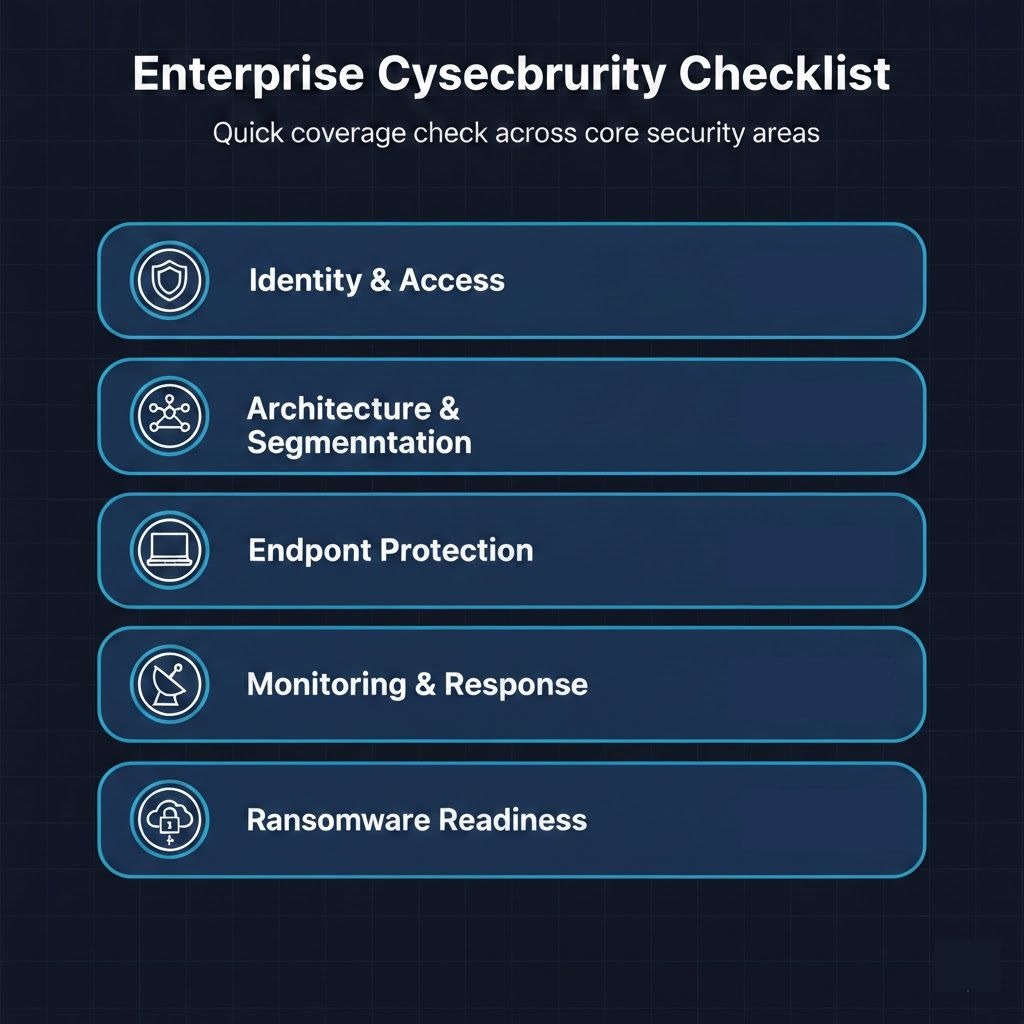
The following checklist supports quick posture validation across strategic pillars:
Identity & Access
- MFA enforced for all privileged accounts
- PAM controlling administrative access
- Quarterly access reviews completed
Architecture & Segmentation
- Zero trust policies implemented
- Network segmentation documented
- Microsegmentation protecting critical workloads
Endpoint Protection
- EDR coverage above 95%
- Patch management SLA defined
- Device compliance enforced
Monitoring & Response
- Centralized logging operational
- 24/7 monitoring active
- Incident response plan documented
- Annual tabletop exercises completed
Ransomware Readiness
- 3-2-1 backup model deployed
- Immutable storage configured
- Quarterly restoration tests performed
Structured validation reduces blind spots and supports audit readiness.
Enterprise cybersecurity failures are rarely caused by a lack of tools. More often, they result from fragmented strategy, unclear ownership, or architectural gaps. Even mature organizations can accumulate risk when controls are deployed without integration or executive alignment.
Common Enterprise Cybersecurity Mistakes
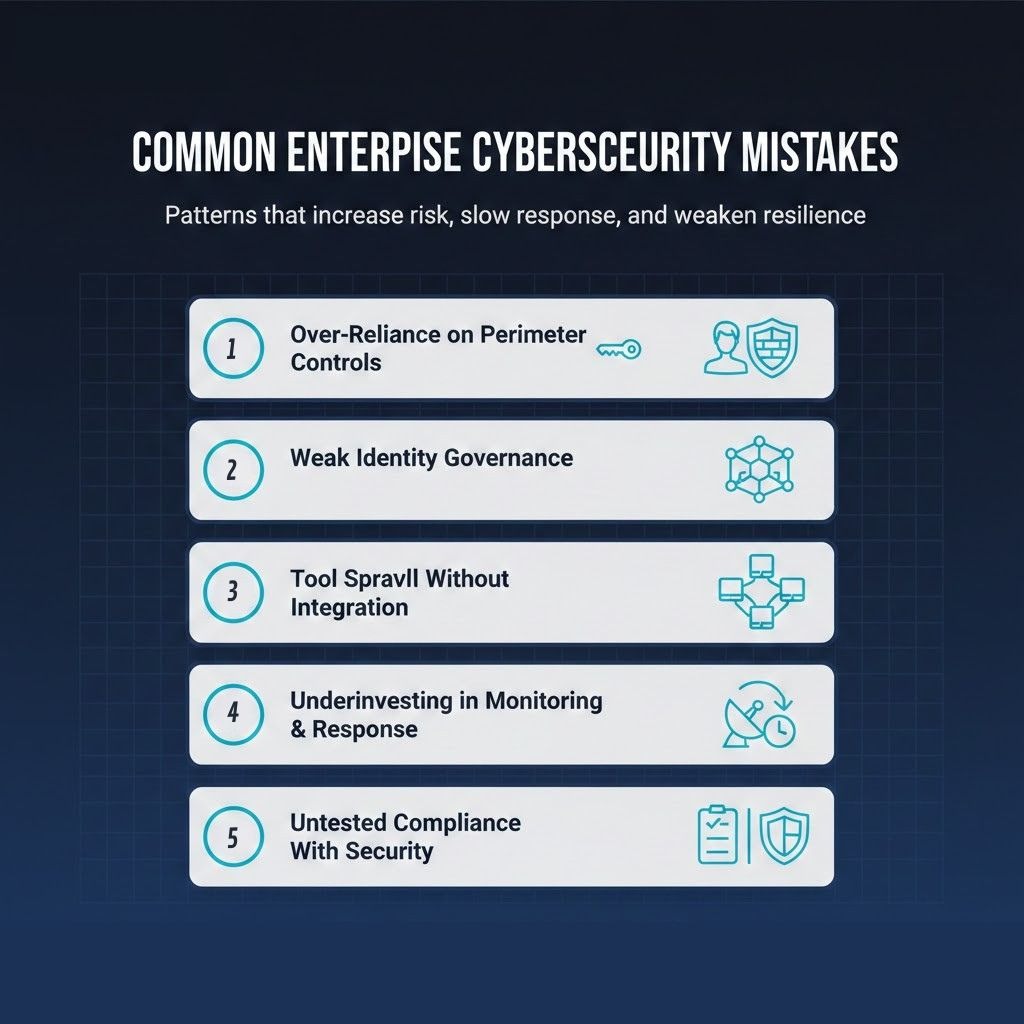
Below are the most common strategic mistakes that weaken enterprise cybersecurity posture.
1. Over-Reliance on Perimeter Controls
Many enterprises still treat firewalls as the primary line of defense. While perimeter controls remain important, they cannot stop credential abuse or insider movement in hybrid environments.
Modern security must prioritize identity validation, segmentation, and continuous monitoring rather than assuming internal traffic is trustworthy.
2. Weak Identity Governance
Identity is often managed operationally rather than strategically. Excessive privileges, inconsistent MFA enforcement, and limited access reviews create unnecessary exposure.
Without strong identity governance, zero trust initiatives and segmentation efforts lose effectiveness.
3. Flat Network Architecture
Flat networks allow attackers to move laterally once access is gained. Lack of segmentation increases breach impact and complicates containment.
Segmentation should align with asset criticality and business risk, not just network topology.
4. Tool Sprawl Without Integration
Purchasing multiple security platforms without architectural alignment leads to alert fatigue and visibility gaps. Disconnected systems reduce operational efficiency.
Security tools must integrate under a centralized monitoring and governance framework.
5. Underinvesting in Monitoring & Response
Preventive controls alone are insufficient. Without 24/7 monitoring and structured incident response, breaches remain undetected longer and escalate in impact.
Detection maturity must scale alongside infrastructure growth.
6. Untested Recovery Plans
Documented backup and response procedures provide limited value if never tested. Restoration drills and tabletop exercises reveal gaps before real incidents occur.
Quarterly recovery validation strengthens resilience and executive confidence.
7. Confusing Compliance With Security
Meeting regulatory requirements does not guarantee strong security posture. Compliance frameworks provide baselines, but enterprises must align controls with real-world risk.
Security maturity should exceed minimum standards and reflect business exposure.
Why Enterprises Choose Catalyst Data Solutions as a Strategic Cybersecurity Partner
Enterprise cybersecurity strategy requires more than selecting the right technologies. It demands architectural alignment, phased execution, and operational sustainability across identity, segmentation, endpoint protection, monitoring, and recovery. Many organizations define strong frameworks but struggle to implement them cohesively across hybrid and distributed environments.
Catalyst Data Solutions supports enterprises in translating cybersecurity strategy into structured, measurable execution. The focus is not on isolated tools, but on integrating the six-pillar framework into modern infrastructure environments.
Organizations engage Catalyst to:
- Conduct enterprise-wide cybersecurity maturity assessments
- Identify identity, segmentation, and monitoring gaps
- Design zero trust–aligned architecture
- Consolidate and modernize security platforms
- Align SOC capabilities with operational requirements
- Strengthen ransomware resilience and recovery validation
- Develop phased roadmaps aligned with budget cycles
This approach ensures enterprise cybersecurity becomes an integrated business capability rather than a collection of disconnected controls.
For CIOs, CISOs, and infrastructure leaders seeking structured execution aligned with modernization initiatives, a strategic assessment provides a clear starting point toward resilient, enterprise-grade security.
FAQs
How is enterprise cybersecurity different from SMB security?
Enterprise environments involve larger attack surfaces, regulatory obligations, distributed infrastructure, and structured governance. Security strategies require formalized frameworks, segmentation, and 24/7 monitoring capabilities beyond simplified small-business controls.
Is zero trust required for enterprise environments?
Zero trust is not legally mandated, but it is widely recognized as foundational. Hybrid work, SaaS adoption, and cloud connectivity eliminate implicit trust models, making continuous verification essential.
Should enterprises build an internal SOC?
The decision depends on expertise, budget, compliance needs, and coverage expectations. Many enterprises adopt hybrid or managed models to achieve consistent 24/7 monitoring while maintaining governance oversight.
How can enterprises reduce tool sprawl in cybersecurity?
Tool sprawl increases complexity, cost, and operational gaps. Consolidation improves visibility and efficiency when aligned to architecture strategy.
- Evaluate overlapping functionality
- Centralize logging and telemetry
- Integrate identity with endpoint controls
- Standardize platforms where possible
Strategic consolidation strengthens control cohesion and lowers operational burden.
How often should ransomware recovery plans be tested?
Critical systems should undergo restoration testing quarterly. Tabletop exercises and technical drills ensure backup integrity and clarify incident response roles, reducing downtime during actual events.
How do we justify enterprise cybersecurity investment to the board?
Enterprise cybersecurity investment should be tied directly to business risk and operational continuity. Board discussions should focus on measurable impact rather than technical controls.
- Quantify potential financial impact of downtime
- Map security gaps to revenue risk
- Align initiatives to regulatory exposure
- Present risk reduction metrics, not tool features
Framing cybersecurity as risk management improves executive alignment.