


Cloud migration has become a strategic priority for enterprises that need to improve agility, modernize operations, and support long-term growth. It is no longer limited to moving servers or applications from one environment to another.
A well-defined cloud migration strategy helps organizations align technology decisions with business goals. When planned carefully, cloud migration supports digital transformation, improves resilience, and creates a more flexible IT foundation for the future.
Key Takeaways:
- A cloud migration strategy aligns workload moves with business goals, governance, architecture planning, and long-term modernization.
- Enterprise cloud adoption is driven by cost optimization, scalability, resilience, security improvements, and faster innovation.
- Readiness assessments evaluate infrastructure, applications, dependencies, compliance, and ROI before migration begins.
- The 7R framework helps enterprises choose whether to rehost, replatform, refactor, repurchase, retain, retire, or relocate workloads.
What Is Cloud Migration?

Cloud migration is the process of moving applications, data, infrastructure, and workloads from on-premise systems to cloud environments, or between cloud environments.
For enterprises, this often involves more than a technical relocation. It can include redesigning applications, updating security models, modernizing infrastructure, and improving operational processes. In many cases, cloud initiatives also connect to broader infrastructure planning needs across compute, storage, and networking environments.
Why Cloud Migration Matters for Enterprises
Enterprises are moving to the cloud because traditional infrastructure can limit speed, increase maintenance costs, and make it harder to scale. Legacy environments may still support critical operations, but they often create barriers to modernization.
A strong cloud migration strategy helps enterprises reduce those barriers. It gives decision-makers a framework for aligning cloud investments with business value, operational efficiency, and long-term modernization goals.
Business Drivers for Enterprise Cloud Migration
Before deciding how to migrate, enterprises need to understand why migration matters to the business. These drivers shape the roadmap, budget, and priorities.
Cost Optimization
Cloud migration can help organizations reduce capital spending and improve resource efficiency. Instead of purchasing infrastructure for peak demand, enterprises can scale usage more dynamically.
That said, cost optimization depends on planning. Without governance, cloud spending can become difficult to control.
Scalability and Agility
Cloud environments allow enterprises to scale resources more quickly than traditional infrastructure models. This supports changing demand, regional expansion, and faster service delivery.
Agility also improves when teams can provision environments faster and reduce dependency on long hardware procurement cycles.
Innovation and Digital Transformation
Cloud adoption supports digital transformation by making it easier to modernize applications, deploy new services, and support development workflows. Organizations can test and launch initiatives with greater speed and flexibility.
For many enterprises, cloud migration also supports wider improvements in data center strategy and application delivery.
Resilience and Disaster Recovery
Cloud platforms can strengthen business continuity through redundancy, backup integration, and more flexible recovery options. This reduces the risk associated with single-site infrastructure and manual recovery processes.
Security Improvements
Many enterprises move to the cloud to improve security visibility, strengthen access controls, and align migration planning with a broader enterprise security strategy. Cloud environments can support stronger identity controls, centralized monitoring, and more consistent security operations.
Key Business Drivers for Enterprise Cloud Migration
| Business Driver | Why It Matters | Enterprise Impact |
| Cost optimization | Reduces overprovisioning and capital expense | Improves financial flexibility and resource efficiency |
| Scalability | Expands resources as demand changes | Supports growth without long infrastructure delays |
| Agility | Speeds deployment and operational response | Improves time to market and service delivery |
| Innovation | Enables modernization and transformation | Supports new digital capabilities |
| Resilience | Improves continuity and recovery planning | Reduces downtime and operational risk |
| Security | Strengthens visibility and policy control | Supports better enterprise risk management |
Core Components of a Cloud Migration Strategy
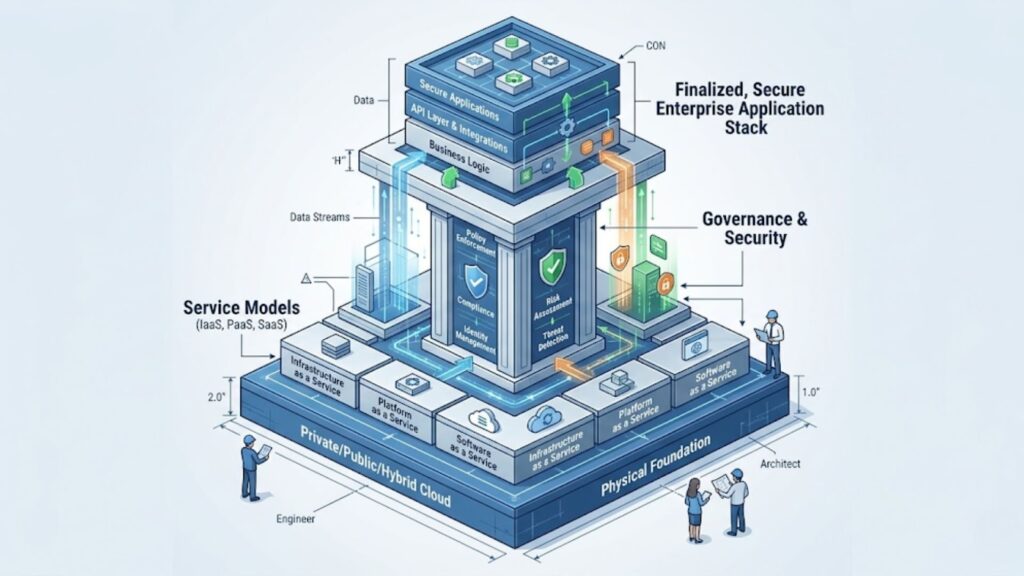
A successful cloud migration strategy depends on strong planning before any workload is moved. Enterprises need to define deployment models, service models, governance structures, and architectural principles that match business needs.
Cloud Deployment Models
Different deployment models serve different operational and compliance goals.
Public Cloud
Public cloud environments provide scalable infrastructure managed by third-party providers. They are well suited for flexible workloads, development environments, and rapid scaling.
Private Cloud
Private cloud environments offer more control over infrastructure and may be preferred for workloads with strict compliance, performance, or data handling requirements.
Hybrid Cloud
Hybrid cloud combines cloud platforms with on-premise systems. This model is common in large enterprises where some workloads must remain local while others move to cloud environments, especially when hybrid infrastructure design plays a central role in workload placement and connectivity planning.
Multi-Cloud
Multi-cloud strategies involve using more than one cloud provider. This can reduce reliance on a single vendor and support specialized workload placement, but it also increases management complexity.
Cloud Service Models
Enterprises should also choose the right service model for each workload.
- IaaS provides infrastructure-level resources such as compute, storage, and networking.
- PaaS offers managed platforms for building and deploying applications.
- SaaS delivers software applications through a subscription-based model.
Each model affects how much control the organization keeps and how much management responsibility shifts to the provider.
Governance and Architecture Planning
Governance defines how cloud environments will be managed, secured, and monitored over time. This includes:
- Identity and access policies
- Cost management standards
- Data protection controls
- Compliance requirements
- Workload placement rules
- Operational ownership
Architecture planning should also address integration, resilience, scalability, and long-term maintainability.
Vendor Ecosystem Considerations
Most enterprise environments depend on a broad technology ecosystem. Cloud migration often involves coordinating cloud platforms, on-premise systems, connectivity, security tools, and backup processes.
Enterprises often migrate workloads to platforms such as AWS or Microsoft Azure, while integrating on-premise infrastructure from vendors like Dell Technologies or HPE to support hybrid environments.
Core Components of an Enterprise Cloud Migration Strategy
| Component | Strategic Question | Why It Matters |
| Deployment model | Public, private, hybrid, or multi-cloud? | Shapes flexibility, control, and compliance alignment |
| Service model | IaaS, PaaS, or SaaS? | Determines the right operating model for workloads |
| Governance | Who owns standards and policy? | Reduces risk and improves consistency |
| Architecture | How will systems integrate and scale? | Supports resilience, security, and performance |
| Vendor ecosystem | Which technology partners fit the roadmap? | Prevents tool gaps and operational fragmentation |
Cloud Readiness Assessment

A cloud migration strategy should begin with a clear assessment of the current environment. This stage helps enterprises identify what is ready to move, what needs redesign, and what may need to stay in place.
Infrastructure Assessment
Infrastructure assessment reviews compute, storage, networking, backup, virtualization, and hardware lifecycle status. The goal is to identify technical constraints, aging platforms, performance bottlenecks, and operational risks.
Application Portfolio Analysis
Not every application belongs in the cloud in the same way. Enterprises should classify applications based on business value, performance requirements, modernization potential, and dependency complexity.
This helps answer important questions:
- Which applications are ready to migrate?
- Which need limited changes before migration?
- Which require deeper redesign?
- Which should remain on-premise for now?
- Which should be retired?
Dependency Mapping
Applications often rely on databases, identity systems, middleware, APIs, storage platforms, and third-party services. Dependency mapping helps avoid migration issues caused by moving one component without its supporting systems.
Security and Compliance Evaluation
Enterprises should assess data sensitivity, regulatory obligations, access policies, encryption requirements, and audit readiness before migration begins. This helps ensure that security controls are designed into the strategy rather than added later.
Cost and ROI Analysis
A complete financial review should compare current infrastructure costs with projected cloud costs, migration effort, operational savings, and long-term efficiency gains.
A practical cost analysis usually includes:
- Infrastructure and licensing costs
- Migration tooling and services
- Staffing and training needs
- Operational efficiency gains
- Performance and resilience improvements
Enterprise Cloud Migration Framework
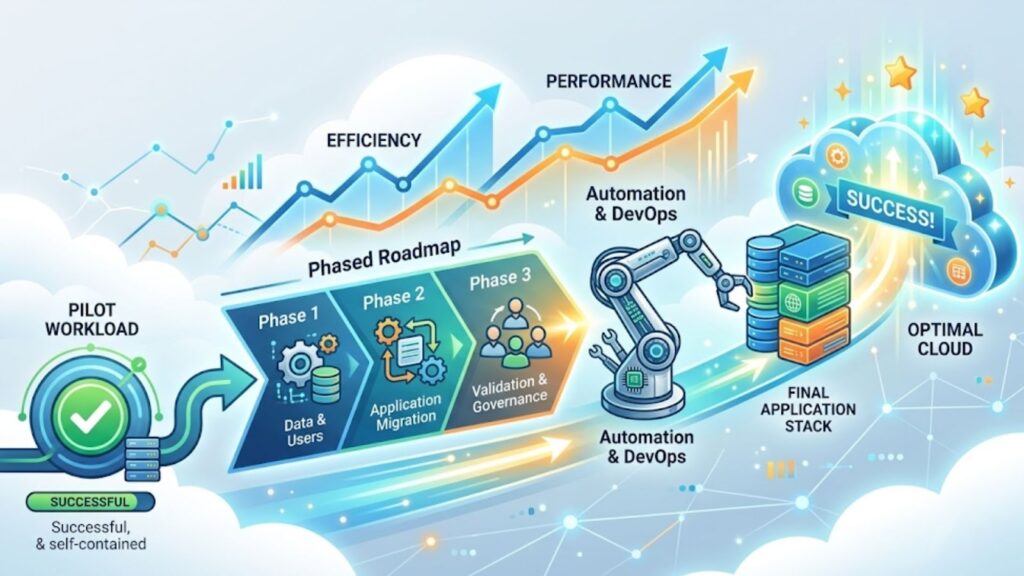
A structured migration framework helps enterprises manage risk and move in phases rather than attempting a large, disruptive transition all at once.
1. Assessment
This phase focuses on discovery, inventory, business alignment, and readiness analysis. Teams evaluate the current environment and define the reasons for migration.
2. Planning
Planning translates assessment findings into a migration roadmap. This includes workload prioritization, sequencing, target architecture, governance requirements, and success metrics.
A strong planning phase should define:
- Migration priorities
- Timeline and milestones
- Resource requirements
- Security controls
- Testing expectations
- Rollback considerations
3. Migration
This phase includes workload movement, validation, cutover planning, and issue management. Depending on workload type, migration may involve rehosting, replatforming, or deeper modernization.
4. Optimization
Once workloads are moved, enterprises need to optimize cost, performance, security, and operations. Many cloud environments become inefficient when optimization is delayed.
5. Governance
Governance continues after migration. Enterprises need ongoing control over architecture standards, access policies, compliance, spending, and service performance.
Cloud Migration Strategies: The 7Rs
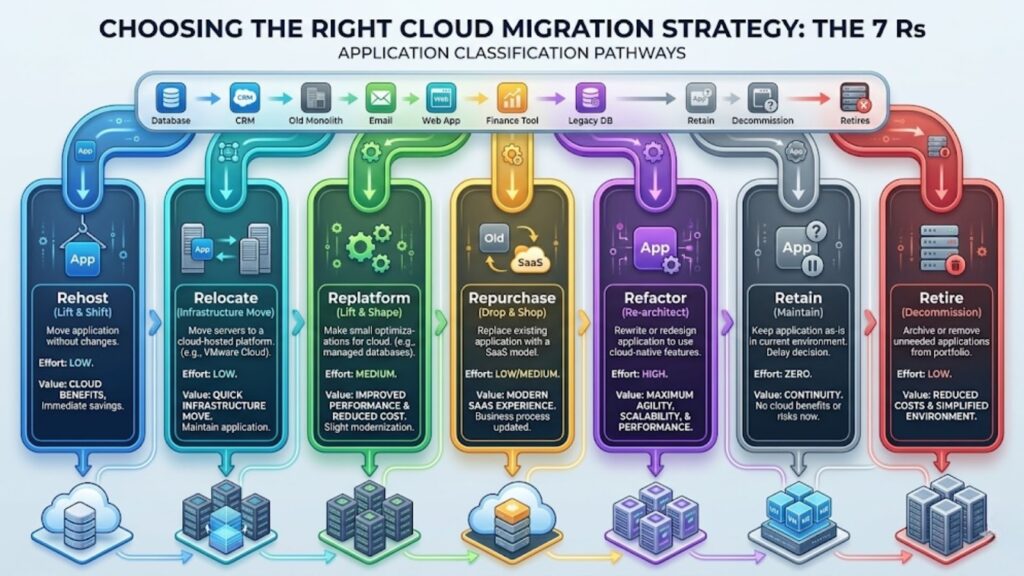
The 7R framework helps enterprises choose the right migration path for each workload. Different applications need different approaches based on technical fit and business value.
Rehost
Rehosting moves an application to the cloud with minimal changes. It is often used when speed matters more than immediate modernization.
Replatform
Replatforming makes limited adjustments to improve performance or compatibility in the cloud without redesigning the full application.
Refactor
Refactoring redesigns an application to take greater advantage of cloud-native capabilities. This often delivers higher long-term value but requires more effort.
Repurchase
Repurchasing replaces an existing application with a SaaS alternative. This can reduce maintenance effort and simplify support.
Retain
Some workloads should remain in their current environment due to compliance, performance, latency, or business constraints.
Retire
Some systems no longer justify the cost or complexity of migration. Retiring them reduces technical debt and operational overhead.
Relocate
Relocation moves workloads at the infrastructure or virtualization layer with minimal application redesign. This approach may fit large enterprise moves where speed is essential.
Common Enterprise Cloud Migration Strategies (7R Framework)
| Strategy | Description | Best Fit |
| Rehost | Move with minimal changes | Fast migrations and lower short-term effort |
| Replatform | Make limited improvements | Applications needing moderate optimization |
| Refactor | Redesign for cloud-native use | Strategic workloads with long-term value |
| Repurchase | Replace with SaaS | Legacy applications with mature SaaS options |
| Retain | Keep in place | Workloads not yet suitable for migration |
| Retire | Decommission outdated systems | Redundant or low-value applications |
| Relocate | Move at infrastructure layer | Large-scale environment transitions |
Cloud Infrastructure and Platform Considerations
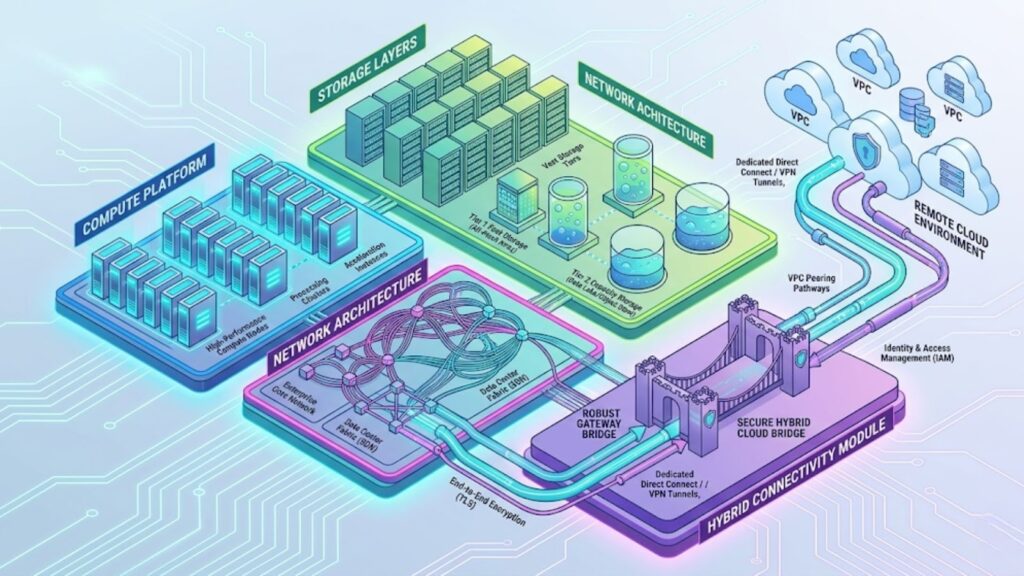
Cloud migration is not only about applications. Enterprises also need to build the infrastructure foundation that supports performance, connectivity, resilience, and long-term operations.
Compute and Storage Platforms
Workload placement depends on compute sizing, storage performance, retention requirements, backup integration, and expected growth. These decisions affect both migration success and long-term cloud efficiency.
Storage planning is especially important for data-intensive workloads. Many organizations connect cloud decisions to broader storage architecture priorities to avoid fragmented data management.
Networking Architecture
Network design has a direct impact on performance, access control, and hybrid cloud reliability. Enterprises need to plan for bandwidth, segmentation, routing, latency, and secure connectivity between environments.
In hybrid environments, networking platforms from providers such as Juniper Networks or HPE Aruba may support secure connectivity, segmentation, and traffic management across distributed infrastructure.
Hybrid Cloud Connectivity
Few enterprises move everything at once. During migration, applications and data often span cloud and on-premise systems. Reliable hybrid connectivity is essential for maintaining integration, service availability, and operational continuity.
This may involve private links, software-defined networking, updated security policies, and changes to network architecture. In some cases, these efforts align closely with broader network cost planning.
Infrastructure Modernization
Migration often exposes limitations in older servers, storage systems, and management tools. That is why many enterprises treat cloud migration as part of a larger modernization effort rather than as a separate project.
Organizations reviewing infrastructure changes during migration may also evaluate platform comparison insights when aligning storage performance, cost, and lifecycle planning.
Security and Compliance in Cloud Migration

Security should be integrated into the migration strategy from the beginning. Enterprises need consistent controls across users, applications, infrastructure, and data.
Identity and Access Management
Identity and access management should define who can access what, under which conditions, and with what level of privilege. Strong authentication, least-privilege access, and centralized identity governance are essential.
Encryption and Data Protection
Enterprises should protect data in transit and at rest using appropriate encryption and key management practices. Backup, retention, and recovery plans should also support resilience and regulatory requirements.
Data protection platforms such as Veeam or Commvault are often included in enterprise cloud strategies to support backup consistency, recovery orchestration, and resilience planning.
Compliance Requirements
Cloud migration must reflect legal, industry, and regional requirements related to privacy, data residency, retention, and auditability. These requirements should inform workload placement and architecture decisions early in the process.
Zero Trust Architecture
Zero trust strengthens cloud security by requiring continuous verification rather than assuming trust based on location or network access. This approach supports stronger segmentation, access control, and policy enforcement across cloud and hybrid environments.
Challenges in Enterprise Cloud Migration

Even well-planned cloud initiatives face obstacles. Recognizing these challenges early improves execution and reduces disruption.
Legacy System Complexity
Older applications may depend on unsupported platforms, tightly coupled infrastructure, or undocumented integrations. These systems often require more discovery and testing before migration.
Integration Challenges
Enterprise systems are connected to many internal and external services. Without careful planning, integration issues can disrupt operations, data flows, and user access.
Organizational Readiness
Cloud migration changes roles, processes, and skill requirements. Success depends on alignment across IT, security, finance, operations, and leadership teams.
Cost Control
Cloud costs can grow quickly when workloads are oversized, usage is not monitored, or governance is weak. Enterprises need ongoing visibility into consumption, performance, and spending accountability.
Best Practices for Successful Cloud Migration

A successful cloud migration strategy depends on careful execution as much as good planning.
Start With Pilot Workloads
Begin with lower-risk workloads to test migration methods, governance standards, and operational processes. Pilot migrations help teams build confidence before moving more critical systems.
Build a Phased Migration Roadmap
A phased roadmap reduces risk by organizing migration into manageable waves. Prioritize workloads based on business value, complexity, and readiness.
Implement Automation and DevOps
Automation improves consistency across provisioning, deployment, testing, and policy enforcement. DevOps practices also help teams manage cloud environments more effectively after migration.
Optimize Continuously
Migration is not the final step. Enterprises should continuously improve cost efficiency, performance, observability, and security posture.
Ongoing optimization often includes:
- Rightsizing compute resources
- Reviewing storage tiers
- Strengthening policy enforcement
- Removing unused services
- Improving monitoring and reporting
Plan Your Enterprise Cloud Migration with Expert Support
In that context, integration partners such as Catalyst Data Solutions Inc. can help bridge migration strategy, infrastructure planning, procurement coordination, and deployment execution across complex hybrid and cloud environments.
With a vendor-agnostic approach, Catalyst supports enterprises that need to modernize infrastructure, reduce procurement complexity, and align cloud initiatives with long-term operational goals.