


Enterprise IT teams are under pressure to do more with less. Hardware costs are rising, lead times can slow projects, and old devices often pile up after refresh cycles. At the same time, companies must show progress on sustainability, data security, and ESG goals.
This is where circular economy IT becomes a practical business strategy. It helps companies extend hardware life, reduce e-waste, recover value from retired assets, and make better procurement decisions across new, refurbished, and reused equipment.
What Is Circular Economy in IT?
Circular economy IT is an approach to managing technology so hardware stays in use longer and creates less waste. Instead of buying, using, and discarding equipment, companies reuse, repair, refurbish, resell, or recycle assets through a planned lifecycle.
This model is important because global e-waste reached 62 million tonnes in 2022, equal to about 7.8 kg per person. Only 22.3% of global e-waste was formally collected and recycled in an environmentally sound way that year. Global e-waste is also projected to reach 82 million tonnes by 2030.
For enterprise IT buyers, circular IT is not only an environmental issue. It also affects cost control, hardware access, compliance, and long-term infrastructure planning. A strong strategy for circular IT planning helps teams avoid waste while keeping systems reliable.
Linear vs Circular IT Lifecycle
A traditional IT lifecycle follows a straight line: buy, deploy, use, replace, and dispose. This model creates waste and often leaves value unused in retired hardware.
A circular lifecycle treats IT assets as resources with multiple possible uses. Equipment may be redeployed, refurbished, resold, donated, or recycled after secure data removal.
| Lifecycle Stage | Linear IT Model | Circular IT Model |
| Procurement | Buy mostly new hardware | Buy new, refurbished, or mixed equipment based on need |
| Deployment | Use until refresh date | Use, monitor, maintain, and optimize |
| Refresh | Replace with new equipment | Reuse, redeploy, or refurbish before replacing |
| End of life | Store, scrap, or dispose | Resell, recycle, or process through ITAD |
| Business impact | Higher waste and missed value | Lower waste, better cost recovery, longer asset life |
This shift is especially useful in data centers, where servers, storage, networking equipment, and GPUs may still hold value after a refresh. A circular model gives IT leaders more options when budgets are tight or when new hardware is delayed.
What Are the Main Principles of a Circular IT Strategy?
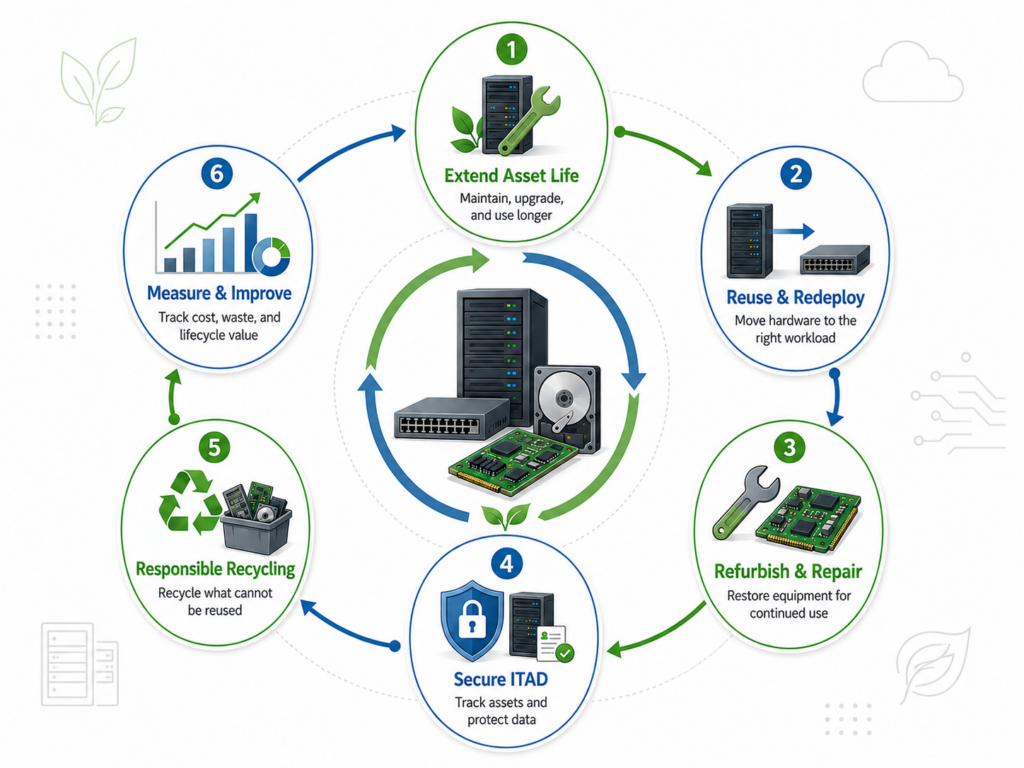
A circular IT strategy works best when it is planned before equipment reaches end of life. The goal is to manage assets with reuse, value recovery, and secure disposal in mind.
Core principles include:
- Extend asset life through maintenance, upgrades, and smart workload placement.
- Redeploy useful hardware across teams, labs, backup environments, or secondary workloads.
- Use refurbished hardware when it meets performance, budget, and timeline needs.
- Track assets clearly from purchase through retirement.
- Use secure ITAD processes for data-bearing devices.
- Recycle responsibly when equipment has no resale or reuse value.
- Align procurement with ESG goals so sustainability is part of buying decisions.
Circular IT does not mean companies should avoid new hardware. It means they should choose the right hardware for the right workload. For example, new systems may be needed for high-performance AI workloads, while refurbished servers or switches may fit backup, test, expansion, or cost-sensitive use cases.
How Does Circular IT Reduce Carbon Footprint?
Circular IT reduces carbon footprint by lowering demand for new manufacturing and keeping useful equipment in service longer. Manufacturing electronics requires raw materials, energy, transport, and packaging. When companies reuse hardware, they reduce some of that upstream impact.
Recycling also matters. The EPA states that recycling 1 million laptops saves energy equal to the electricity used by more than 3,500 U.S. homes in one year.
| Circular IT Action | Carbon and Waste Impact | Business Value |
| Extending server life by 1–2 years | Reduces demand for new equipment | Delays capital spending |
| Buying refurbished switches | Avoids unnecessary new production | Cuts acquisition cost |
| Redeploying old hardware | Keeps assets out of waste streams | Supports internal capacity |
| Using certified ITAD | Improves recycling and reuse rates | Reduces compliance risk |
| Reselling usable assets | Extends product lifecycle | Recovers budget value |
For data centers, the impact can be meaningful because refresh cycles are frequent. Many organizations replace hardware every 3–5 years, even when some equipment can still support lower-priority workloads.
A practical e-waste reduction plan helps IT teams decide what should be reused, resold, recycled, or securely destroyed.
How Can Companies Build a Sustainable IT Strategy?
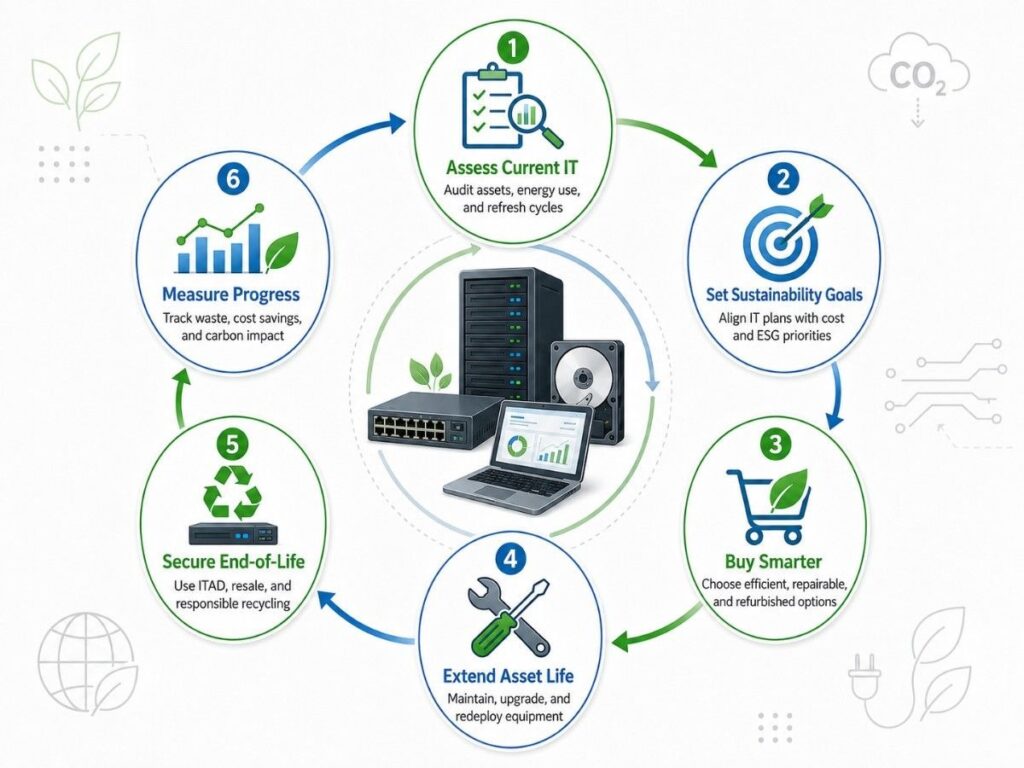
A sustainable IT strategy connects procurement, operations, security, finance, and ESG reporting. It should not sit only with the sustainability team. IT leaders need clear rules for how assets are bought, used, tracked, refreshed, and retired.
Measure the Current Hardware Estate
Start with a full asset inventory. Companies need to know what they own, where it is, how old it is, and whether it still has business value.
A strong inventory should include:
- Device type and model
- Serial number and location
- Warranty status
- Configuration and age
- Workload role
- Data-bearing components
- Estimated resale or reuse value
This step supports better budgeting and reduces surprise spending during refresh cycles.
Extend Hardware Life Before Replacing It
Not every asset needs to be replaced at the first refresh date. Some hardware can stay useful through memory upgrades, storage changes, firmware updates, spare parts, or redeployment.
This is where workload matching matters. A server that is no longer ideal for production may still work for testing, backup, internal tools, or lower-demand applications.
Create an ITAD and Reuse Path
Every company needs a clear path for retired equipment. Without one, old assets may sit in storage, lose resale value, or create data security risk.
A proper ITAD process includes asset tracking, certified data destruction, chain of custody, resale review, and responsible recycling. A structured ITAD program helps companies reduce risk while recovering value from retired hardware.
Reducing E-Waste Through Better IT Lifecycle Decisions
Reducing e-waste starts before hardware reaches end of life. Companies create less waste when they buy based on real workload needs, extend asset life, reuse working equipment, and plan secure disposal early.
A better IT lifecycle strategy helps teams avoid overbuying, reduce storage waste, and recover value from hardware that still has market demand.
Plan Before the Refresh Cycle
Many e-waste problems begin when refresh planning happens too late. If teams wait until hardware is already removed from service, assets may sit in storage and lose resale value.
To reduce waste:
- Review hardware age, condition, and workload role before refresh.
- Identify assets that can be reused internally.
- Separate equipment with resale or buyback value.
- Plan secure data removal before disposal.
- Choose recycling only when reuse or resale is not practical.
Reuse and Redeploy Working Hardware
Not every retired device is ready for disposal. Servers, switches, storage, and GPUs may still support lower-demand workloads.
| Asset Type | Possible Reuse Path | E-Waste Benefit |
| Servers | Backup, testing, internal tools | Extends useful life |
| Switches | Lab, branch, or secondary network use | Delays replacement waste |
| Storage | Non-critical archive or test storage | Reduces disposal volume |
| GPUs | AI testing, rendering, or lower-demand workloads | Preserves high-value assets |
| Laptops/desktops | Redeployment or donation after data wipe | Keeps devices in use longer |
Use ITAD for Secure End-of-Life Handling
When equipment cannot be reused, ITAD helps companies manage it safely. A good ITAD process protects data, tracks assets, and routes hardware to resale, refurbishment, or certified recycling.
ITAD can help by:
- Wiping or destroying data-bearing devices
- Tracking chain of custody
- Sorting reusable and non-usable assets
- Recovering value from resale
- Recycling materials responsibly
Make E-Waste Reduction Part of Procurement
Procurement decisions affect future waste. Companies should consider repairability, warranty, parts availability, resale value, and upgrade options before buying.
A practical buying checklist includes:
- Can this hardware support multiple workload types?
- Can parts be replaced or upgraded?
- Will it hold resale value after refresh?
- Is a refurbished option available?
- Does the vendor support lifecycle or ITAD planning?
This turns e-waste reduction into a lifecycle decision, not just an end-of-life task.
Business and Cost Benefits of Circular IT
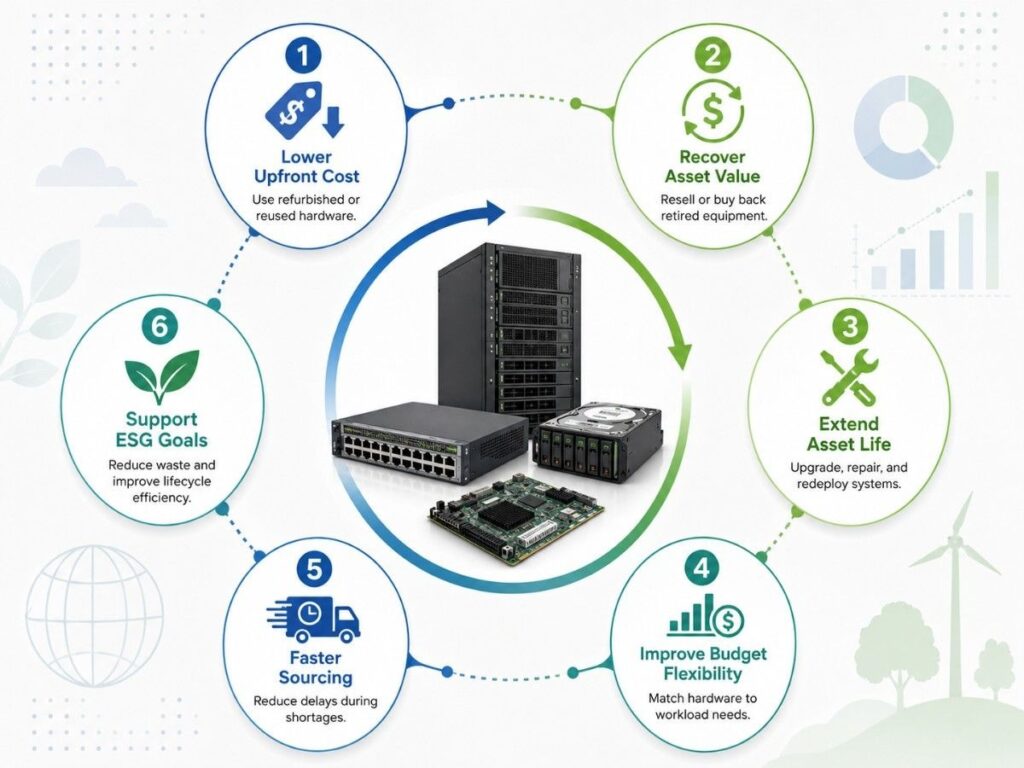
Circular IT can reduce costs across the full hardware lifecycle. It can lower upfront spending, reduce emergency procurement, recover value from retired assets, and improve budget flexibility.
Refurbished hardware is often used when companies need reliable infrastructure at a lower cost. In many cases, refurbished IT equipment can reduce costs by 30–70%, depending on product type, age, condition, and market demand.
| Business Goal | Circular IT Tactic | Expected Benefit |
| Lower capital cost | Buy tested refurbished hardware | 30–70% lower upfront cost |
| Improve budget control | Reuse or redeploy existing assets | Delays unnecessary purchases |
| Recover value | Resell retired servers and networking gear | Offsets refresh costs |
| Reduce delays | Source from secondary markets | Avoids long OEM lead times |
| Support ESG goals | Track reuse, resale, and recycling | Improves reporting and governance |
Circular IT also supports better risk management. When supply chains are tight, companies with flexible sourcing options can keep projects moving. A practical plan for hardware cost savings helps finance and IT teams make decisions based on total value, not only purchase price.
ROI of Hardware Reuse
The ROI of hardware reuse comes from both cost savings and value recovery. A company may avoid buying new equipment, delay a refresh, reduce disposal fees, and resell assets that still have market demand.
For example, refurbished IT hardware can often reduce upfront costs by 30–70%, depending on product type, condition, generation, and demand. That savings can be significant when companies need extra servers, switches, storage, or GPUs but do not need the newest generation for every workload.
Hardware reuse can also create recovery value during refresh cycles. Many enterprise assets still have resale or buyback value within a typical 3–5 year data center refresh cycle, especially servers, networking gear, and GPUs that remain in demand across secondary markets.
ROI can come from:
- Lower purchase cost
- Longer use of existing assets
- Reduced storage and disposal cost
- Resale or buyback value
- Faster deployment during shortages
- Lower risk of unused inventory
Companies should evaluate total cost of ownership, not just the initial price. A lower-cost refurbished server may be the right choice for a secondary workload, while a new system may be better for a critical production cluster.
Budget Optimization Strategies for Circular IT
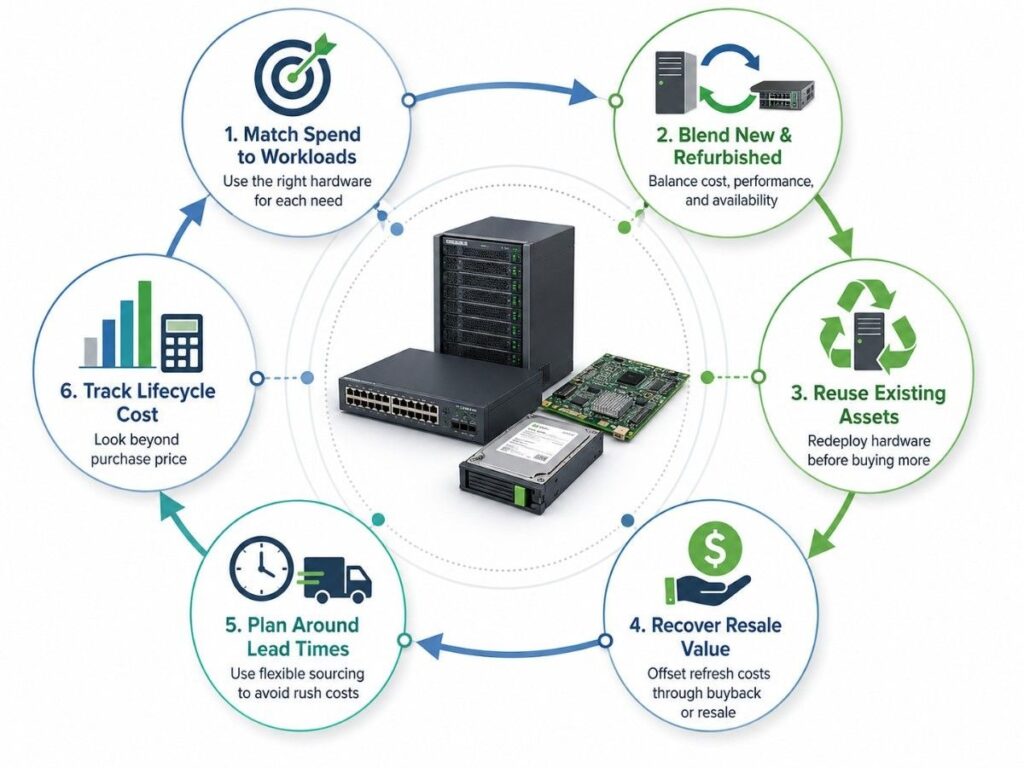
Circular IT gives procurement teams more ways to control budgets. Instead of using one buying path for every need, companies can use a blended approach.
A balanced strategy may include:
- New hardware for core production workloads
- Refurbished hardware for expansion or backup capacity
- Redeployed assets for internal or test environments
- ITAD buyback programs for retired equipment
- Lifecycle planning before major refresh projects
This is useful when new hardware lead times are long or when budgets are fixed. Many enterprise buyers now compare new, refurbished, and available alternatives before making a purchase.
For buyers facing shortages, refurbished supply options can support faster deployment without forcing teams into a single OEM path.
Why Should Companies Choose Circular IT Over Traditional IT?
Companies should choose circular IT because it supports lower costs, less waste, better asset use, and stronger lifecycle control. Traditional IT often focuses on replacement. Circular IT focuses on value.
The traditional model can work when budgets are large, lead times are short, and sustainability is not a key concern. But many enterprise teams now face tighter budgets, hardware shortages, ESG reporting pressure, and data security requirements.
Circular IT helps companies answer practical questions:
- Can this hardware be reused before it is replaced?
- Can a refurbished option meet the business need?
- Can retired equipment recover value?
- Can ITAD reduce risk and support compliance?
- Can procurement support ESG goals without slowing projects?
The result is a more flexible IT strategy. Companies can still buy new hardware when needed, but they gain more options across the lifecycle.
ESG Goals and IT Procurement

ESG goals are now part of many IT buying decisions. Procurement teams are being asked to show how hardware choices affect waste, carbon impact, reuse, and responsible disposal.
Circular IT supports ESG by giving companies a clear way to measure and report lifecycle actions. This includes reused assets, refurbished purchases, recycled equipment, and resale recovery.
IT procurement teams can support ESG goals by:
- Adding refurbished options to sourcing policies
- Asking vendors about testing and grading standards
- Requiring secure ITAD documentation
- Tracking e-waste diversion
- Reporting asset recovery and reuse outcomes
- Choosing suppliers that support lifecycle planning
A good ESG strategy is also practical. It should support uptime, security, budget, and availability. Sustainable procurement works best when it helps the business operate better, not when it adds extra complexity.
Need Help Building Circular IT Into Your Infrastructure Strategy?
Catalyst Data Solutions helps organizations build practical circular IT strategies by supporting procurement, refresh planning, hardware reuse, and ITAD. We work closely with OEMs such as Cisco, Arista, HPE, and NVIDIA, while staying vendor-agnostic so each recommendation fits the customer’s performance, budget, availability, and timeline needs.
Whether a company is planning a new deployment, considering refurbished hardware, or deciding what to do with old enterprise servers after an upgrade, Catalyst helps identify the most practical path forward. That may include redeployment, resale, refurbishment, secure recycling, or a mix of options that reduces cost, improves availability, and supports long-term lifecycle goals.
FAQs
Q: What is the circular economy in IT hardware?
The circular economy focuses on extending the lifecycle of IT hardware through reuse, refurbishment, and resale instead of disposal. This reduces e-waste and improves cost efficiency.
Q: How does refurbished IT support sustainability goals?
Refurbished hardware reduces:
- Electronic waste
- Carbon emissions from manufacturing
- Resource consumption
Extending hardware life by even 1–2 years can significantly reduce environmental impact.
Q: Why are enterprises adopting circular IT strategies?
Organizations are adopting circular strategies to:
- Reduce costs
- Meet ESG goals
- Optimize asset utilization
- Minimize supply chain risks
Q: How does ITAD connect to the circular economy?
ITAD enables circular economy by:
- Recovering usable hardware
- Reselling equipment into secondary markets
- Recycling non-usable components
Q: How can companies start a circular IT strategy?
Companies can start by auditing current hardware, identifying assets for reuse or resale, and creating a secure ITAD process. The first step is knowing what equipment is active, unused, aging, or ready for refresh.
Q: Is circular IT safe for data security?
Yes, circular IT can be safe when data-bearing devices are wiped, sanitized, or destroyed using certified standards. Secure ITAD, asset tracking, and chain of custody are key to reducing data risk.
Q: What are the biggest challenges in circular IT?
The main challenges are poor asset tracking, unclear refresh plans, data security concerns, and lack of resale or recycling processes. These issues can be reduced with lifecycle planning and a trusted ITAD partner.
Q: How do companies measure circular IT success?
Companies measure success by tracking reused assets, refurbished purchases, resale recovery, recycled equipment, e-waste reduction, and cost savings. These metrics also support ESG reporting and procurement planning.