



A traditional hardware reseller helps a customer locate, purchase, and receive IT equipment. Catalyst Data Solutions supports a broader infrastructure decision that can begin before a product is selected and continue through deployment, support, refresh, and asset retirement.
The distinction is not access to hardware. Many providers can supply servers, storage, networking equipment, components, and related technology.
The difference is how the provider helps the customer decide what to buy, confirm that it will work, deliver it within project constraints, support it after installation, and recover value when it is retired.
Catalyst Data Solutions Inc is built around enterprise hardware sourcing, infrastructure planning, multi-OEM options, implementation, maintenance, lifecycle management, ITAD, and asset recovery.
For customers managing complex environments, these connected services can reduce procurement risk, limit internal handoffs, and improve the value of infrastructure investments across their useful life.
Hardware Reseller, VAR, or Infrastructure Partner?
Terms such as hardware reseller, value-added reseller, or VAR, and IT solutions provider are often used interchangeably.
The label matters less than the work a provider performs and the responsibilities it accepts.
| Provider model | Typical starting point | Primary contribution | Typical end point |
| Transactional hardware reseller | Customer supplies an approved part number | Pricing, availability, order processing, and delivery | Equipment is delivered |
| Value-added reseller | Customer identifies a product category or technical requirement | Configuration, licensing, integration, or selected technical services | Product and defined services are delivered |
| Infrastructure and lifecycle partner | Customer presents a workload, project goal, constraint, or refresh requirement | Planning, multi-OEM evaluation, sourcing, deployment, support, and asset recovery | Infrastructure is operated, refreshed, redeployed, or retired |
A conventional reseller can be the right choice for a straightforward purchase. A broader partner model becomes useful when the decision involves compatibility, multiple manufacturers, supply constraints, deployment planning, ongoing support, or lifecycle value.
The Central Difference: Product Transaction vs Infrastructure Decision
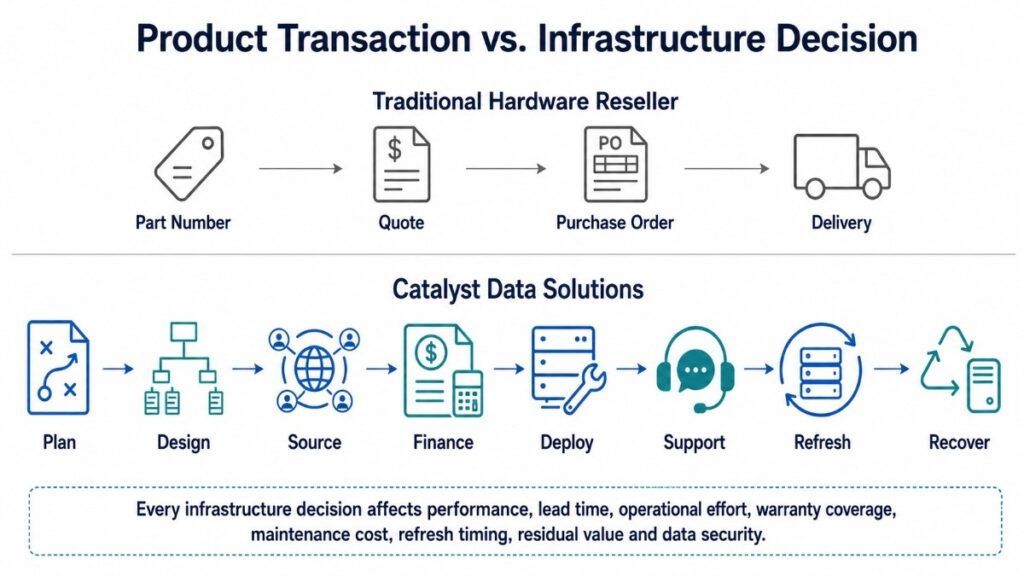
A traditional hardware transaction often follows a simple process:
Part number → Quote → Purchase order → Delivery
Catalyst Data Solutions supports a broader engagement path:
Plan → Design → Source → Finance → Deploy → Support → Refresh → Recover
The customer is not only acquiring an asset. The customer is making a decision that can affect system performance, lead time, operational effort, warranty coverage, maintenance cost, refresh timing, residual value, and data-security obligations.
Before the Purchase: Improve the Decision
Plan Around the Workload and Environment
A transactional reseller usually responds to a requested SKU or bill of materials. We work with customers while they are still defining their requirements or evaluating whether the requested products are suitable.
Our multi-OEM infrastructure services span assessment, architecture, fulfillment, deployment, ongoing operations, and lifecycle management.
The planning process may consider:
- Workload requirements: Performance, capacity, latency, availability, resilience, and growth expectations.
- Current environment: Existing hardware, software, licensing, integrations, technical debt, and legacy dependencies.
- Operational constraints: Internal staffing, maintenance windows, facilities, power, cooling, security, and support requirements.
- Commercial factors: Budget, availability, financing, useful life, support cost, and potential recovery value.
- Implementation needs: Deployment sequence, site readiness, project milestones, acceptance testing, and ownership.
This approach helps determine whether the initial request is the right answer for the customer’s environment.
It may also identify opportunities to retain existing assets, use a phased refresh, choose a previous-generation platform, or separate urgent replacements from longer-term modernization.
The intended outcome is not a larger equipment order. It is a better-supported infrastructure decision.
Compare More Than One Viable OEM Path
Many organizations operate mixed technology environments. Their compute, storage, networking, security, power, cooling, and edge systems may come from several manufacturers.
Our multi-OEM technology ecosystem gives customers the opportunity to evaluate several viable product paths rather than beginning with one manufacturer as the automatic answer.
A multi-OEM evaluation may compare:
- Technical fit: Performance, capacity, interoperability, manageability, and security requirements.
- Commercial fit: Purchase price, licensing, financing, discounts, and contractual conditions.
- Availability: Lead times, stock position, production schedules, and acceptable alternatives.
- Operational fit: Internal skills, support processes, standardization, monitoring, and spare-parts strategy.
- Lifecycle fit: Warranty, maintenance options, useful life, upgrade paths, residual value, and retirement requirements.
This does not mean every project should combine several manufacturers.
Standardizing on one OEM may be the best choice when it improves operational consistency, support efficiency, staff familiarity, or integration.
We evaluate options across multiple manufacturers based on each customer’s technical, operational, commercial, and lifecycle requirements. When standardization on one OEM offers the best fit, we support that approach as well.
During the Purchase: Manage Sourcing and Project Risk
Source Across Conditions and Product Generations
Standard distribution is often sufficient when the required current-generation products are readily available.
Complex environments may also require previous-generation systems, refurbished equipment, end-of-life components, replacement parts, bulk quantities, or hardware that is difficult to locate through standard channels.
Our enterprise hardware procurement and sourcing capabilities are designed to support a wider range of project and lifecycle needs.
The sourcing process may include:
- New current-generation equipment for active deployments, expansions, and standardized refresh programs.
- Previous-generation products where compatibility or lifecycle continuity matters more than adopting the newest platform.
- Legacy and hard-to-find components for repairs, spares, capacity expansion, or delayed migration plans.
- Bulk and project procurement for multi-unit purchases, scheduled rollouts, and location-based deployment plans.
- Refurbished options when condition, testing, warranty, support, and workload risk meet the customer’s requirements.
Flexible sourcing can help customers balance availability, compatibility, budget, warranty coverage, and implementation risk.
It can also reduce pressure to replace a stable platform solely because one component is unavailable through standard distribution.
Our guidance on refurbished enterprise IT hardware can help buyers evaluate condition, testing, warranties, savings, and operational suitability.
Refurbished hardware should not be presented as automatically equivalent to new equipment. Suitability depends on preparation standards, expected workload, support availability, service life, and the organization’s risk tolerance.
Review Configuration and Compatibility Details
An order only creates value when the delivered equipment works within the intended environment.
Two products from the same family may have different hardware revisions, firmware requirements, licensing terms, power specifications, or compatibility limitations.
Our published process includes reviewing the requested part number, quantity, condition, compatibility, and timeline before confirming availability or recommending an alternative.
A practical review may examine:
- Exact identification: Manufacturer, model, part number, revision, serial requirements, and component condition.
- System compatibility: Memory, processors, storage, optics, transceivers, interfaces, firmware, and operating systems.
- Facilities requirements: Rack dimensions, power draw, cabling, cooling, weight, and environmental limits.
- Commercial coverage: Licensing, subscription requirements, warranty status, support eligibility, and return conditions.
- Project timing: Availability, delivery deadlines, staging requirements, installation dates, and acceptable substitutions.
This process cannot guarantee that every possible compatibility issue will be identified.
It can reduce avoidable purchasing errors, clarify assumptions, and help the customer compare alternatives before placing an order.
For internal teams, this may remove time-consuming work involving part-number validation, supplier coordination, compatibility research, replacement options, and delivery planning.
Coordinate Fulfillment as Part of the Project
Purchasing a single product differs from delivering an infrastructure project across several teams, sites, or deployment windows.
Project fulfillment may require much more than processing a purchase order.
We help coordinate:
- Forecasting and inventory planning around project phases, quantities, lead times, and replacement requirements.
- Kitting and staging so equipment, components, accessories, and documentation arrive as a complete deployment unit.
- Imaging and asset tagging based on approved customer standards and inventory processes.
- Location-based delivery for phased, multi-site, campus, branch, data center, or regional rollout programs.
- Returns and replacements when equipment is damaged, delayed, incorrect, or unsuitable for the intended deployment.
This coordination can reduce handoffs between architecture, procurement, logistics, installation, and internal operations teams.
It also gives customers a clearer view of where equipment is located, what remains outstanding, who owns each task, and whether delivery dates remain aligned with the project schedule.
How the Operating Models Affect the Customer
| Customer concern | Transaction-focused approach | Infrastructure-partner approach |
| Product selection | Customer identifies the product | Requirements and viable options may be evaluated first |
| OEM choice | Often begins with one selected manufacturer | Several manufacturer paths may be compared |
| Availability problem | Quote is delayed or product is unavailable | Alternatives may include other OEMs, generations, or conditions |
| Compatibility | Primarily owned by the customer | Part numbers, configurations, and assumptions may be reviewed |
| Deployment | Usually handled after delivery | Fulfillment, staging, logistics, and rollout may be coordinated |
| Support | Customer arranges coverage separately | Warranty, maintenance, spares, and escalation may be planned |
| Retirement | Managed as a later project | Recovery, redeployment, sanitization, and disposition may be planned earlier |
The value of the broader model depends on the project.
It is most relevant when several of these concerns must be addressed together rather than assigned to separate providers and internal teams.
After Delivery: Protect Operational Value

Support Hardware Beyond Initial Delivery
Traditional hardware fulfillment may end when the product reaches the customer.
Infrastructure continues to create operating requirements after installation. Equipment may need warranty coordination, replacement parts, technical escalation, spare-parts planning, field support, or coverage after the OEM support period ends.
Catalyst Data Solution Inc offers third-party hardware maintenance for environments that include end-of-life or end-of-service-life equipment.
This can give customers more options when deciding whether to:
- Renew OEM coverage.
- Move selected assets to third-party maintenance.
- Hold replacement parts or on-site spares.
- Continue operating stable equipment.
- Replace systems through a phased refresh.
The appropriate choice depends on equipment criticality, failure risk, parts availability, staff capabilities, service coverage, and business requirements.
Specific response times, service areas, savings claims, and service-level commitments must be verified in the applicable agreement before publication or purchase.
Connect Infrastructure to Ongoing Operations
Some customers need ongoing operational services in addition to hardware support.
Catalyst’s managed IT services and support may include monitoring, patching, backup, network management, help desk services, vendor coordination, and IT asset management.
For each engagement, the defined scope clarifies which services Catalyst delivers directly, which involve partners, who is responsible for each service level, and how incidents are escalated between teams.
A responsibility map should define:
| Responsibility | Questions to resolve |
| Monitoring | Which systems are covered, and during which hours? |
| Escalation | Who receives an alert, opens the case, and coordinates vendors? |
| Remediation | Which actions can be completed without customer approval? |
| Evidence | What reports, logs, tickets, or service records are provided? |
| Partner delivery | Which party contracts, operates, and owns the service commitment? |
We define clear responsibility boundaries so customers understand who takes action, who approves changes, what evidence is provided, and how service issues are escalated.
Plan Retirement and Asset Recovery Before Buying
Lifecycle planning should not begin after equipment has been removed from service.
The original purchasing decision can influence useful life, maintenance options, redeployment potential, resale demand, data risk, recycling requirements, and residual value.
Our ITAD and asset recovery services connect asset retirement with inventory control, chain of custody, sanitization, remarketing, reuse, recycling, and reporting.
A retirement plan may address:
- Asset identification: Serialized inventory, ownership records, condition, location, and data-bearing components.
- Redeployment: Moving usable equipment to secondary sites, labs, development environments, or lower-risk workloads.
- Data protection: Approved sanitization, destruction requirements, custody controls, and completion evidence.
- Value recovery: Testing, grading, remarketing, resale, buyback, or other approved recovery channels.
- Responsible disposition: Recycling, reporting, certificates, environmental requirements, and final asset closure.
Planning these activities earlier can improve refresh timing and reduce last-minute decisions about retired equipment.
It can also help procurement teams evaluate acquisition cost alongside support expense, useful life, downtime risk, redeployment options, residual value, and disposition cost.
A Practical Example: A Customer-First Arista Network Refresh for a Telecommunications Provider
See how Catalyst Data Solution Inc helped a regional telecommunications provider modernize four locations through a coordinated Arista network refresh completed in eight weeks with no unplanned customer-facing outage.
Download the Arista Network Refresh Case Study
When a Traditional Hardware Reseller May Be Sufficient
A conventional reseller may be the appropriate choice when:
- The exact manufacturer, model, configuration, and part number are already approved.
- The required product is available through normal distribution.
- Architecture and compatibility guidance are not required.
- Internal teams manage deployment, support, and asset retirement.
- Price and delivery are the primary decision factors.
Using a wider infrastructure engagement for every routine purchase may add unnecessary work.
The provider model should match the complexity, risk, and internal ownership of the project.
When an Infrastructure and Lifecycle Partner May Be the Better Fit
A broader model may be useful when the customer:
- Is still deciding which architecture or product path to select.
- Operates a mixed-OEM or legacy environment.
- Faces constrained availability or hard-to-find requirements.
- Needs staging, deployment, or multi-location coordination.
- Wants to connect procurement with support, refresh, ITAD, and recovery.
The determining factor is not only order size.
A small order may carry significant operational risk when it affects a critical legacy system. A large order may remain straightforward when products, responsibilities, and deployment processes are already defined.
Questions to Ask Before Selecting a Provider
Buyers should request evidence of how the provider operates.
| Buyer question | Evidence to request |
| How are requirements defined? | Discovery process, assessment template, or documented project inputs |
| How are OEM options compared? | Decision criteria, scorecard, alternatives, and tradeoff documentation |
| How is compatibility reviewed? | Part-number checks, configuration review, assumptions, and approval process |
| How is fulfillment managed? | Logistics plan, staging scope, delivery ownership, and acceptance process |
| How is equipment supported? | Service catalog, coverage terms, escalation path, and responsibility map |
| How are retired assets handled? | Chain-of-custody workflow, sanitization policy, reporting, and recovery process |
This evidence is more useful than generic claims such as “best in class,” “full service,” or “completely unbiased.”
It shows what the provider does, how decisions are made, which assumptions guide the recommendation, and where accountability sits.
How Catalyst Goes Beyond a Hardware Transaction

A traditional hardware reseller mainly helps a customer purchase equipment that has already been selected. Catalyst supports a wider infrastructure decision by connecting planning, multi-OEM evaluation, sourcing, fulfillment, deployment, support, and asset retirement.
Our involvement can begin before procurement through requirements discovery and compatibility review. It continues through flexible sourcing and project coordination, then extends after delivery through maintenance, refresh planning, ITAD, redeployment, and asset recovery.
This broader model is most useful when a project involves several manufacturers, legacy dependencies, supply constraints, multiple locations, or lifecycle responsibilities. It may not be necessary for a routine order with an approved part number and clearly defined internal ownership.
How We Compare With Traditional Hardware Resellers
| Area of differentiation | Traditional hardware reseller | Catalyst infrastructure-partner model | Customer value |
| Starting point | Approved manufacturer and part number | Workload, project objective, constraint, or refresh requirement | Helps confirm what should be purchased before the order is placed |
| Product evaluation | Focuses on requested products | Can compare viable options across manufacturers, generations, and conditions | Improves technical, commercial, and lifecycle decisions |
| Sourcing | Primarily current products through standard channels | May include new, refurbished, previous-generation, legacy, and hard-to-find equipment | Expands options when availability, compatibility, or budget is constrained |
| Project delivery | Quote, order processing, and shipping | May coordinate staging, imaging, asset tagging, logistics, and deployment | Reduces handoffs between procurement, technical, and deployment teams |
| Ongoing support | Often arranged separately | Can connect warranty coordination, maintenance, spares, escalation, and managed support | Creates clearer operational ownership after delivery |
| Asset retirement | Usually outside the original transaction | Can plan redeployment, sanitization, remarketing, recycling, and value recovery | Reduces retirement risk and supports better lifecycle economics |
The difference is therefore not simply the number of products we can source. It is the ability to connect the equipment purchase to the wider technical, operational, financial, and lifecycle plan.
Organizations evaluating a complex refresh, mixed-OEM environment, constrained sourcing requirement, or lifecycle program can request an infrastructure consultation with us to discuss requirements, alternatives, timelines, and responsibilities.
Frequently Asked Questions
Is Catalyst Data Solutions a hardware reseller?
Yes. We source and supply enterprise hardware, but our operating model extends beyond product fulfillment. We also support infrastructure planning, multi-OEM evaluation, project deployment, maintenance, lifecycle management, ITAD, and asset recovery.
How is Catalyst different from a traditional managed service provider?
Many managed service providers focus primarily on operating software, endpoints, networks, or cloud services.
We combines managed operations with enterprise hardware procurement, infrastructure architecture, warranty and maintenance options, deployment support, and IT asset disposition. Customers can therefore connect day-to-day IT operations with the physical infrastructure lifecycle.
Will Catalyst help us select the right product, or do we need an exact SKU?
You do not need an exact SKU. Our product managers evaluate your technical needs, budget, timeline, compatibility, and available options to recommend the right product and configuration.
Can Catalyst help design infrastructure as well as source hardware?
Yes. We support infrastructure assessment, architecture, sourcing, fulfillment, deployment, and lifecycle management. For each engagement, we clearly define the responsibilities of our team, the customer, manufacturers, and other partners.
Does Catalyst work with multiple hardware manufacturers?
Yes. We evaluate and source technology across multiple OEMs and product categories. This allows us to compare viable options based on workload fit, compatibility, availability, support, cost, and lifecycle requirements rather than automatically starting with one manufacturer.
What happens after the equipment is delivered?
Depending on the engagement, we may support installation coordination, warranty management, maintenance, managed services, spare-parts planning, refresh strategy, redeployment, ITAD, and asset recovery.
The agreed scope clearly documents service coverage, responsibilities, and escalation ownership.
When should a company use an infrastructure lifecycle partner?
A broader partner model may be appropriate when a project involves multiple OEMs, compatibility risks, constrained supply, legacy systems, multi-site deployment, ongoing maintenance, or asset-retirement requirements.