


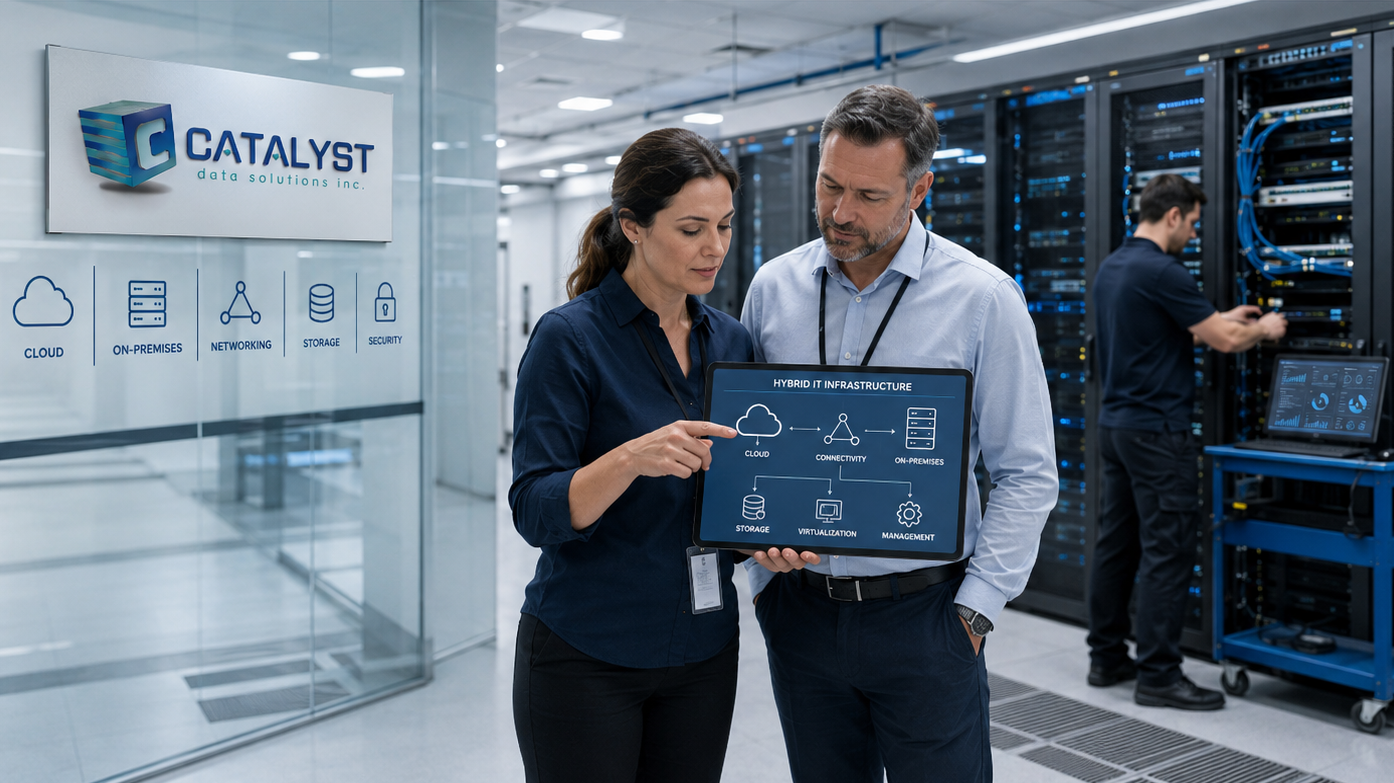
Catalyst Data Solutions Inc is a vendor-neutral infrastructure and lifecycle partner for organizations modernizing complex hybrid and on-prem environments. We support architecture, hardware sourcing, deployment, ongoing operations, maintenance, and IT asset disposition, with the exact mix defined by each project.
Instead of treating these needs as separate transactions, we connect them around the customer’s workloads, installed environment, budget, timeline, support requirements, and lifecycle goals.
Our model gives teams multi-OEM choices, practical implementation phases, flexible sourcing options, and clear accountability.
What Kind of Company Is Catalyst Data Solutions?
Technology companies are often placed into a single category: reseller, value-added reseller, integrator, managed service provider, or ITAD company.
We work across several of these roles, but our clearest position is as an infrastructure and lifecycle partner. We connect technology decisions before, during, and after procurement.
| Partner role | How We Support Customers |
| Hardware reseller | Sources new, prior-generation, refurbished, constrained, and hard-to-find enterprise technology |
| Value-added reseller | Helps compare technology choices and align sourcing with business, technical, budget, and lifecycle requirements |
| Infrastructure integrator | Supports assessment, architecture, staging, deployment, change coordination, testing, and documentation |
| Managed service provider | Provides defined operational support services based on the agreed coverage model and responsibilities |
| Maintenance provider | Supports selected current-generation, EOL, and EOSL equipment through defined maintenance options |
| Lifecycle and ITAD provider | Connects asset inventory, redeployment, value recovery, sanitization, recycling, and reporting to the next refresh |
| Global transformation firm | Not positioned as the default provider for every large consulting, application, or worldwide transformation program |
Our service model brings together planning, procurement, implementation, deployment, managed operations, hardware fulfillment, and circular-economy services. Customers can engage us for a connected infrastructure program or for clearly defined service modules.
What Makes Catalyst Different From Other VARs?

At Catalyst Data Solutions Inc, we go beyond the traditional VAR model by connecting infrastructure decisions across the full technology lifecycle.
Rather than focusing only on product procurement, Catalyst can help organizations:
- Assess workloads, dependencies, risks, and existing infrastructure
- Compare multiple OEM and sourcing options
- Plan phased hybrid and on-prem modernization
- Coordinate staging, deployment, testing, and handoff
- Define support, maintenance, and escalation responsibilities
- Include redeployment, asset recovery, and ITAD in the original plan
The difference is not simply access to multiple technology brands. It is the way we evaluates tradeoffs across performance, compatibility, lead time, support, cost, useful life, and exit value.
We work best with organizations that need more than a hardware transaction without turning every infrastructure project into a large global transformation program.
The Gap Between a Hardware Transaction and a Mega-Transformation
A transactional reseller is useful when the buyer already knows the exact product, configuration, quantity, and delivery requirement.
That model becomes less effective when the purchase is tied to broader questions:
- Will the proposed equipment work with the installed environment?
- Should the organization standardize, reuse existing assets, or compare another OEM?
- Can the rollout be phased around budget, facilities, staffing, or procurement limits?
- Who will stage, deploy, support, maintain, and eventually retire the equipment?
- How will the decision affect future support costs and recovery value?
At the other end of the market, a global systems integrator may offer extensive consulting, transformation, and international delivery capacity. That model may be appropriate for very large programs, but not every infrastructure project needs that breadth, cost structure, or level of organizational change.
Catalyst is intended to occupy the practical space between those models. Its vendor-agnostic infrastructure services can connect design, sourcing, implementation, operations, and lifecycle planning around a defined infrastructure outcome.
Who Catalyst Data Solution Inc Serve
We support organizations that need to modernize interconnected infrastructure through practical phases, clear responsibilities, and accountable delivery.
The strongest fit often involves one or more of the following conditions:
- A mixed environment containing several OEMs or technology generations
- Hybrid, on-prem, edge, campus, or multi-site infrastructure
- Legacy dependencies that prevent an immediate full replacement
- Tight budget cycles or phased capital planning
- Hard-to-find, constrained, prior-generation, or refurbished equipment
- Lean internal teams that need added architecture, procurement, or delivery capacity
- Refresh projects that must include maintenance, redeployment, or asset recovery
- Public-sector, education, or regulated procurement and documentation requirements
- AI, data center, network, storage, compute, power, or cooling constraints that must be assessed together
We support enterprise, education, public-sector, regulated, and infrastructure teams.
Our industry-specific infrastructure solutions also focus on environments where performance, procurement, resilience, lifecycle planning, and documentation requirements must be balanced.
Five Infrastructure Decisions That Should Work as One System
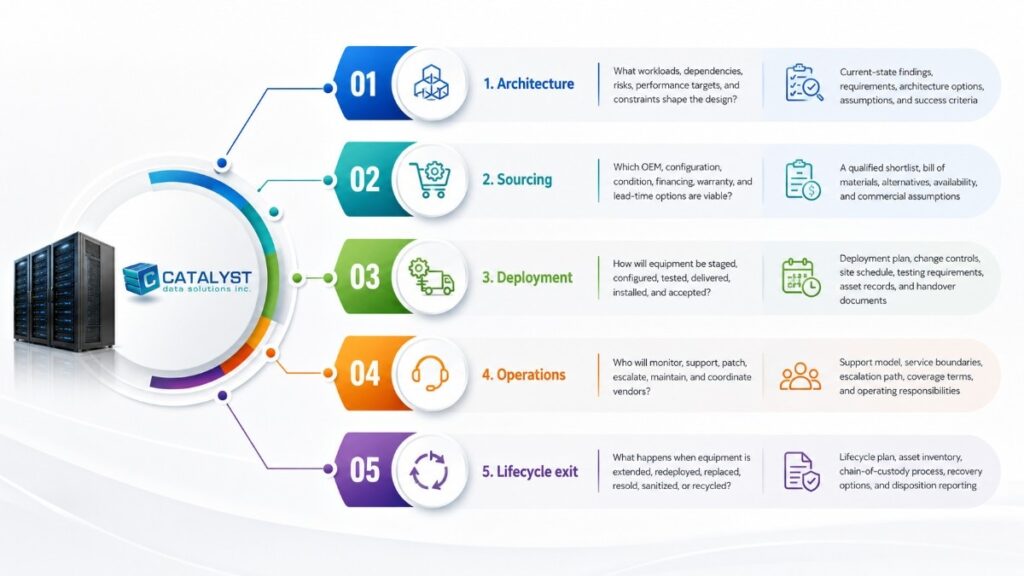
A significant infrastructure project is rarely a single purchasing decision. It is a sequence of connected choices.
| Decision area | Questions that need to be answered | Useful project output |
| 1. Architecture | What workloads, dependencies, risks, performance targets, and constraints shape the design? | Current-state findings, requirements, architecture options, assumptions, and success criteria |
| 2. Sourcing | Which OEM, configuration, condition, financing, warranty, and lead-time options are viable? | A qualified shortlist, bill of materials, alternatives, availability, and commercial assumptions |
| 3. Deployment | How will equipment be staged, configured, tested, delivered, installed, and accepted? | Deployment plan, change controls, site schedule, testing requirements, asset records, and handover documents |
| 4. Operations | Who will monitor, support, patch, escalate, maintain, and coordinate vendors? | Support model, service boundaries, escalation path, coverage terms, and operating responsibilities |
| 5. Lifecycle exit | What happens when equipment is extended, redeployed, replaced, resold, sanitized, or recycled? | Lifecycle plan, asset inventory, chain-of-custody process, recovery options, and disposition reporting |
The value comes from understanding how one decision changes the others.
A lower purchase price may create higher support or energy costs. A standard platform may simplify operations but reduce sourcing flexibility. A refurbished system may be suitable for one workload but not another. A faster refresh may reduce operating risk but remove useful assets too early.
We evaluate these tradeoffs across one connected infrastructure lifecycle instead of treating architecture, sourcing, deployment, operations, and asset disposition as unrelated transactions.
How Multi-OEM Recommendations Work in Practice
Vendor neutrality should be a documented decision process, not a claim based on the number of logos displayed on a website.
The process should begin by defining:
- Business and workload requirements
- Current infrastructure and technical dependencies
- Performance, resilience, security, and support needs
- Budget, lead-time, and deployment constraints
- Useful-life and lifecycle objectives
- Decision criteria and their relative importance
Only then should specific products or OEMs be compared.
We source enterprise IT hardware procurement across software, networking, compute, storage, servers, power, cooling, current-generation equipment, and selected legacy or end-of-life requirements.
We confirm availability, coverage, warranty options, and service terms for each configuration and delivery location before finalizing the solution.
A Useful Shortlist Shows Tradeoffs
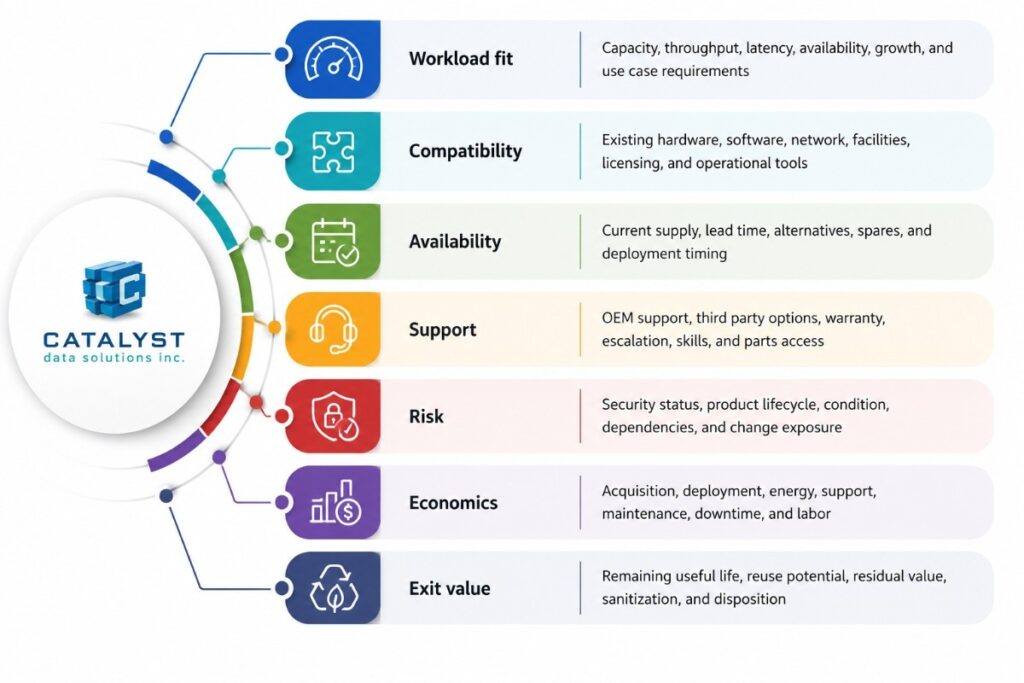
A shortlist should not be a long catalog of available products. It should narrow the market to options that meet the project’s minimum requirements.
| Evaluation factor | What the team should examine |
| Workload fit | Capacity, throughput, latency, availability, growth, and use-case requirements |
| Compatibility | Existing hardware, software, network, facilities, licensing, and operational tools |
| Availability | Current supply, lead time, alternatives, spares, and deployment timing |
| Support | OEM support, third-party options, warranty, escalation, skills, and parts access |
| Risk | Security status, product lifecycle, condition, dependencies, and change exposure |
| Economics | Acquisition, deployment, energy, support, maintenance, downtime, and labor |
| Exit value | Remaining useful life, reuse potential, residual value, sanitization, and disposition |
Our multi-OEM technology partner ecosystem spans networking, compute, storage, security, power, cooling, and other infrastructure categories.
We base every recommendation on the customer’s requirements not simply on the vendors in our partner ecosystem.
Flexible Sourcing Does Not Mean Lower Standards
New equipment is not automatically right for every role. Refurbished or prior-generation equipment is not automatically the economical choice.
Each option should be evaluated against:
- Workload criticality
- Product condition and testing
- Software and license requirements
- Security and firmware status
- Compatibility with the installed environment
- Warranty and maintenance coverage
- Expected remaining life
- Energy and operating costs
- Replacement and exit plans
The objective is not to preserve every existing asset or introduce unnecessary variation. It is to select the sourcing path that fits the risk, timeline, operating model, and economics of the assigned workload.
How We Manage Direct and Partner-Delivered Services
A credible infrastructure partner should not imply that every capability is delivered by the same internal team.
We deliver selected services directly and coordinate with qualified OEMs, maintenance providers, field-service organizations, logistics providers, managed-service teams, security specialists, and ITAD processing partners where specialist delivery is required.
Before work begins, we document the delivery model, responsible parties, service boundaries, escalation paths, and ownership at each stage.
| Responsibility question | What the engagement should define |
| Who designs the solution? | Named architecture and approval roles |
| Who supplies each component? | Seller, OEM, distributor, condition, warranty, and lead-time responsibilities |
| Who stages and deploys it? | Configuration, logistics, field services, testing, acceptance, and documentation |
| Who operates it? | Monitoring, patching, backup, incident, capacity, and change-management scope |
| Who supports hardware failures? | Ticket ownership, escalation, parts logistics, field dispatch, and restoration targets |
| Who handles retired assets? | Inventory, custody, transport, sanitization, resale, recycling, and reporting |
| Who owns the final outcome? | Customer, Catalyst, OEM, and partner responsibilities at each stage |
We provide managed IT services and support accross monitoring, endpoint support, patch management, backup, network management, cloud services, security controls, and asset management.
We clearly define the service scope, coverage window, response terms, tools, responsibilities, and exclusions in each agreement.
For equipment that has moved beyond standard OEM coverage, we evaluate third-party IT hardware maintenance options that can extend support and useful life. Coverage depends on the platform, region, service window, parts model, escalation process, and agreed service level.
Lifecycle Planning Begins Before the Purchase
Infrastructure lifecycle planning should not begin when a truck arrives to remove retired equipment.
Architecture and procurement decisions affect:
- Warranty and maintenance options
- Spares and replacement planning
- Energy and facility requirements
- Software and licensing dependencies
- Useful life and upgrade paths
- Redeployment opportunities
- Residual value
- Data-sanitization requirements
- Transport and chain-of-custody risk
- Recycling and reporting obligations
Our secure IT asset disposition services include inventory, pickup, chain-of-custody controls, data sanitization, testing, remarketing, recycling, value recovery, and reporting options.
For each ITAD program, we define the applicable standards, processing parties, certificate requirements, reporting, and customer-specific controls.
Planning the exit early can also influence the initial design. Equipment that is easier to inventory, maintain, reuse, resell, sanitize, and remove may create more flexibility at the next refresh.
How Catalyst’s Infrastructure Model Works in Practice
The following customer examples will show how Catalyst connects infrastructure architecture, sourcing, deployment, support, maintenance, and lifecycle planning in real operating environments.
Each example will be added after the project details, responsibilities, results, and publication permissions have been reviewed and approved.
Case Study: Multi-Campus Infrastructure Refresh
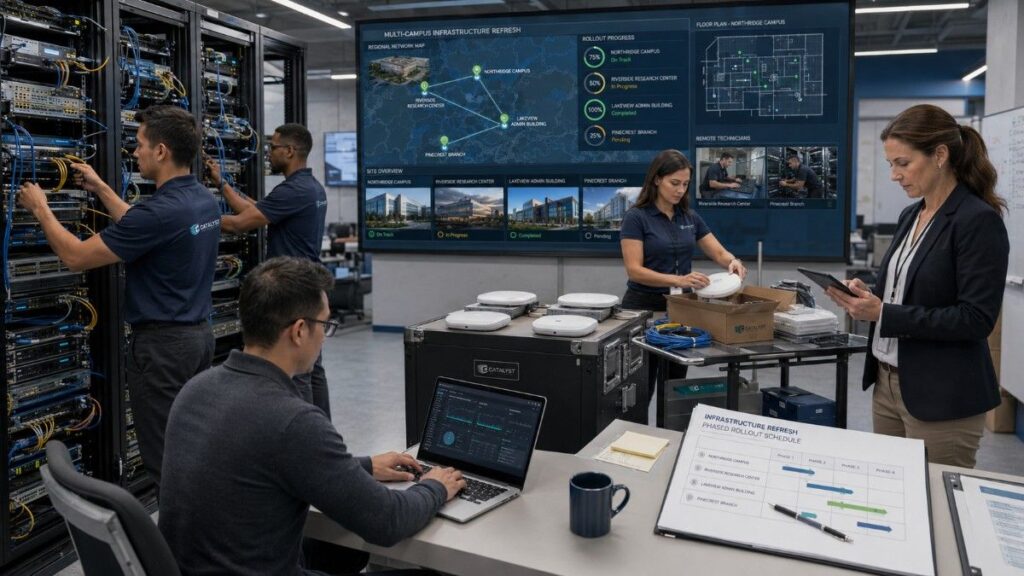
A regional university operating a primary campus, two satellite learning centers, and several administrative facilities needed to modernize an aging infrastructure environment without disrupting classes, research activity, student services, or day-to-day university operations.
The university’s environment included a mixture of server, storage, switching, wireless, and backup technologies acquired at different stages of its growth. Some systems were approaching the end of support, while others still had several years of usable life. Documentation was inconsistent, support agreements were fragmented, and the internal IT team needed a practical modernization plan that could be completed across multiple budget cycles.
Replacing every system at once would have created unnecessary cost and operational risk. The university instead needed a phased approach that distinguished between infrastructure requiring immediate replacement, equipment that could remain in service, and systems that could be redeployed elsewhere within the institution.
Catalyst Data Solutions’s Role
We worked with the university’s technology leadership and internal IT team to assess the existing environment, identify operational risks, and establish priorities for the refresh.
Catalyst’s responsibilities included:
- Reviewing the university’s existing server, storage, networking, and support environment.
- Identifying equipment approaching the end of support or creating performance and reliability risks.
- Developing a phased refresh strategy aligned with academic calendars and approved budgets.
- Evaluating new, certified refurbished, and prior-generation infrastructure options.
- Confirming hardware compatibility, licensing requirements, warranties, and support coverage.
- Sourcing equipment from multiple manufacturers and approved distribution channels.
- Coordinating equipment staging, configuration requirements, delivery schedules, and deployment sequencing.
- Supporting the university’s internal team during installation, migration, and post-deployment validation.
- Developing a lifecycle plan for retained, redeployed, and retired infrastructure.
Where manufacturer-specific configuration or advanced professional services were required, Catalyst coordinated with the relevant OEM or certified specialist partner. The university’s internal IT team retained control of application migration, institutional security policies, change approvals, and final production validation.
Project Timeline
The assessment and architecture phase was completed over approximately four weeks. Equipment sourcing, staging, and deployment were then completed in phases over a three month period, with the most disruptive work scheduled around semester breaks and lower-activity maintenance windows.
Outcome
The phased approach allowed the university to address its highest-risk infrastructure first while continuing to use systems that remained reliable and supportable. Verified outcomes for this Multi-Campus Infrastructure project:
- Completion of the refresh without interruption to scheduled classes or student services.
- Reduction in the number of unsupported or end-of-life systems.
- Improved infrastructure performance, resiliency, and visibility.
- Consolidation of support and warranty coverage.
- Reduced unnecessary replacement costs by retaining suitable equipment.
- A documented three- to five-year infrastructure lifecycle roadmap.
- More predictable capital planning for future technology investments.
Case Study: Multi-Site IT Asset Disposition and Infrastructure Lifecycle Project
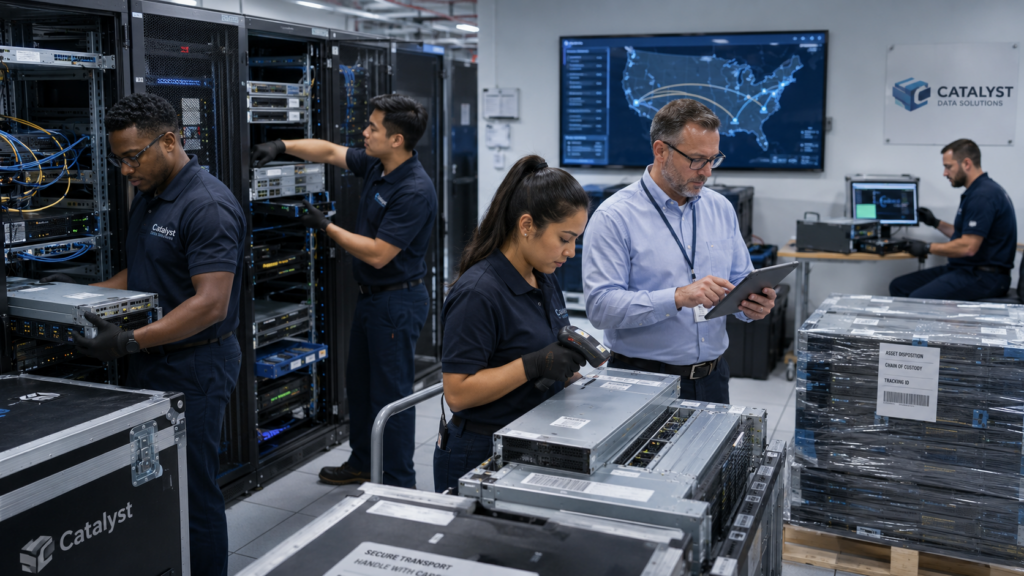
A multi-location organization was consolidating several offices and upgrading portions of its data center and network infrastructure. The project left the organization with servers, storage systems, network equipment, employee devices, and related components distributed across multiple locations.
The organization needed more than a company that could simply remove unwanted equipment. It required a controlled IT asset disposition process that addressed inventory accuracy, chain of custody, data security, environmental responsibility, asset value recovery, and the identification of equipment that could still support other parts of the business. The internal IT team also needed the decommissioning process coordinated with the deployment of replacement infrastructure so that productive equipment was not removed prematurely and outdated assets did not remain in facilities after the transition.
Catalyst Data Solutions’ Role
We helped the customer develop a lifecycle plan covering equipment designated for reuse, redeployment, resale, recycling, or certified destruction.
Responsibilities included:
- Reviewing available asset inventories and identifying information gaps.
- Coordinating on-site asset identification, labeling, packing, and removal.
- Recording manufacturer, model, serial number, configuration, and asset condition.
- Maintaining documented chain of custody from collection through final disposition.
- Coordinating secure data sanitization and physical media destruction based on customer requirements.
- Testing equipment with potential resale or redeployment value.
- Evaluating market demand and recovery value for eligible infrastructure.
- Managing responsible recycling for equipment without practical reuse or resale value.
- Providing disposition reports, asset records, and supporting certificates.
Specialist data-destruction or recycling partners were used where certified processing was required. The customer retained responsibility for approving disposition lists, confirming internal data-retention requirements, releasing assets for removal, and validating any equipment designated for internal redeployment.
Project Timeline
Planning and inventory reconciliation were completed over approximately three weeks. Collection and processing were performed in scheduled phases over four weeks to align with office closures, infrastructure migrations, and facility access requirements.
Outcomes
The coordinated ITAD process helped the customer complete its infrastructure transition without losing visibility into retired assets or creating unnecessary security and compliance exposure.
- Removal and reconciliation of several thousand technology assets.
- Documented chain of custody for all collected equipment.
- Verified sanitization or destruction of data-bearing devices.
- Recovery of value from eligible servers, storage, networking, and component inventory.
- Reduced storage, transportation, and facility-clearance costs.
- Prevention of usable assets being discarded or recycled prematurely.
- Completion of office or data center closures according to schedule.
- Detailed reporting supporting internal security, financial, sustainability, and audit requirements.
Where asset recovery proceeds are verified, the outcome may also be expressed as a percentage of financial return to the customer.
What a First Engagement Should Produce
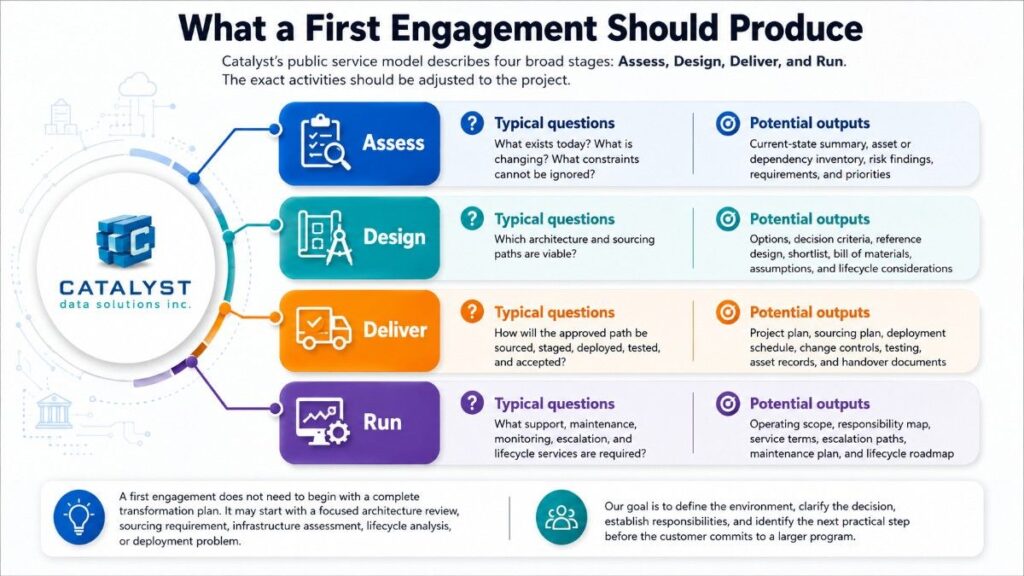
Catalyst’s public service model describes four broad stages: Assess, Design, Deliver, and Run. The exact activities should be adjusted to the project.
| Engagement stage | Typical questions | Potential outputs |
| Assess | What exists today? What is changing? What constraints cannot be ignored? | Current-state summary, asset or dependency inventory, risk findings, requirements, and priorities |
| Design | Which architecture and sourcing paths are viable? | Options, decision criteria, reference design, shortlist, bill of materials, assumptions, and lifecycle considerations |
| Deliver | How will the approved path be sourced, staged, deployed, tested, and accepted? | Project plan, sourcing plan, deployment schedule, change controls, testing, asset records, and handover documents |
| Run | What support, maintenance, monitoring, escalation, and lifecycle services are required? | Operating scope, responsibility map, service terms, escalation paths, maintenance plan, and lifecycle roadmap |
A first engagement does not need to begin with a complete transformation plan. It may start with a focused architecture review, sourcing requirement, infrastructure assessment, lifecycle analysis, or deployment problem.
Our goal is to define the environment, clarify the decision, establish responsibilities, and identify the next practical step before the customer commits to a larger program.
A Practical Partner for Interconnected Infrastructure Decisions
We support organizations that need more than a hardware transaction without turning every infrastructure project into a mega-transformation.
Its role is to help connect the decisions that shape infrastructure performance and value:
- What should be built
- Which technology paths should be considered
- How equipment should be sourced
- How deployment should be governed
- How the environment should be supported
- How assets should be extended, recovered, or retired
The result should be a defined infrastructure path built around the customer’s actual environment .not a generic service package or a product list.
Request an Infrastructure Fit Review to discuss your current environment, project constraints, sourcing needs, support requirements, and the decisions that must be resolved before moving forward.
Pre-Publication Verification
Before publication, leadership, delivery, sales, and legal should approve:
- The company fact sheet and final category statement
- Named engagement stages and guaranteed deliverables
- Direct versus partner-delivered responsibilities
- Service regions, hours, coverage, and escalation terms
- Customer permissions for every example
- Any warranty, certification, compliance, SLA, savings, or performance claim
The playbook requires proof to act as a publication gate and prohibits expanding answer blocks with unsupported claims.
Need Help Planning a Complex Hybrid IT Project?
At Catalyst Data Solutions Inc we connect infrastructure planning and multi-OEM sourcing with our live hardware inventory, updated daily with a wide range of enterprise IT infrastructure, alongside deployment, support, maintenance, ITAD, and asset recovery.
We shape every engagement around the customer’s workloads, installed environment, budget, timeline, operational requirements, priorities, and long-term technology goals. We apply this approach to hybrid and on-premises modernization, multi-site refreshes, legacy transitions, constrained hardware sourcing, and infrastructure lifecycle extension.
We helps teams compare viable options, clarify responsibilities, document tradeoffs, and build a phased path from assessment through deployment and eventual asset retirement.
Request an Infrastructure Fit Review to discuss your environment, project constraints, sourcing needs, support requirements, and next steps. We can help determine whether its vendor-neutral infrastructure and lifecycle model is the right fit for your organization’s goals, risks, and operating needs.