AI workloads are growing fast, and that growth is changing how data center networks are designed. In many AI environments, the network is no longer a supporting layer in the background. It is now a major factor in cluster performance, infrastructure efficiency, and total operating cost.
When the network cannot keep up, expensive GPUs sit idle while waiting for data to move between nodes. That delay increases job completion time, raises energy use, and forces organizations to spend more on hardware, power, cooling, and troubleshooting. A better network design helps teams use GPU resources more efficiently while controlling both capital and operating costs.
That is why cost optimization in AI networking now depends on more than buying faster switches. It requires scalable architectures, higher-speed fabrics, careful hardware choices, and better automation. The organizations that get this right can improve utilization, reduce wasted spend, and build AI-ready infrastructure that scales with less friction.

The cost of an AI data center network usually starts with hardware, but it does not end there. A full cost picture includes the network fabric itself, the connectivity layer, facility demands, and the day-to-day work needed to keep the environment stable.
The main cost components typically include:
In AI environments, these costs rise faster because traffic patterns are heavier and more sensitive to delay. Distributed training creates constant east-west traffic, so the network must deliver bandwidth and predictability at the same time.
Infrastructure teams often need to make these decisions alongside server planning and facility preparation. That is why organizations evaluating AI-ready environments often review compute, power, cooling, and networking as one connected investment rather than separate purchases.
Poor network design creates costs that are easy to miss in the planning stage.
These hidden costs usually include:
In AI training clusters, small network problems can become large business problems. Even minor congestion can slow distributed jobs, while packet loss can disrupt synchronization across nodes. The result is lower efficiency from the most expensive hardware in the environment.
| Cost Area | Direct Cost Components | Hidden Cost Components |
| Hardware | Switches, NICs, controllers | Oversizing to compensate for weak design |
| Connectivity | Optics, DACs, AOCs, patching | Re-cabling during scale-out or retrofit |
| Facilities | Rack space, cooling, power delivery | Higher runtime energy cost |
| Operations | Support, maintenance, licenses | Troubleshooting delays and labor overhead |
| AI Performance | N/A | GPU idle time and slower job completion |
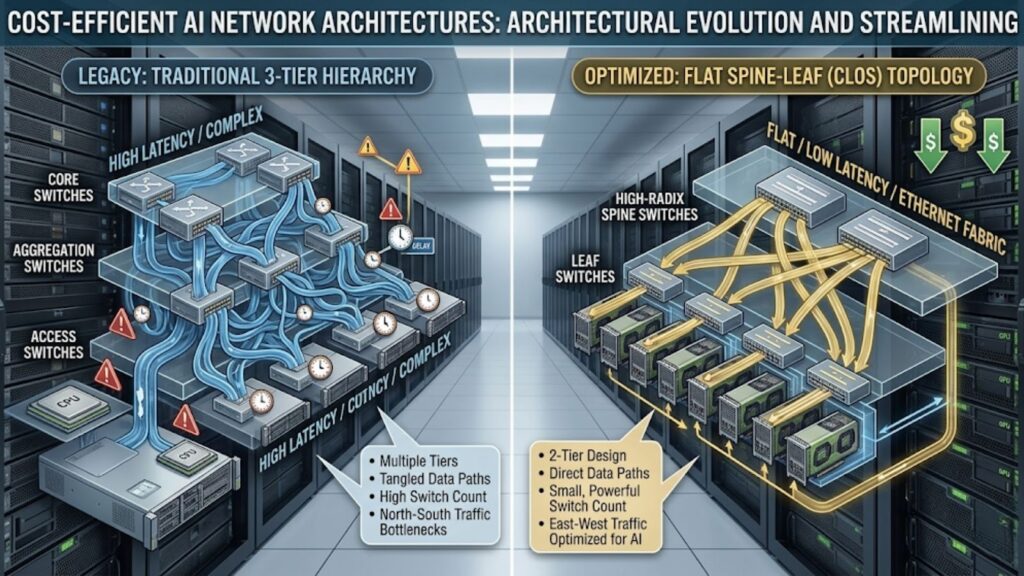
Ethernet has become a leading choice for AI data center networks because it offers scale, broad ecosystem support, and more flexibility across vendors. For many organizations, Ethernet provides a practical path to high-performance AI networking without forcing a single-stack approach.
Its cost advantages often include:
That flexibility matters when organizations need to scale AI networking over time. It also matters when teams want to align networking decisions with broader GPU infrastructure planning instead of treating the fabric as a separate design problem.
High-radix designs help reduce the number of devices and layers needed to support large AI clusters. This can lower latency, simplify the topology, and reduce the amount of hardware required to reach target scale.
A high-radix approach can support cost optimization by:
For AI clusters, that means better performance potential with less architectural complexity. Fewer layers also reduce operational overhead and make the environment easier to troubleshoot.
Spine-leaf and Clos architectures remain central to AI networking because they scale well and support heavy east-west traffic. In distributed AI jobs, many nodes exchange data at the same time, so a scalable fabric is essential.
A strong Clos design helps by:
This approach is especially useful when organizations expect AI environments to grow from a pilot deployment into a larger production cluster.
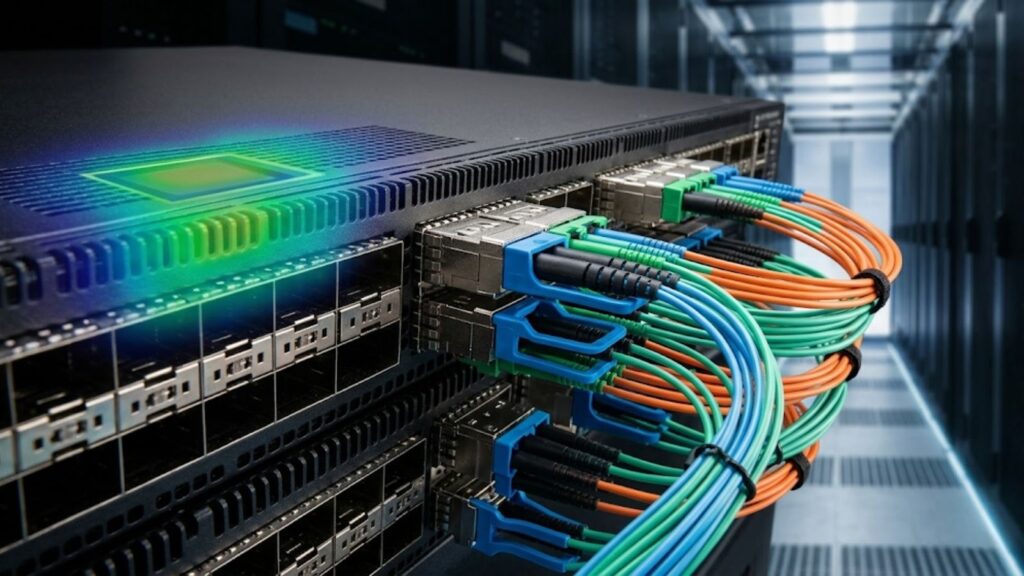
High-density switching platforms can lower cost per port and reduce the amount of rack space needed for the network layer. They also help reduce cable complexity and improve the economics of scaling large AI environments.
Benefits of higher port density include:
These gains are especially valuable in environments where floor space, cooling headroom, and deployment speed all matter at once.
Optics and cabling are often underestimated in AI networking budgets. In reality, they can have a major effect on both upfront cost and operating efficiency.
The right optics and cabling strategy can help by:
This is particularly important in retrofit projects, where existing infrastructure may not have much room for added power or cooling. In those cases, network planning should be tied closely to physical deployment constraints and server platform choices.
Efficient ASICs help reduce power use across the fabric. That matters because AI clusters do not just demand bandwidth. They also place more pressure on the power and cooling envelope of the data center.
More efficient switching silicon supports cost control by:
For organizations investing in AI infrastructure, energy efficiency is no longer only a sustainability issue. It is also a major budget issue.
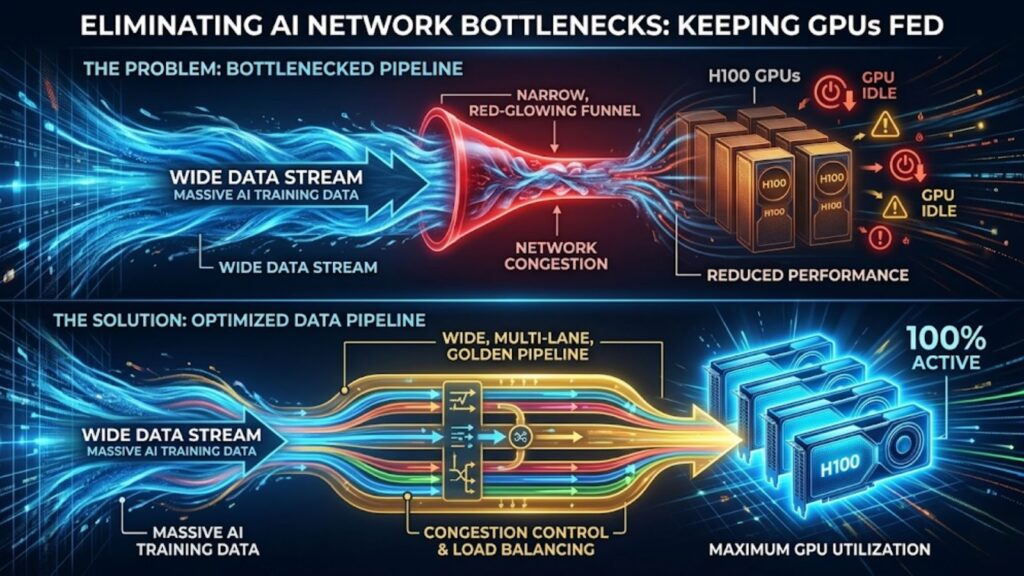
Congestion control has a direct effect on AI cost because it affects how quickly GPUs can exchange data and complete synchronized tasks. When congestion is not handled well, expensive compute resources wait instead of working.
Good congestion control helps:
That makes it one of the most practical ways to improve return on AI hardware investment.
AI traffic is often uneven. Some links become heavily used while others stay underused. Strong load balancing spreads traffic more effectively across available paths and helps prevent hotspots.
This improves cost efficiency by:
For large AI environments, load balancing is not only a performance feature. It is part of how the network protects infrastructure value.
Low latency is essential in AI clusters because distributed jobs rely on frequent communication between nodes. The faster that data exchange happens, the less time GPUs spend waiting.
Low-latency networking supports cost control by:
When latency and packet handling are optimized together, the network becomes a stronger contributor to overall AI efficiency.

Automation reduces the manual effort needed to deploy, validate, and scale AI networks. That lowers labor costs and also reduces the risk of misconfiguration.
Automation platforms can help teams:
In AI environments, where scale can grow quickly, this kind of repeatability becomes a major advantage.
As AI infrastructure becomes more dynamic, network operations also need to become more responsive. AI-driven operations can help teams identify anomalies faster, detect congestion trends earlier, and respond before problems affect workloads.
This supports cost optimization by:
That is especially important for lean infrastructure teams managing both traditional workloads and fast-growing AI environments.
Telemetry and observability give teams the visibility needed to manage AI networks efficiently. Without that visibility, it becomes harder to know whether slowdowns come from the network, the GPU layer, or the physical environment.
Better observability supports lower cost by:
In AI environments, clear visibility often prevents expensive guesswork.
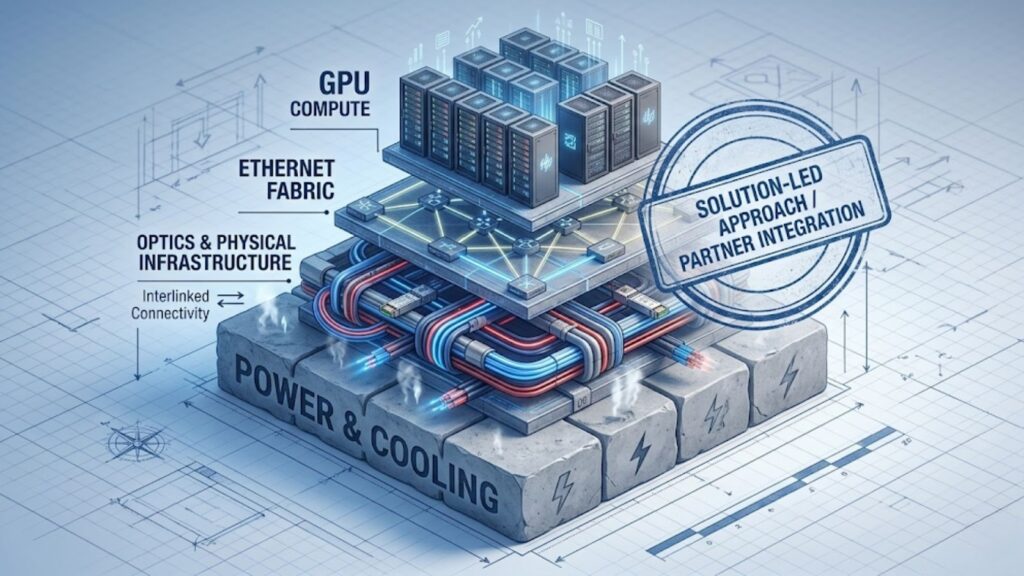
Cost-efficient AI networking depends on keeping GPUs productive, scaling cleanly, and controlling power and operational overhead.
The network should keep GPUs working, not waiting. Reducing congestion, packet loss, and latency helps improve cluster efficiency and lowers the cost of each AI job.
AI networks should scale without major redesign. Spine-leaf or Clos architectures, high-density switching, and better rack planning help support growth with less complexity and lower expansion cost.
The best design balances speed, efficiency, and long-term value. Efficient switches, optics, and cooling strategies can reduce power use while supporting higher-density AI deployments.
Automation and observability help reduce manual work, speed troubleshooting, and improve day-to-day efficiency. For organizations planning AI-ready environments,
Choosing the right AI network stack is rarely about one vendor alone. Most organizations need to balance switching performance, optics strategy, management simplicity, automation maturity, retrofit demands, and long-term scale.
The strongest cost outcomes usually come from matching the right platforms to the actual workload, facility limits, and growth plan. In practice, a solution-led approach often works better than forcing the entire design around a single OEM.
Arista is often considered for AI Ethernet fabrics that require high throughput, low latency, and strong operational consistency. Its value in cost optimization is tied to high-density switching, scalable leaf-spine design, and software consistency across large Ethernet environments.
Arista can be a strong fit when the priority is:
For organizations building or expanding GPU clusters, this can support better performance without adding unnecessary design complexity.
Juniper is often evaluated when automation and operational efficiency are central to the cost model. In AI environments, automation helps reduce provisioning effort, improve consistency, and lower the risk of errors that affect workload performance.
Juniper is commonly associated with:
This can be especially useful for organizations that want to scale the network without scaling manual operations at the same pace.
HPE Aruba Networking is often relevant for organizations that value simpler operations and a more unified enterprise infrastructure model. It may not always be the first name in large AI fabric discussions, but it can be attractive in environments where usability and day-to-day manageability are important.
Its potential value includes:
That makes it worth considering for organizations expanding from traditional data center operations into AI workloads.
NVIDIA plays an important role in AI networking because its platforms shape how many organizations think about GPU communication, backend bandwidth, and workload design. Even in multivendor Ethernet environments, NVIDIA remains an important reference point for cluster requirements and performance expectations.
Its relevance usually includes:
Rather than treating NVIDIA as the only path, many organizations use it as a performance benchmark when shaping a broader infrastructure strategy.
| Vendor | Main Cost Optimization Angle | Best-Fit Value |
| Arista | High-density Ethernet fabrics and scalable high-speed design | Efficient scale-out networking |
| Juniper Networks | Automation and operational consistency | Lower manual overhead |
| HPE Aruba Networking | Simplified management and enterprise alignment | Easier operational adoption |
| NVIDIA | AI cluster design context and performance benchmarking | Strong reference for workload needs |
For organizations comparing these options, the real advantage often comes from building the right mix of networking, optics, rack design, and supporting power and cooling around the workload. That is especially important when evaluating cooling and facility strategy,GPU build planning, and broader infrastructure alignment across different AI growth phases.
A cost-efficient AI network depends on more than switch selection alone. It requires the right mix of architecture, optics, rack design, and supporting power and cooling to keep performance high and long-term costs under control.
For organizations planning AI-ready infrastructure, a solution-led, multi-vendor approach often provides a more practical path to long-term scalability. In that context, integration partners such as Catalyst Data Solutions Inc. can help bridge network design, facility readiness, and deployment planning across evolving AI environments.
They are expensive because they require high-bandwidth switching, advanced optics, low-latency traffic handling, and strong power and cooling support. The hidden costs of poor design, such as GPU idle time and longer job completion, can make the total cost even higher.
The network affects how quickly GPUs can exchange data during distributed jobs. If the network is congested or inefficient, GPUs wait instead of computing. That lowers utilization and increases infrastructure cost per completed task.
Ethernet is often preferred because it offers scale, broad vendor support, and more flexibility for multivendor design. It can also fit better into existing data center operations while still supporting high-performance AI workloads.
Automation reduces manual provisioning, improves consistency, lowers the risk of configuration errors, and speeds up troubleshooting. All of that helps reduce operating cost while making the network easier to scale.