


Organizations today manage applications, data, and services across multiple infrastructure environments. Some workloads still run inside internal data centers, while others operate in public cloud platforms. As businesses grow and digital systems become more complex, relying on a single infrastructure model often becomes limiting.
Hybrid cloud infrastructure connects on-premises systems with public cloud environments to create a flexible and scalable architecture. This model allows organizations to keep sensitive data within controlled infrastructure while using cloud platforms for elastic computing, analytics, and modern application development.
Many enterprises adopt hybrid architectures to balance performance, security, and cost. Instead of replacing existing systems entirely, organizations can integrate legacy infrastructure with cloud services and gradually modernize their IT environment. This approach supports both operational stability and long-term infrastructure scalability.
Key Takeaways:
- Hybrid cloud integrates on-premises, private cloud, and public cloud using secure connectivity and unified management for portability.
- Workload placement balances performance, cost, data sensitivity, and compliance across environments to reduce risk and improve efficiency.
- Common deployment models include public-private integration, cloud bursting, disaster recovery setups, and edge-to-cloud architectures for distributed workloads.
- Core components include network connectivity, centralized monitoring, automation, orchestration, and scalable storage with consistent identity, encryption, and controls.
Understanding Hybrid Cloud Infrastructure
Hybrid cloud infrastructure combines different computing environments into a unified system that supports modern applications and data services. Instead of relying on only one infrastructure type, organizations integrate internal systems with cloud platforms to create a flexible architecture that adapts to changing workload demands.
This approach allows IT teams to maintain control over sensitive data while benefiting from the scalability and computing resources available in public cloud environments. As businesses grow and digital services expand, hybrid infrastructure helps organizations balance performance, security, and operational efficiency.
What Is Hybrid Cloud Infrastructure
Hybrid cloud infrastructure refers to an IT architecture that integrates:
- On-premises infrastructure
- Private cloud environments
- Public cloud platforms
These environments are connected through secure networking and unified management systems. Applications and data can move between environments depending on workload requirements, performance needs, or compliance policies.
The key idea behind hybrid cloud is integration. The different infrastructure environments must work together as a single ecosystem rather than operating as isolated systems.
Key Characteristics of Hybrid Cloud
Hybrid cloud environments share several defining characteristics that allow them to function effectively across multiple infrastructure platforms.
Interoperability
Systems and applications must communicate across environments. Integration technologies and APIs allow workloads to exchange data between cloud platforms and on-premises systems.
Workload Portability
Applications can run in different environments without requiring significant redesign. This flexibility allows organizations to move workloads when performance, cost, or infrastructure capacity changes.
Centralized Infrastructure Management
Hybrid environments often rely on centralized management tools that monitor infrastructure resources across multiple platforms. These tools help administrators manage compute, storage, and networking from a single interface.
Secure Connectivity
Encrypted network connections ensure secure communication between environments. These connections help protect data while it moves between internal infrastructure and cloud services.
How Hybrid Cloud Environments Work

Hybrid cloud environments integrate on-premises infrastructure with public cloud services to create a unified IT architecture. Organizations commonly connect internal data centers with platforms such as Microsoft Azure, Amazon Web Services, or Google Cloud so applications and data can run across multiple environments.
In this model, workloads run where they perform best. Sensitive systems may remain on private infrastructure, while scalable applications operate in public cloud environments. Technologies such as Kubernetes, secure VPN connections, and enterprise networking help maintain reliable communication between systems.
This architecture allows organizations to scale resources when demand increases while maintaining control over critical systems and sensitive data.
Key Aspects of How Hybrid Clouds Work
Several technologies and infrastructure practices allow hybrid cloud environments to operate effectively.
Unified Infrastructure Management
Centralized orchestration platforms manage infrastructure across environments.
- Tools such as VMware or OpenStack provide centralized monitoring and automation.
- Administrators can manage compute, storage, and networking from a single control layer.
Secure Interconnectivity
Hybrid infrastructure relies on secure network connections.
- Virtual private networks (VPNs) and SD-WAN connect private and public environments.
- APIs help applications communicate across systems.
Virtualization and Containerization
These technologies make applications portable across infrastructure platforms.
- Virtualization separates applications from hardware.
- Container platforms help deploy workloads consistently across environments.
Data Portability and Disaster Recovery
Hybrid cloud supports flexible data placement and system resilience.
- Sensitive data can remain on-premises while scalable workloads run in the cloud.
- Data replication between environments supports backup and failover capabilities.
Hybrid Cloud vs Traditional Infrastructure
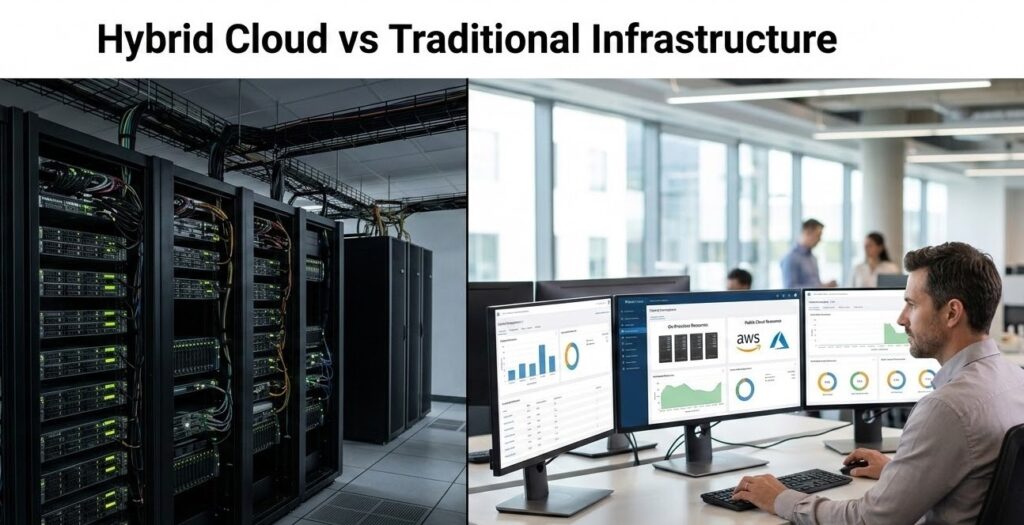
Traditional infrastructure usually operates within internal data centers where organizations manage all hardware and systems themselves. While this model provides strong control over resources, scaling infrastructure often requires purchasing and installing additional hardware.
Hybrid cloud infrastructure adds flexibility by combining internal systems with public cloud platforms. This allows organizations to expand computing capacity when needed while still maintaining control over critical workloads.
| Feature | Hybrid Cloud Infrastructure | Traditional Infrastructure |
| Infrastructure Model | Combines on-premises systems with public cloud platforms | Runs mainly inside internal data centers |
| Scalability | Can scale workloads using cloud resources | Requires new hardware to scale |
| Flexibility | Workloads can run across multiple environments | Applications run in a single location |
| Cost Structure | Pay for resources based on usage | Higher upfront hardware investment |
| Disaster Recovery | Cloud can support backup environments | Requires separate recovery infrastructure |
Hybrid Cloud Deployment Models
Organizations implement hybrid cloud in several ways depending on workload requirements and infrastructure strategy.
Common Hybrid Cloud Deployment Models
| Deployment Model | Description | Common Use Cases |
| Public + Private Cloud | Combines public cloud services with private cloud infrastructure | Enterprise applications, secure data storage |
| Cloud Bursting | Applications run in private infrastructure but scale to public cloud during high demand | Seasonal workloads, e-commerce |
| Disaster Recovery Hybrid | Backup infrastructure hosted in the cloud for failover | Business continuity planning |
| Edge + Cloud Hybrid | Edge computing systems connect with centralized cloud resources | IoT systems, manufacturing environments |
Hybrid deployment models help organizations design flexible infrastructure capable of adapting to changing operational needs.
Core Components of Hybrid Cloud Infrastructure

Hybrid cloud architecture relies on several integrated infrastructure layers that support compute, networking, and storage across environments.
Hybrid Cloud Components
| Component | Description | Role in Hybrid Cloud |
| Public Cloud Platforms | Cloud services provided by external providers | Delivers scalable computing and storage |
| Private Cloud | Dedicated infrastructure for one organization | Supports secure workloads |
| On-Premises Infrastructure | Existing internal data centers and legacy systems | Maintains traditional applications |
| Network Connectivity | Secure communication channels between environments | Enables hybrid integration |
| Management Platform | Monitoring and orchestration tools | Provides centralized infrastructure control |
These components allow organizations to distribute workloads across infrastructure environments while maintaining operational visibility.
Public Cloud Platforms
Public cloud platforms provide on-demand infrastructure resources such as compute power, storage capacity, and networking services.
Major public cloud providers include:
- Amazon Web Services
- Microsoft Azure
- Google Cloud
These platforms support scalable workloads, global deployment capabilities, and advanced analytics services.
High-performance computing environments sometimes extend hybrid cloud architectures with GPU infrastructure used for AI and data analytics in advanced GPU clusters.
Private Cloud Environment
Private cloud infrastructure provides dedicated computing resources for a single organization. These systems may be hosted internally or delivered through managed infrastructure providers.
Common private cloud environments include:
- Virtualized data centers
- Dedicated hosted infrastructure
- Private cloud platforms managed by service providers
Organizations deploying private cloud infrastructure frequently design high-performance systems similar to custom GPU server architectures when intensive computing workloads are required.
On-Premises Infrastructure
Many organizations continue to operate critical applications within internal data centers.
Examples include:
- Enterprise databases
- ERP systems
- Industry-specific operational software
Hybrid cloud enables these legacy systems to remain operational while gradually integrating with modern cloud infrastructure as part of a long-term Cloud Migration Strategy.
Network Connectivity
Secure networking is essential for hybrid cloud environments because it connects distributed infrastructure components.
Typical connectivity methods include:
- Virtual private networks
- Dedicated private cloud connections
- Encrypted communication channels
Hybrid infrastructure designs often integrate modern switching platforms similar to those used in enterprise campus networks to maintain reliable communication across distributed environments.
Efficient network architecture also contributes to operational efficiency through network infrastructure optimization strategies that reduce long-term infrastructure costs.
Unified Management Platform
Hybrid cloud environments rely on centralized management tools that monitor and control infrastructure resources across platforms.
Key capabilities include:
- Infrastructure monitoring
- Automated provisioning
- Performance analytics
- Resource orchestration
Unified infrastructure management platforms help reduce operational complexity by centralizing monitoring, automation, and policy enforcement across on-premises and cloud environments.
Hybrid Cloud Architecture Design

Designing a hybrid cloud architecture involves organizing infrastructure so applications, data, and services can operate smoothly across on-premises systems and cloud platforms. The goal is to place workloads in the environment that best meets performance, security, and cost requirements while keeping all systems connected and manageable.
A well-structured hybrid architecture focuses on four key areas: workload distribution, connectivity, infrastructure portability, and centralized management.
Hybrid Cloud Resources
Hybrid cloud environments combine public cloud platforms, private cloud infrastructure, and on-premises data centers. Organizations distribute workloads based on operational needs.
Typical workload placement includes:
- Sensitive or regulated data stored in private infrastructure or internal data centers
- Scalable applications running in public cloud environments
- Development or analytics workloads using cloud resources for flexible computing capacity
This model allows businesses to match each workload with the most suitable infrastructure environment.
Connectivity Across Environments
Secure and reliable connectivity is essential for hybrid cloud operations. Network connections allow applications and data to move between infrastructure environments without disruption.
Common connectivity methods include:
- Virtual Private Networks (VPN)
- Dedicated private connections
- Direct cloud network links
These connections support critical hybrid capabilities such as data transfer, failover systems, and disaster recovery operations.
Workload Portability and Automation
Hybrid architectures rely on technologies that allow applications to run consistently across environments.
Virtualization
Virtual machines enable multiple operating systems and applications to run on shared hardware, improving infrastructure efficiency.
Containerization
Containers package applications and their dependencies together, making it easier to deploy them across different environments.
Infrastructure as Code
Infrastructure automation tools allow systems to be deployed using configuration scripts, ensuring consistent infrastructure setup across both cloud and on-premises environments.
Centralized Management and Monitoring
Managing multiple infrastructure environments requires unified monitoring and control.
Centralized management platforms help organizations:
- Monitor system performance
- Manage workloads across environments
- Automate infrastructure provisioning
- Enforce security and compliance policies
These tools provide visibility across the entire hybrid environment, allowing IT teams to maintain operational stability and efficiency.
Hybrid Cloud Deployment Process
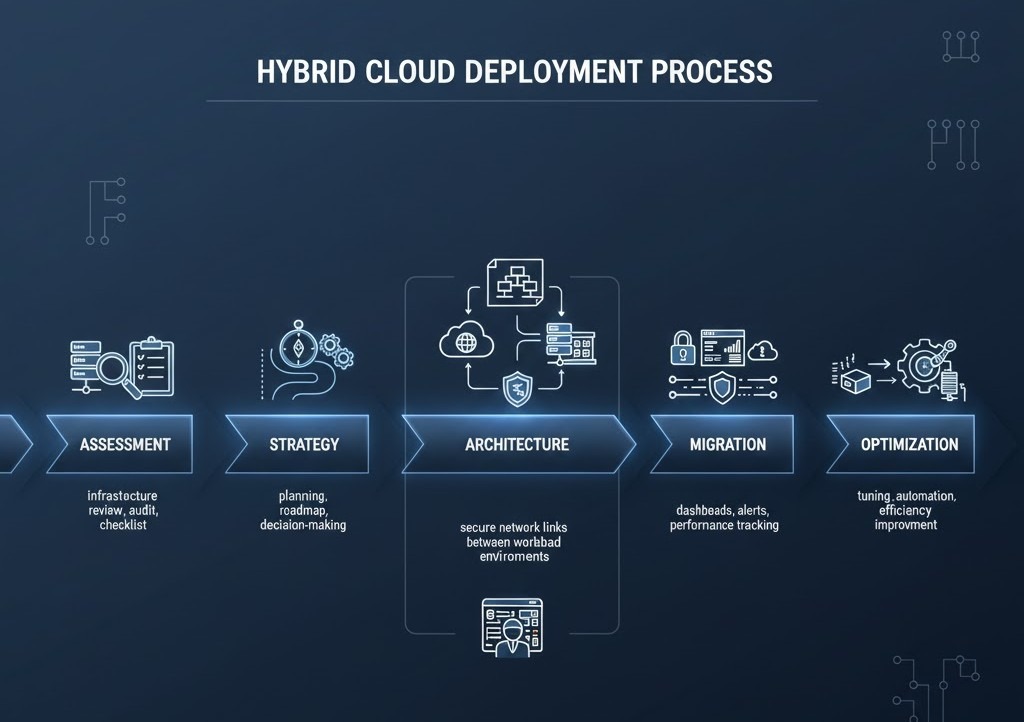
Deploying hybrid cloud infrastructure requires a structured approach. Organizations must evaluate existing systems, design a suitable architecture, and gradually integrate cloud services with internal infrastructure. A clear deployment process helps reduce operational risk and ensures workloads run reliably across environments.
Gartner notes that successful cloud migrations depend on building a strong foundation and establishing effective governance to avoid cost traps and support a smooth transition.
Step One – Assess Existing Infrastructure
The first step is evaluating the current IT environment. This includes reviewing servers, storage systems, applications, and network architecture.
Organizations should identify:
- Critical business applications
- Infrastructure performance requirements
- Data storage needs
- Security and compliance requirements
This assessment helps determine which workloads should remain on-premises and which can move to cloud platforms.
Step Two – Define Cloud Strategy and Goals
After the infrastructure assessment, organizations should define a clear cloud strategy. This step focuses on aligning cloud adoption with business objectives.
Key considerations include:
- Infrastructure scalability requirements
- Cost optimization goals
- Security and regulatory compliance needs
- Long-term digital transformation plans
The Flexera State of the Cloud Report highlights that cloud governance, especially managing cloud spend, remains the top challenge, so organizations with a defined strategy and governance practices are better positioned to run hybrid environments consistently.
Step Three – Design Hybrid Cloud Architecture
The next step involves designing the hybrid infrastructure architecture. This includes determining how applications, storage systems, and networks will operate across environments.
Architecture design typically includes:
- Workload placement planning
- Network architecture design
- Storage integration strategy
- Infrastructure management tools
A well-planned architecture ensures that public cloud services integrate smoothly with private infrastructure.
Step Four – Establish Secure Network Connectivity
Reliable and secure networking is essential for hybrid cloud environments. Infrastructure environments must communicate securely and efficiently.
Common connectivity options include:
- Virtual Private Networks (VPN)
- Dedicated cloud connections
- Encrypted network tunnels
Secure connectivity allows workloads, data, and applications to move between environments without exposing sensitive information.
Step Five – Migrate Applications and Workloads
Once infrastructure and networking are prepared, organizations can begin migrating applications and workloads to the cloud.
Migration strategies may include:
- Rehosting existing applications
- Refactoring applications for cloud platforms
- Gradually moving workloads in phases
Step Six – Implement Monitoring and Management Tools
After deployment, organizations must monitor infrastructure performance across all environments.
Monitoring tools typically provide:
- Infrastructure performance tracking
- Resource usage monitoring
- Security alerts and event detection
- Automated infrastructure management
Unified monitoring platforms improve visibility and simplify infrastructure management in hybrid environments.
Step Seven – Optimize Performance and Costs
Hybrid cloud infrastructure requires continuous optimization. Organizations should regularly evaluate workloads, resource usage, and infrastructure costs.
Optimization activities include:
- Adjusting workload placement
- Scaling cloud resources based on demand
- Monitoring cloud spending
- Improving infrastructure efficiency
Tools and Technologies for Hybrid Cloud
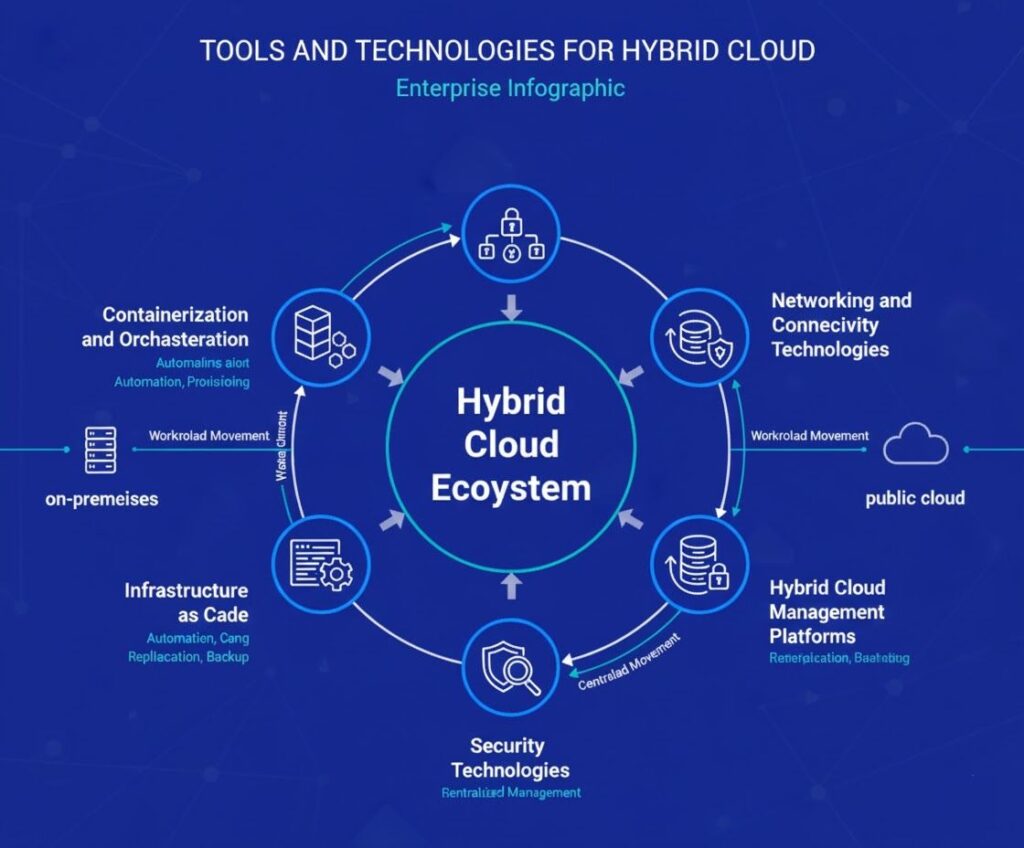
Hybrid cloud infrastructure depends on several technologies that enable integration between on-premises systems and cloud platforms.
These tools help organizations manage workloads across environments, automate infrastructure operations, and maintain consistent security policies.
The main goal of hybrid cloud technologies is to provide workload portability, centralized management, and scalable infrastructure while allowing organizations to maintain control over critical systems.
Containerization and Orchestration
Containerization allows applications to run consistently across different infrastructure environments. Containers package software with all required dependencies, ensuring that applications behave the same whether they run on-premises or in the cloud.
Orchestration platforms manage these containers across distributed systems. They help automate deployment, scaling, and resource allocation.
Common capabilities include:
- Automated application deployment
- Container lifecycle management
- Load balancing and scaling
- Consistent application environments
Container orchestration technologies have become a standard approach for running applications across hybrid infrastructure.
Infrastructure as Code
Infrastructure as Code (IaC) enables organizations to deploy and manage infrastructure using configuration files rather than manual processes.
With IaC tools, administrators can define servers, networks, and storage resources in code. This allows infrastructure to be created automatically and consistently across different environments.
Benefits include:
- Faster infrastructure deployment
- Reduced configuration errors
- Consistent infrastructure environments
- Easier scaling across multiple platforms
IaC is widely used in hybrid cloud environments because it simplifies infrastructure management across both cloud and on-premises systems.
Networking and Connectivity Technologies
Reliable networking technologies are essential for hybrid cloud operations. They allow secure communication between internal data centers and cloud platforms.
Common connectivity technologies include:
- Virtual Private Networks (VPN)
- Dedicated private network connections
- Encrypted communication channels
These technologies help ensure low-latency connectivity, secure data transfer, and stable communication between infrastructure environments.
Hybrid Cloud Management Platforms
Hybrid infrastructure requires centralized tools that provide visibility and control across different environments.
In some organizations, hybrid environments also extend to multi-cloud deployments where workloads run across multiple public cloud providers such as AWS, Azure, and Google Cloud, requiring unified management tools that can coordinate resources, policies, and monitoring across all platforms.
Management platforms typically provide:
- Infrastructure monitoring dashboards
- Resource usage analytics
- Policy enforcement and governance
- Automated workload management
These platforms allow administrators to manage public cloud resources, private infrastructure, and on-premises systems from a unified interface.
Data Storage and Mobility
Data storage technologies support hybrid infrastructure by allowing data to move between environments while maintaining performance and reliability.
Hybrid storage solutions typically support:
- Scalable storage capacity
- Data replication across environments
- Data synchronization and portability
These technologies ensure applications can access data reliably regardless of where workloads are running.
Security Technologies
Security tools protect applications and data across hybrid infrastructure environments. Because hybrid architectures involve multiple platforms, consistent security controls are essential.
Many organizations also use a cloud security compliance checklist to verify encryption, access control policies, data protection standards, and continuous monitoring across both on-premises and cloud systems.
Key security technologies include:
- Data encryption for data at rest and in transit
- Data Loss Prevention systems
- Identity and Access Management platforms
- Continuous monitoring and threat detection
These security technologies help organizations maintain compliance and protect sensitive information across distributed infrastructure environments.
Real-World Use Cases
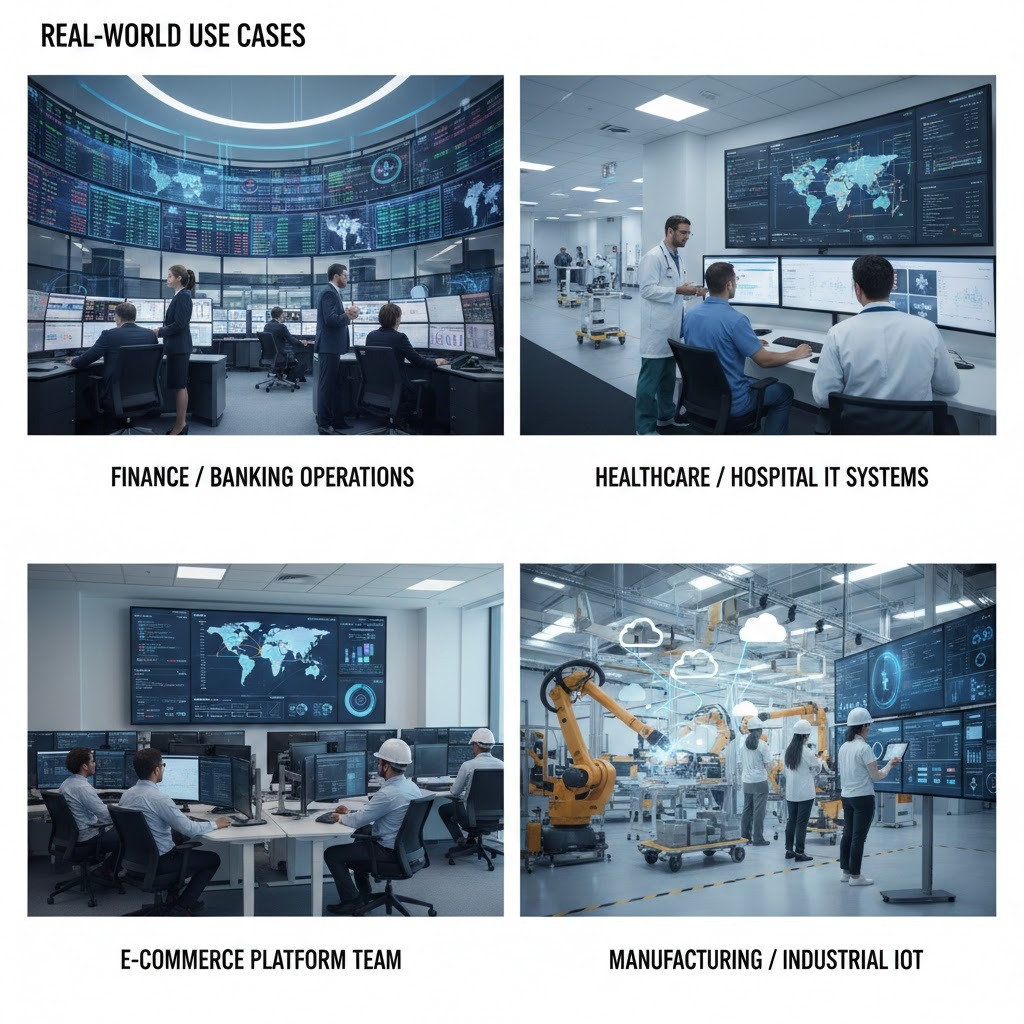
Hybrid cloud is most useful when an organization needs both control and flexibility. It is common in regulated industries, high-traffic digital businesses, and IT teams modernizing legacy systems.
Gartner projects that most organizations will adopt a hybrid cloud approach through 2027, which reflects how practical this model has become for real operational needs.
Where hybrid cloud fits best
| Industry | What runs on-premises or private | What runs in public cloud | Why this mix works |
| Financial services | Core data systems, regulated records | Digital channels, analytics, dev/test | Keeps strict control while scaling customer demand |
| Healthcare | Patient systems, local clinical apps | Backup, secure sharing, analytics | Balances access needs with security and resilience |
| E-commerce and retail | Product databases, order systems (often) | Traffic spikes, web front ends, promotions | Handles peak loads without overbuilding hardware |
| SaaS and enterprise IT | Identity, internal tools, legacy apps | CI/CD, customer apps, elastic compute | Speeds delivery while protecting critical systems |
| Manufacturing and IoT | Plant systems, edge processing | Central analytics, dashboards, long-term storage | Low latency on-site with cloud scale for insights |
Financial services
Banks and financial organizations often keep sensitive systems close to controlled infrastructure while using cloud capacity for less sensitive workloads. A common pattern is:
- Private environment: transaction data, customer records, audit logs
- Public cloud: customer portals, reporting, fraud analytics, dev/test pipelines
This approach supports compliance needs while still enabling faster product updates and scalable digital experiences.
Healthcare systems
Healthcare organizations frequently use hybrid models to keep clinical systems stable while improving resilience and access. One widely used pattern is:
- On-premises/private: patient data systems, clinical applications, local availability needs
- Public cloud: secure backup, recovery environments, and broader access to data services
Healthcare-focused analysis highlights hybrid storage as a way to improve access to critical data while strengthening security and backup readiness.
E-commerce and retail
Retail platforms often face sudden demand spikes during seasonal events and promotions. Hybrid architectures commonly use cloud bursting, where steady workloads remain private, and extra capacity shifts to public cloud during peak load.
This pattern is practical for:
- Flash sales and seasonal peaks
- Temporary campaign traffic
- Rapid scaling without permanent hardware spend
Hybrid cloud bursting is frequently cited as an effective way to absorb spikes while maintaining predictable baseline operations.
SaaS and enterprise IT modernization
Many organizations modernize in phases instead of moving everything at once. Hybrid cloud supports this by allowing:
- Legacy systems to stay stable while new services are built in the cloud
- Development and testing to scale without affecting production environments
- Gradual refactoring of applications over time
Manufacturing, edge, and IoT operations
Manufacturing and IoT environments often require fast local processing and reliable operations even with limited connectivity. Hybrid cloud supports:
- Edge/on-site: real-time control systems, local processing, safety systems
- Cloud: centralized analytics, reporting, long-term storage, model training
This reduces latency for on-site operations while enabling scalable analytics across many locations.
Future Trends in Hybrid Cloud
Hybrid cloud is becoming a long-term operating model as organizations balance scale, control, and compliance.
- Hybrid becomes standard
Many organizations are moving from “hybrid as a transition” to “hybrid as the default.” - Edge + cloud expansion
More hybrid designs include edge locations for low-latency processing, with cloud services providing central analytics and management. IDC projects edge spending at nearly $261B in 2025, rising toward $380B by 2028. - AI reshapes workloads
AI is changing where compute runs and how data is governed across environments. Gartner expects 50% of cloud compute resources to be devoted to AI workloads by 2029. - Stronger cost governance
As hybrid environments grow, organizations invest more in unified visibility, policy controls, and spending discipline. Flexera continues to highlight cloud spend management as a leading challenge.
FAQs
When should a company choose a hybrid cloud instead of a public cloud?
Organizations often choose hybrid cloud when they must keep certain workloads on private infrastructure due to security, compliance, or legacy system requirements while still benefiting from cloud scalability.
How do organizations design an effective hybrid cloud architecture?
Effective hybrid cloud design requires infrastructure assessment, workload analysis, secure network connectivity, centralized management tools, and consistent security policies across environments.
What is hybrid cloud infrastructure and how does it work?
Hybrid cloud infrastructure integrates private infrastructure, on-premises systems, and public cloud platforms through secure networking and unified management tools, allowing workloads to operate across environments.
What are the biggest challenges in hybrid cloud deployment?
Common challenges include infrastructure complexity, integration issues with legacy systems, data synchronization difficulties, and maintaining consistent security policies.
What are the key benefits of hybrid cloud infrastructure for enterprises?
Major benefits include improved scalability, better disaster recovery capabilities, enhanced security control, cost optimization, and the ability to gradually modernize legacy infrastructure.