



SLED IT procurement is how state, local, education, and public sector buyers purchase technology. For schools, libraries, and agencies, the process must balance cost, contract access, vendor options, hardware fit, delivery timing, and internal approval rules.
A school may need wireless access points before summer installation. A library may need firewalls and switches before a branch upgrade. A city agency may need laptops, storage, cloud subscriptions, or support renewals before a fiscal deadline.
State contracts and cooperative purchasing can make this process easier. They give buyers access to approved purchasing paths, but they do not remove the need for clear scopes, accurate quotes, local review, or practical fulfillment planning.
This guide explains how SLED IT procurement works, how state contracts and cooperative purchasing differ, and how buyers can compare real options before placing orders.
What Is SLED IT Procurement?
SLED stands for state, local, and education. SLED IT procurement covers technology purchases made by public agencies, K-12 schools, libraries, higher education, counties, cities, and related public organizations. These buyers often follow formal purchasing rules because public funds are involved.
In practice, SLED IT buying includes much more than issuing a purchase order. Buyers must define the need, confirm the purchasing path, compare vendors, review pricing, check availability, and document the decision. For schools, this planning may connect with E-Rate basics when eligible network infrastructure is involved.
What Are State Contracts in SLED IT Buying?
State contracts are purchasing agreements created by a state procurement office or state agency. They usually cover products and services that public buyers need often, including IT hardware, software, cloud tools, maintenance, support, and professional services.
For example, a district may use a state contract to buy Cisco Catalyst switches, Meraki access points, HPE Aruba wireless equipment, Fortinet firewalls, laptops, storage, or support renewals. The contract may simplify buying, but the buyer still needs to confirm product fit, quote accuracy, and local approval steps.
What Is Cooperative Purchasing?
State contracts are purchasing agreements created by a state procurement office or state agency. They give eligible public buyers access to pre-approved purchasing paths for commonly purchased technology products and services.
Common categories include:
- IT hardware and networking equipment
- Software and cloud subscriptions
- Maintenance and support renewals
- Professional and implementation services
- Cybersecurity and infrastructure tools
For example, a district may use a state contract to purchase Cisco Catalyst switches, Meraki access points, HPE Aruba wireless equipment, Fortinet firewalls, laptops, or storage systems. While the contract can simplify procurement, buyers should still verify:
- Product and solution fit
- Quote accuracy and completeness
- Vendor authorization status
- Local approval and documentation requirements
State Contracts vs. Cooperative Purchasing: What Is the Difference?
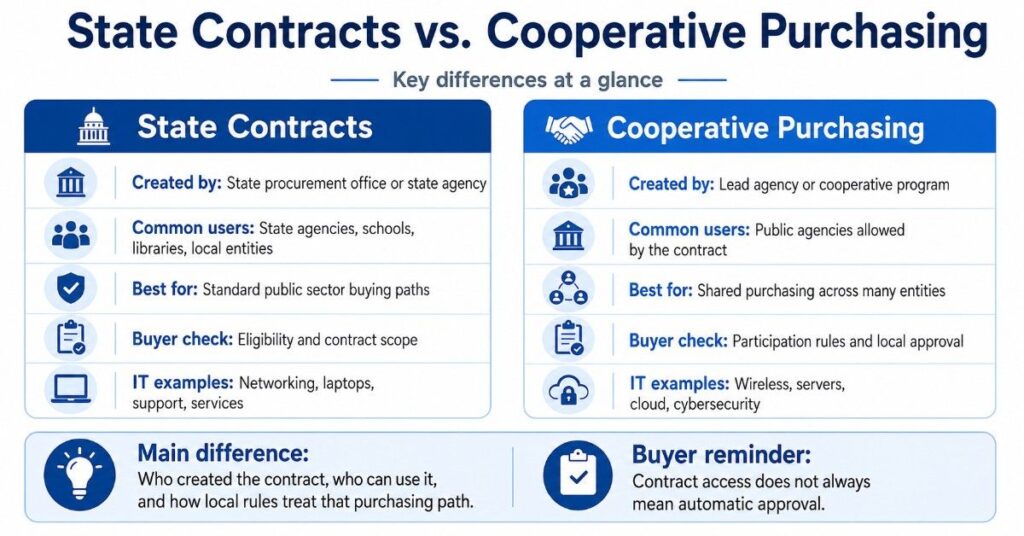
State contracts and cooperative contracts both help public buyers purchase through an existing contract vehicle. The main difference is who created the contract, who can use it, and how the buyer’s local rules treat that purchasing path.
The difference matters because contract access does not always mean purchase approval. A school may qualify for a cooperative contract but still need board approval. A city may use a state contract but still require quote documentation above a certain dollar amount.
| Area | State Contracts | Cooperative Purchasing |
| Created by | State procurement office or state agency | Lead agency or cooperative program |
| Common users | State agencies, schools, libraries, local entities | Public agencies allowed by the contract |
| Best for | Standard public sector buying paths | Shared purchasing across many entities |
| Buyer check | Eligibility and contract scope | Participation rules and local approval |
| IT examples | Networking, laptops, support, services | Wireless, servers, cloud, cybersecurity |
How Does the SLED IT Procurement Process Work?
The process starts with a real technology need, not a contract search. IT teams should first define what problem they are solving, what equipment already exists, what standards must be maintained, and what timeline or budget constraints apply. Procurement teams can then determine which purchasing paths support that requirement.
Once the scope is defined, buyers can move through a structured procurement process. Each step should build toward a documented purchasing decision that considers compliance, pricing, product fit, availability, and fulfillment requirements.
- Planning:
- Define the project need and expected outcome
- Establish the budget window and funding source
- Document the current environment and technical requirements
- Identify preferred OEM standards, if applicable
- Procurement Path Selection:
- Confirm local procurement rules and approval thresholds
- Determine whether a state contract, cooperative contract, local solicitation, or reseller channel can be used
- Verify buyer eligibility for the selected contract vehicle
- Scope Development:
- Build a clear hardware, software, or service scope
- Include quantities, technical specifications, licensing, and support requirements
- Define delivery expectations and project timelines
- Vendor Quote Collection:
- Request itemized quotes from qualified vendors
- Ensure quotes include part numbers, pricing, support terms, and lead times
- Confirm reseller authorization when required
- Evaluation and Review:
- Compare pricing across vendors
- Review product compatibility and technical fit
- Check availability, lead times, and support coverage
- Validate contract references and purchasing documentation
- Purchase and Recordkeeping:
- Complete internal approvals and purchasing requirements
- Issue the purchase order through the approved procurement path
- Save quotes, approvals, evaluations, and purchase records for future reference
How Do Contract Vehicles Simplify IT Procurement?
Contract vehicles can simplify procurement by giving buyers an approved structure for vendor access, product categories, and pricing methods. This can reduce the time needed to find eligible vendors and help teams focus on comparing actual solutions.
They are especially useful for repeatable IT needs. A district may standardize on a wireless platform, a county may renew firewall subscriptions each year, or a library may refresh laptops in phases. Contract access can support cleaner education IT planning across multiple buying cycles.
Contract vehicles often help buyers with:
- Faster vendor shortlisting
- More consistent quote requests
- Easier purchase documentation
- Access to OEM-authorized channels
- Repeatable pricing structures
- Better support for staged refreshes
Why Do Local Procurement Rules Still Matter?
Local procurement rules still matter because state and cooperative contracts do not automatically override internal policy. Schools, libraries, cities, and agencies may have their own approval levels, quote requirements, board rules, grant conditions, or documentation standards.
This is why buyers should treat contract vehicles as purchasing tools, not complete procurement answers. A contract can support the buying path, but local procurement, legal, finance, or program teams must confirm how the purchase should be approved and documented.
How Does E-Rate Fit Into SLED Procurement Planning?
E-Rate can overlap with SLED IT procurement when schools and libraries buy eligible connectivity or internal network infrastructure. FCC guidance says E-Rate discounts can range from 20% to 90%, based on factors such as poverty level and rural status.
USAC guidance also states that price of eligible products and services must be the primary factor when selecting an E-Rate service provider. Buyers planning funded network projects should separate sourcing support from E-Rate compliance, filing, or legal advice.
For practical planning, E-Rate may involve switches, access points, routers, wiring, and related eligible internal connections. Teams preparing bids can use an E-Rate vendor selection guide to think through bid comparison and documentation before award decisions.
How Do OEM and Channel Partners Fit Into SLED IT Procurement?
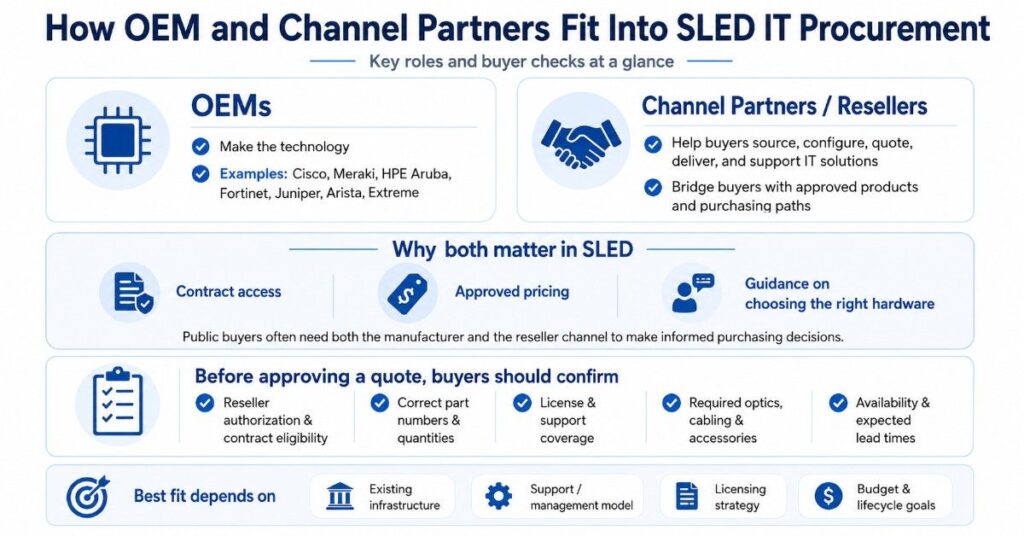
OEMs make the technology, while channel partners and resellers help buyers source, configure, quote, deliver, and support it. In SLED procurement, both play an important role because public buyers often need contract access, approved pricing, and guidance on selecting the right hardware.
Common OEMs in public sector IT include Cisco Catalyst, Cisco Meraki, HPE Aruba, Fortinet, Juniper, Arista, and Extreme Networks. The best fit depends on factors such as:
- Existing infrastructure and compatibility needs
- Preferred support and management model
- Licensing requirements and renewal strategy
- Budget, lifecycle, and long-term planning goals
Before moving forward with a quote, buyers should review more than just the price. It is important to confirm:
- Reseller authorization and contract eligibility
- Hardware part numbers and quantities
- License and support coverage
- Required optics, cabling, and accessories
- Product availability and expected lead times
Taking time to verify these details helps avoid missing components, unexpected costs, and delays later in the procurement process.
What Do Schools, Libraries, and Public Agencies Actually Buy?
SLED buyers usually purchase practical infrastructure that supports daily operations. Schools may refresh wireless, switches, laptops, and security tools. Libraries may upgrade public Wi-Fi, firewalls, cabling, and branch equipment. Agencies may buy servers, storage, cloud subscriptions, and maintenance renewals.
These purchases often connect to larger lifecycle plans. A network upgrade may include switches, access points, firewalls, optics, cabling, support, and cloud management. Buyers can reduce confusion by aligning each purchase with a clear network refresh plan before quotes are requested.
| Procurement Category | Common SLED Purchases | What Buyers Should Confirm |
| Networking | Switches, routers, optics, transceivers | Port count, uplinks, PoE, support |
| Wireless | Access points, cloud licenses, mounts | Coverage, user density, management |
| Firewalls | Appliances, subscriptions, support | Throughput, VPN, security services |
| Servers and storage | Compute, backup, SAN, NAS | Capacity, growth, warranty |
| End-user devices | Laptops, desktops, Chromebooks | Standard model, warranty, lifecycle |
| Security tools | Endpoint, filtering, logging, MFA | Coverage, renewal dates, reporting |
| Maintenance | OEM support, renewals, spares | Term, response level, coverage dates |
How Can Contract Availability Affect Fulfillment?
Contract availability does not always mean product availability. A switch, firewall, access point, or server may be listed under a contract, but stock can still be limited, delayed, discontinued, or replaced by a newer model.
This creates risk for schools and agencies with fixed project windows. A wireless deployment may need to happen during summer break. A firewall replacement may need to happen before support expires. Buyers should check inventory and lead times before relying on a quote.
How Should Buyers Check Pricing, Availability, and Lead Times?
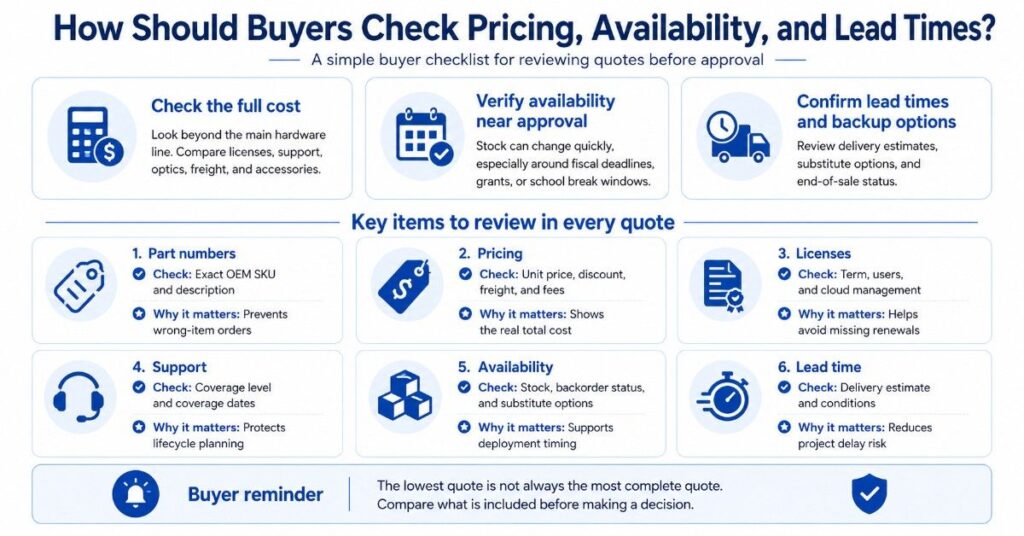
Buyers should check the full project cost, not only the main hardware line. One quote may include licenses, support, optics, freight, and accessories. Another may only include the core equipment, which can make the lower price misleading.
Availability should be checked close to purchase approval because stock can change quickly. SLED buyers often order near fiscal deadlines, grant timelines, or school break windows. That makes lead time, substitute options, and end-of-sale status important.
| Quote Item | What to Check | Why It Matters |
| Part numbers | Exact OEM SKU and description | Prevents wrong-item orders |
| Pricing | Unit price, discount, freight, fees | Shows real total cost |
| Licenses | Term, users, cloud management | Avoids missing renewals |
| Support | Coverage level and dates | Protects lifecycle planning |
| Availability | Stock, backorder, substitute options | Supports deployment timing |
| Lead time | Delivery estimate and conditions | Reduces project delay risk |
How Can SLED Buyers Build a Quote-Ready Hardware Scope?
A quote-ready scope gives vendors enough detail to respond with realistic pricing. It should describe the current environment, project goal, required hardware, preferred OEM standards, acceptable equivalents, support needs, and delivery timeline.
For example, a wireless upgrade project may need access points, PoE switches, cabling, mounts, cloud licenses, and support. A switching project may need port counts, uplink speed, optics, stacking cables, power supplies, and maintenance.
A strong scope should include:
- Buildings, branches, or sites included
- Current equipment and platform standard
- Required hardware categories
- OEM preference or equivalent language
- Quantities and technical needs
- Licensing and support term
- Installation or fulfillment expectations
- Delivery timeline and project window
- Contract vehicle, if already known
How Should Buyers Compare New, Refurbished, and Hard-to-Find Hardware?
New hardware is often the best fit for standard refreshes, long lifecycle planning, and OEM-supported deployments. It can also be easier to align with warranties, software subscriptions, and support renewals across multiple buildings or departments.
Refurbished or hard-to-find hardware can help with spares, legacy environments, lab systems, budget-sensitive replacements, and urgent needs when current platforms must stay in place. Buyers should confirm policy, funding rules, security expectations, and support fit before choosing that path.
This type of comparison can support cost-conscious network planning when teams need practical options without weakening performance or reliability.
What Should Vendors Understand About Selling Through Contract Vehicles?
Vendors selling to SLED buyers should make the buying process easier to review. A strong quote should show the contract name, contract number, OEM details, part numbers, quantities, unit pricing, support terms, license terms, lead time, and exclusions.
Vendors should also avoid vague bundles. A “network refresh package” may slow procurement if it does not show switches, access points, optics, cabling, licenses, support, and delivery terms. Clear detail helps buyers compare options and defend the purchase record.
How Should Buyers Organize Procurement Records?
Buyers should save records in a way that explains the full path from need to purchase. This includes the scope, contract vehicle, vendor quotes, evaluation notes, approvals, purchase order, and final award or order record.
For E-Rate-related purchases, teams should also keep bid and vendor selection records organized. The planned 2028 E-Rate portal makes clean documentation even more important, but good records help any SLED buyer manage risk.
Useful records include:
- Project scope or request summary
- Contract vehicle details
- Vendor quote responses
- Product and part number list
- Evaluation or comparison notes
- Internal approval records
- Purchase order and award documents
- Final delivery or fulfillment notes
Need Help Comparing New, Refurbished, and Hard-to-Find Hardware?
Planning a network refresh, wireless upgrade, firewall replacement, or hardware refresh? Catalyst Data Solutions Inc. helps schools, libraries, and public agencies compare new, refurbished, and hard-to-find IT hardware so procurement teams can make more informed purchasing decisions with greater confidence.
Catalyst supports the hardware sourcing and fulfillment side of IT procurement, including availability checks, compatibility reviews, lifecycle planning, and hard-to-find equipment sourcing.
While they can help buyers evaluate practical hardware options across networking, wireless, servers, storage, security, and support renewals
FAQs
Can a school use both a state contract and a cooperative contract?
Yes. A school may have access to more than one purchasing path. The right choice depends on local policy, contract eligibility, product coverage, pricing, vendor authorization, and approval rules.
How can Catalyst help if our preferred OEM hardware is delayed or hard to find?
Catalyst can help check alternate sourcing paths, refurbished availability, compatible replacement models, and equivalent configuration options. This is useful when schools, libraries, or agencies need to protect project timelines without rushing into hardware that does not fit the existing environment.
Can Catalyst help us build a cleaner hardware scope for vendor comparison?
Yes. Catalyst can help turn a general need, such as a switch refresh or wireless upgrade, into a clearer quote-ready hardware scope. That may include part numbers, quantities, optics, cabling, licensing, support terms, and delivery considerations so buyers can compare vendor responses more confidently.
Does cooperative purchasing always remove the need for quotes?
No. Some buyers still need multiple quotes, board approval, or written justification. Cooperative purchasing may simplify the path, but local procurement rules still control the final approval process.
Can SLED buyers ask for better pricing under a contract?
Sometimes. Some contracts set ceiling pricing or discount structures, and buyers may still request sharper pricing for larger bundles. Procurement teams should confirm what the contract allows before negotiating.
What if the hardware is approved but becomes unavailable?
The buyer may need an updated quote, substitute product, revised approval, or new delivery plan. Availability should be checked before the purchase order is released, especially for summer or fiscal year projects.
Are refurbished switches or firewalls a good fit for schools?
They can be useful for spares, legacy systems, labs, and budget-sensitive refreshes. Buyers should confirm policy, support coverage, security expectations, and funding rules before including refurbished hardware.
Why do OEM standards matter in SLED procurement?
OEM standards reduce support complexity. A district using Cisco Meraki, HPE Aruba, Fortinet, Juniper, Arista, or Extreme may prefer compatible equipment so management, licensing, support, and staff training stay consistent.
Can Catalyst choose the contract vehicle for a buyer?
Catalyst can help compare hardware options, availability, quote-ready configurations, and fulfillment paths. Contract selection and procurement compliance decisions should remain with the buyer’s procurement, legal, or program advisor.