

Choosing an IT infrastructure partner is not simply a question of company size, product catalog, or number of technology partners.
The better question is: Which partner model fits the way your project needs to be designed, sourced, deployed, supported, and refreshed?
That distinction becomes especially important in complex data center programs. A team may need to modernize existing infrastructure, compare several OEM platforms, source equipment that is difficult to find, extend the life of older systems, or prepare an existing facility for AI workloads.
For organizations considering GPU infrastructure, the decision becomes even more specific:
Can the existing data center support AI, what can remain in place, and which systems need to be upgraded before new GPU infrastructure is purchased?
Those questions require more than a product quote. They require a clear view of the current environment, workload requirements, sourcing options, support model, and long-term lifecycle plan.
How the Three Partner Models Differ at a Glance
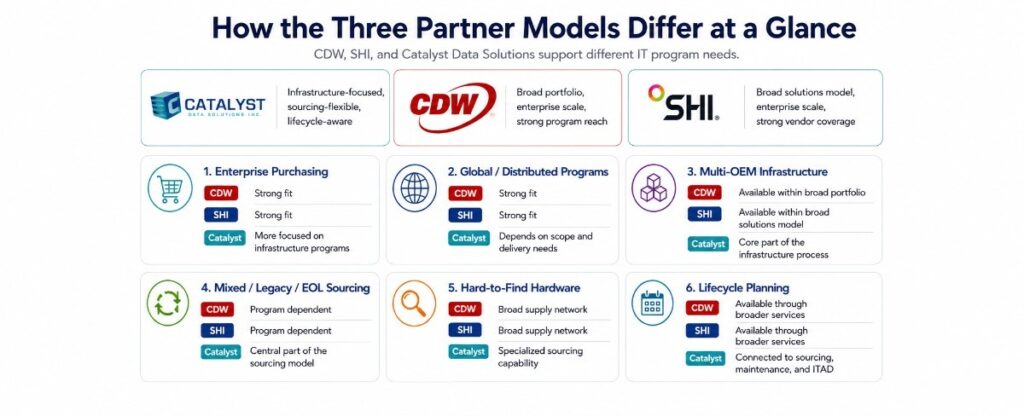
CDW, SHI, and Catalyst Data Solutions operate with different strengths and delivery models. None is automatically the best choice for every IT program.
CDW and SHI are large technology providers with broad portfolios, extensive vendor relationships, and the ability to support large programs across many technology categories.
At Catalyst Data Solutions, we focus more closely on infrastructure programs where architecture choices, multi-OEM evaluation, sourcing flexibility, support, and lifecycle planning need to work together.
| Program requirement | CDW | SHI | Catalyst Data Solutions |
| Broad enterprise technology purchasing | Strong fit | Strong fit | More focused on infrastructure programs |
| Large distributed or global programs | Strong fit | Strong fit | Depends on scope and delivery requirements |
| Multi-OEM infrastructure evaluation | Available within broad portfolio | Available within broad solutions model | Core part of our infrastructure process |
| Mixed new, refurbished, legacy, or EOL sourcing | Program dependent | Program dependent | Central part of our sourcing model |
| Hard-to-find enterprise hardware | Broad supply network | Broad supply network | Specialized sourcing capability |
| Data center lifecycle planning | Available through broader services | Available through broader services | Connected to sourcing, maintenance, and ITAD |
| AI infrastructure readiness | Broad infrastructure and AI capabilities | Broad infrastructure and AI capabilities | Focused on identifying what can remain and what must change |
The differences become clearer when the comparison is tied to a real infrastructure problem.
Start With the IT Program, Not the Provider Name
A specialized data center infrastructure partner should first understand the environment it is being asked to change.
That includes:
- Current servers, storage, and networking
- Workload requirements
- Performance and capacity limits
- Power and cooling conditions
- Support and maintenance status
- OEM end-of-support dates
- Existing contracts
- Security requirements
- Available budget
- Refresh timeline
This is particularly important when the organization already has a complex or mixed infrastructure estate.
Our Infrastructure Partner Model is built around connecting infrastructure decisions instead of treating hardware purchases as isolated transactions.
At Catalyst Data Solutions, we evaluate what the environment needs before narrowing the technology path. That gives us a clearer basis for comparing platforms, sourcing options, support models, and lifecycle costs.
If AI Is Driving the Project, Assess the Data Center First
AI infrastructure can expose limits that were not important for traditional workloads.
A data center that supports conventional virtualization or database workloads may not automatically support dense GPU systems.
Before investing in GPU infrastructure, the assessment should answer several basic questions.
What infrastructure can stay?
Existing infrastructure may still support parts of the AI environment.
For example:
- Current storage may remain suitable for some inference workloads.
- Existing servers may continue handling applications, management, or data preparation.
- Current network infrastructure may remain useful for management traffic.
- Existing racks may work if weight, airflow, and power limits are sufficient.
- Current backup and monitoring systems may remain part of the operating model.
The goal should not be to replace working infrastructure without a reason.
What may need to change?
GPU workloads can place much greater demand on:
- Rack power density
- Cooling
- East-west network traffic
- Storage throughput
- Latency
- Cabling
- UPS capacity
- Physical rack design
A proper data center modernization assessment should find those limits before the bill of materials is finalized.
| Infrastructure area | Can often remain when… | Upgrade becomes more likely when… |
| Servers | Existing systems still support non-GPU workloads | Accelerator compute is required |
| Storage | Throughput and latency meet workload needs | Storage cannot feed GPU workloads fast enough |
| Network | Current bandwidth supports expected traffic | GPU clusters require higher-speed east-west traffic |
| Racks | Weight, depth, airflow, and service space are adequate | New systems exceed rack limits |
| Power | Available circuits and UPS capacity have headroom | GPU density exceeds safe capacity |
| Cooling | Current system handles expected heat load | Rack density rises beyond cooling capacity |
| Monitoring | Current tools support the new stack | New hardware is outside existing visibility |
This is why an AI infrastructure decision should begin with workload and facility constraints rather than GPU selection.
What Should a Vendor-Neutral IT Infrastructure Partner Do?
“Vendor neutral” should describe a decision process, not simply a large list of vendor logos.
A multi-OEM technology consultant should be able to show how different platforms are evaluated and why one path is selected.
At Catalyst Data Solutions Inc, our multi-OEM technology partners give us access to infrastructure technologies across compute, storage, networking, power, cooling, security, and related data center systems.
But access alone is not enough.
The comparison process should be documented.
How to compare multiple OEMs
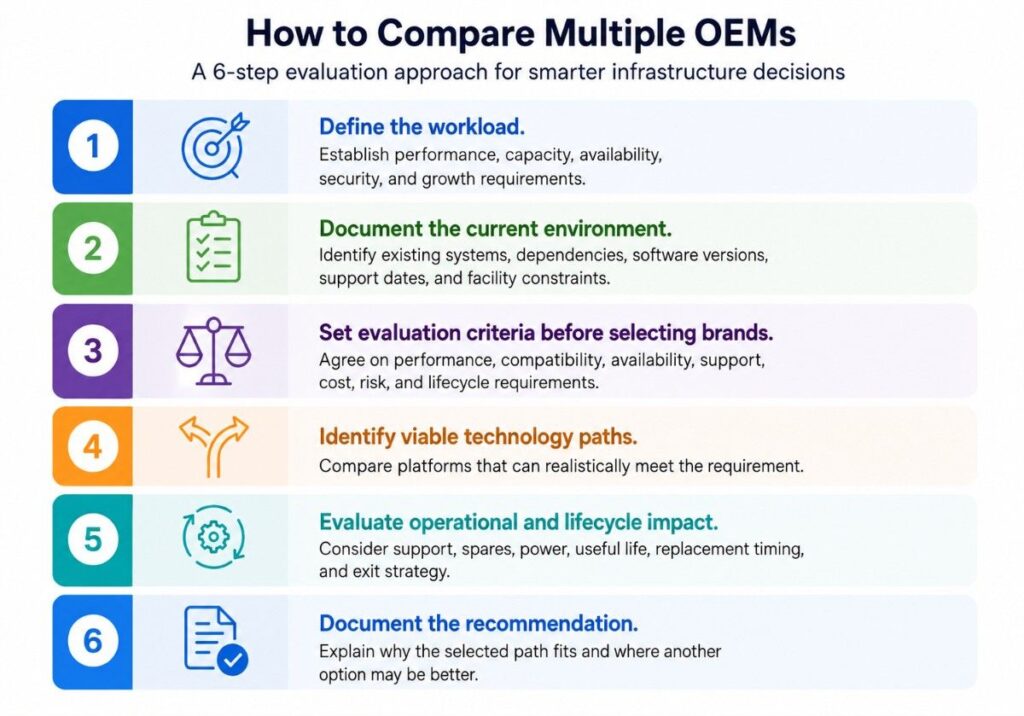
A useful multi-OEM evaluation can follow six steps:
- Define the workload.
Establish performance, capacity, availability, security, and growth requirements. - Document the current environment.
Identify existing systems, dependencies, software versions, support dates, and facility constraints. - Set evaluation criteria before selecting brands.
Agree on performance, compatibility, availability, support, cost, risk, and lifecycle requirements. - Identify viable technology paths.
Compare platforms that can realistically meet the requirement. - Evaluate operational and lifecycle impact.
Consider support, spares, power, useful life, replacement timing, and exit strategy. - Document the recommendation.
Explain why the selected path fits and where another option may be better.
This approach also makes procurement easier because the sourcing team knows what alternatives remain acceptable if availability changes.
Which Partner Provides the Strongest Sourcing Flexibility?
There is no useful answer without defining the sourcing problem.
A large provider may offer advantages when an organization needs broad purchasing scale, standardized contracts, or large quantities across many product categories.
A specialized infrastructure partner can become more useful when sourcing requirements are unusual.
That can include:
- Previous-generation equipment
- Refurbished systems
- Discontinued hardware
- EOL or EOSL equipment
- Hard-to-find components
- Exact-match expansion hardware
- Replacement parts for legacy infrastructure
At Catalyst Data Solutions, our enterprise hardware procurement process can include current-generation, prior-generation, refurbished, legacy, and hard-to-find enterprise equipment when those options fit the technical and risk requirements.
This flexibility can matter when replacing an entire platform would cost more or create more disruption than extending the existing environment.
When New Hardware Is Not the Only Option
Factory-new equipment is often appropriate, but it is not automatically the best answer for every system.
A prior-generation or refurbished system can sometimes support:
- Capacity expansion
- Development environments
- Disaster recovery sites
- Edge locations
- Labs
- Legacy application support
- Temporary infrastructure
- Spare pools
Our guidance on new versus refurbished hardware explains why condition should be evaluated alongside workload, warranty, support life, availability, and cost.
| Option | Often appropriate for | Main questions |
| Current-generation new | New platforms and demanding workloads | Cost, lead time, support |
| Prior-generation new | Expansion and standardization | Support runway, compatibility |
| Refurbished | Cost control, labs, DR, expansion | Testing, source, warranty |
| EOL/discontinued | Legacy dependencies and exact-match needs | Security, support, exit plan |
| Maintenance extension | Stable systems not ready for refresh | Parts, SLA, failure risk |
The decision should be based on the role of the equipment, not simply its age.
Who Can Source Hard-to-Find Enterprise Hardware?

This question often appears when a data center cannot be refreshed all at once.
A company may need an IT reseller for discontinued hardware because an application, cluster, network, or storage environment still depends on a specific platform.
At Catalyst Data Solutions, our enterprise hardware sourcing flexibility allows us to work across standard OEM channels and other vetted sourcing paths when appropriate.
That can include hard-to-find or end-of-life enterprise equipment.
However, availability should not be the only test.
Before older equipment is introduced into an environment, we evaluate factors such as:
- Compatibility
- Firmware
- Software or licensing requirements
- Warranty
- Support options
- Security exposure
- Parts availability
- Expected remaining service life
If the system remains technically sound but OEM support has ended, multi-Vendor hardware maintenance may help extend its useful life while a future migration is planned.
When CDW May Be the Better Fit
CDW may fit programs where broad purchasing scale and technology coverage are major requirements.
Organizations may prefer this model when they need:
- Large enterprise purchasing programs
- Broad software and hardware procurement
- Extensive contract coverage
- Standardized purchasing across many locations
- A wide portfolio under one provider relationship
These are legitimate advantages of a large national technology provider.
A narrower specialist model should not be presented as automatically superior when scale is the main requirement.
When SHI May Be the Better Fit
SHI may fit organizations that place a high value on global reach, broad technology coverage, and large integration resources.
That can matter when a program involves:
- Many offices or regions
- Large enterprise licensing needs
- Extensive technology procurement
- Global operating requirements
- Broad solution integration
Again, the decision depends on program conditions.
The purpose of the comparison is not to identify a universal winner. It is to match the provider model to the work.
When Catalyst May Be the Better Fit
At Catalyst Data Solutions, our model is most relevant when the infrastructure problem requires close coordination across several decisions.
That can include:
- Data center modernization
- Mixed-vendor infrastructure
- Multi-OEM evaluation
- AI infrastructure readiness
- Phased hardware refreshes
- Constrained supply
- Legacy platform support
- Hard-to-find enterprise equipment
- Lifecycle extension
- ITAD tied to the next refresh
Our role is to connect those decisions rather than handle sourcing as a separate activity.
After deployment, our managed infrastructure support can support the operational side of the environment, while sourcing and maintenance planning can continue around the infrastructure lifecycle.
That becomes useful when an organization wants to modernize gradually rather than treat every refresh as a full replacement.
The Partner Decision Should Include the End of the Lifecycle
Infrastructure planning should also account for what happens when existing equipment leaves production.
A refresh can create usable equipment, spare inventory, resale value, or assets that require secure retirement.
Our ITAD and asset recovery work connects retirement planning with redeployment, resale, data handling, and final disposition.
That creates four possible paths for an existing asset:
- Keep it in its current role.
- Redeploy it to a lower-demand role.
- Sell or recover value from it.
- Retire and dispose of it correctly.
For AI and data center modernization projects, this helps prevent usable infrastructure from being discarded simply because a new platform is being introduced.
When a Blended Partner Model Is Rational
One provider does not always need to own the entire IT environment.
A large organization may use a national provider for broad procurement while working with a specialized data center infrastructure partner for a complex infrastructure project.
That model can work if ownership is clear.
Define who is responsible for:
- Architecture
- OEM evaluation
- Procurement
- Staging
- Deployment
- Maintenance
- Monitoring
- Change control
- Escalation
- Security responsibilities
- Asset disposition
This is especially important in AI deployments, where facilities, network, storage, compute, security, and operations teams may all depend on one another.
Questions to Ask Before Choosing an Infrastructure Partner

The strongest comparison comes from asking each provider the same practical questions.
- What types of infrastructure programs are the best fit for your model?
- How do you compare multiple OEMs?
- Will you document why one platform was selected over another?
- Can you assess which parts of our existing data center can support AI?
- How do you evaluate storage, networking, power, and cooling before GPU procurement?
- Can you source new, prior-generation, refurbished, discontinued, and EOL hardware?
- How do you validate hard-to-find equipment before deployment?
- Who owns deployment, monitoring, maintenance, escalation, and change control?
- How do you handle equipment that no longer has OEM support?
- How does asset recovery affect the next refresh?
- When would another provider or a blended model make more sense?
These answers reveal the provider’s operating model more clearly than a product catalog or partner list.
Choose the Model That Fits the Program
CDW, SHI, and Catalyst Data Solutions should not be evaluated as interchangeable versions of the same provider.
A large national or global provider can make sense when scale, geographic coverage, broad purchasing, and wide technology scope lead the decision.
A specialized infrastructure partner becomes more relevant when the challenge involves deeper coordination across architecture, sourcing, existing assets, maintenance, and lifecycle planning.
For AI projects, the same principle applies.
Before buying GPU infrastructure, determine what the existing data center can support, where the real bottlenecks are, and which upgrades are actually required.
At Catalyst Data Solutions inc, we use that assessment to guide our infrastructure design, sourcing, support, and lifecycle decisions rather than assuming that modernization requires replacing everything.
When the next step is a data center refresh, AI-readiness review, mixed-estate modernization project, or difficult sourcing requirement, you can discuss Your IT program with our team.