


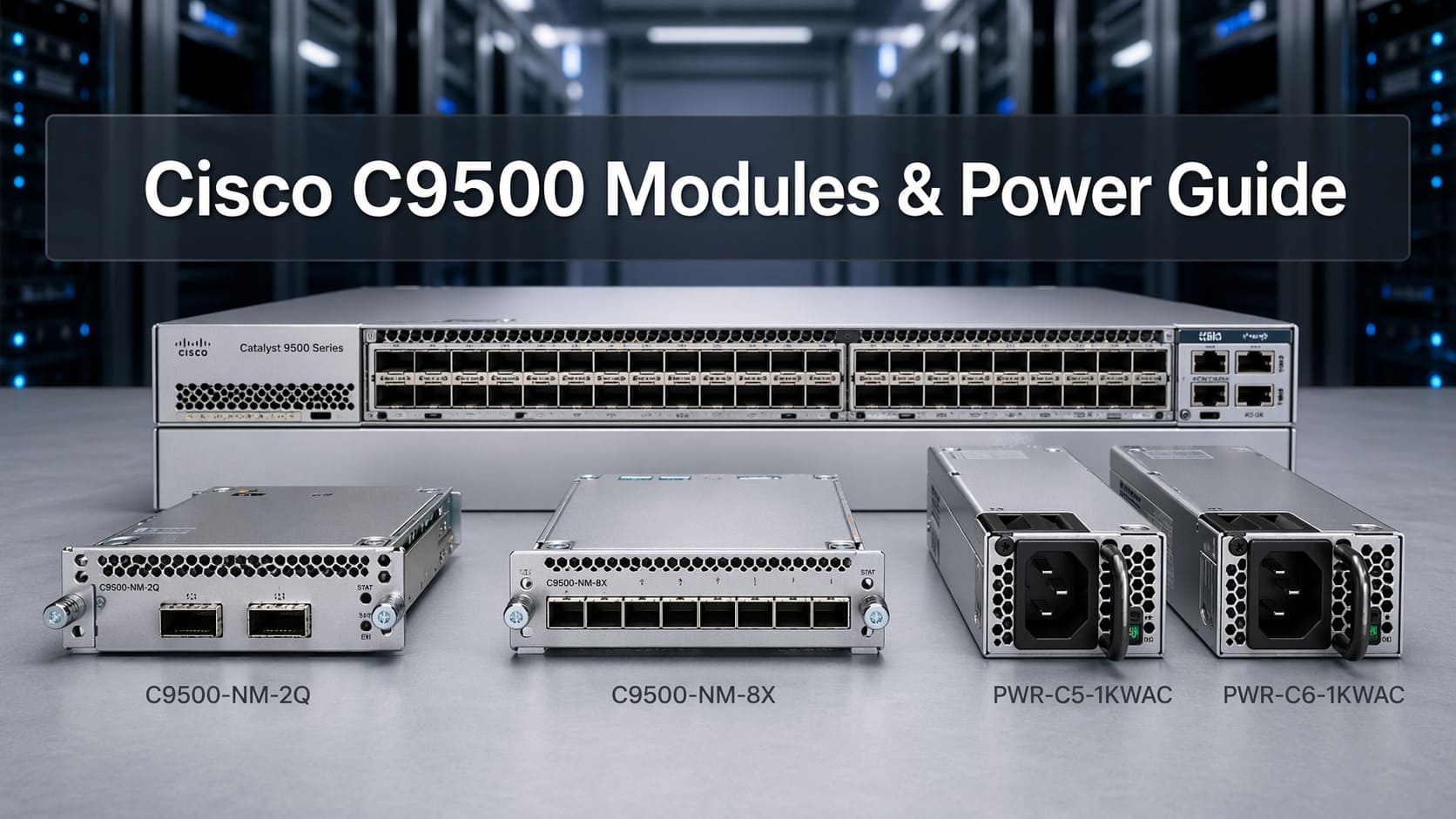
Choosing Cisco switch hardware is rarely just about the switch itself. Uplink modules and power supplies shape how the network performs day to day, how easily it scales, and how much room is left for future change.
For IT teams planning upgrades, the real challenge is making sure each part fits the design. A 40G uplink module, an 8-port 10G module, and two 1000W power supplies may all look close at first glance, but each one supports a different deployment goal. Businesses comparing Cisco switching options often need that match right the first time to avoid compatibility issues, wasted budget, or limits on expansion later.
Key Takeaways:
- C9500-NM-2Q adds 2 x 40G QSFP+ uplinks for C9500-16X core and aggregation deployments.
- C9500-NM-8X adds 8 x 1/10G SFP/SFP+ uplinks for dense, flexible 10G connectivity.
- PWR-C5-1KWAC and PWR-C6-1KWAC both provide 1000W AC power but support different Catalyst 9200 platforms.
- Dual power supplies improve redundancy and are better for PoE-heavy access networks with phones, cameras, and access points.
Cisco C9500 Network Modules Overview
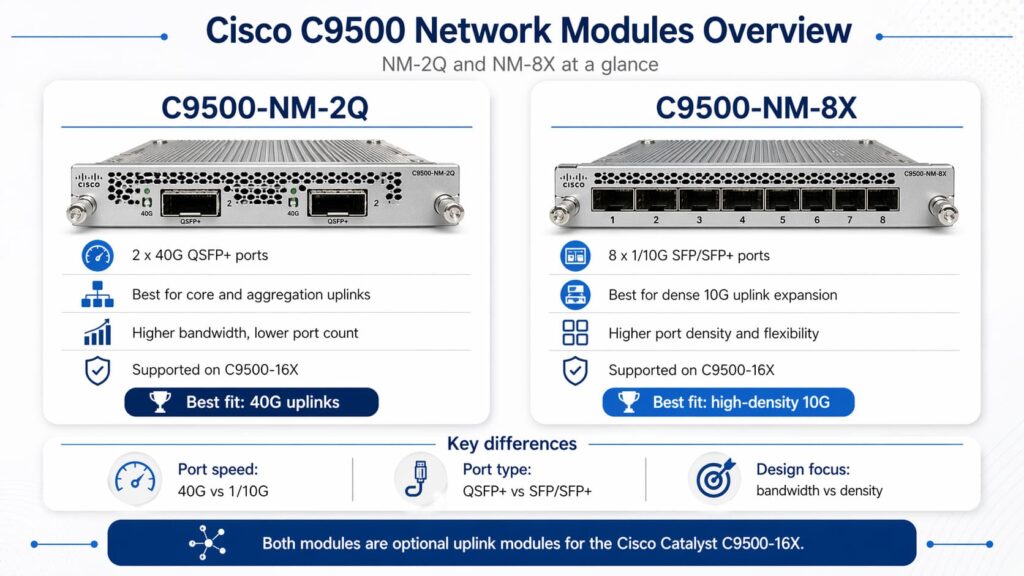
The Cisco Catalyst 9500 line is commonly used at the core or aggregation layer, where uplink flexibility matters. In this comparison, the focus is on the two optional network modules tied to the C9500-16X platform.
C9500-NM-2Q
C9500-NM-2Q is a 2-port 40G QSFP+ network module built for environments that need fewer uplink ports but higher bandwidth per port. It is a strong fit when the design calls for 40G aggregation, short and simple link maps, or connections into a larger core with QSFP-based optics already in place.
Common strengths include:
- 2 x 40G uplink capacity
- Lower port count with higher per-port throughput
- Cleaner fit for core or aggregation handoff
- Useful when cabling and optics standards already favor QSFP+
Teams working through network modernization plans often prefer NM-2Q when they want a smaller number of faster links instead of many 10G uplinks.
C9500-NM-8X
C9500-NM-8X is an 8-port 1/10G SFP/SFP+ network module. It is usually the better option when the switch must connect to multiple distribution, server, storage, or upstream links at 10G.
Its value comes from flexibility:
- 8 x 1/10G SFP or SFP+ ports
- Better fit for high 10G uplink density
- Easier migration from older 1G or 10G designs
- Wide optics familiarity for enterprise teams
In real projects, the 8-port uplink module is often selected when growth is expected across several cabinets, IDFs, or service links rather than one or two large uplink paths.
Key Differences Between NM-2Q and NM-8X
The difference is not only speed. It is really about link strategy.
| Feature | C9500-NM-2Q | C9500-NM-8X |
| Port count | 2 | 8 |
| Port speed | 40G | 1G/10G |
| Port type | QSFP+ | SFP/SFP+ |
| Best use | Core or aggregation uplinks | Dense 10G uplink expansion |
| Expansion style | Fewer, faster links | More, flexible links |
If the design needs simple, high-bandwidth uplinks, NM-2Q is the cleaner answer. If the design needs many 10G handoffs, NM-8X usually wins.
Module Compatibility and Supported Switch Platforms
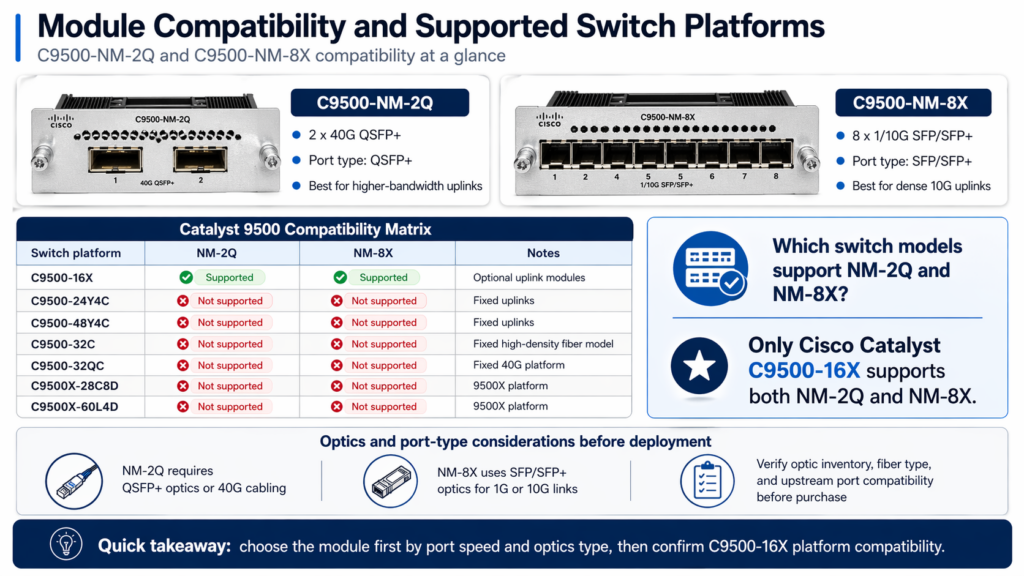
Compatibility is one of the most important checks in this category because these modules do not fit across all Catalyst 9500 models.
Catalyst 9500 Compatibility Matrix
Cisco lists C9500-NM-2Q and C9500-NM-8X as optional network modules for the C9500-16X. They are not supported on C9500-24Y4C, C9500-48Y4C, C9500-32C, C9500-32QC, or 9500X models.
Which Switch Models Support NM-2Q and NM-8X
For practical buying and deployment, use this rule:
- Supported: C9500-16X
- Not supported: C9500-24Y4C, C9500-48Y4C, C9500-32C, C9500-32QC, and 9500X platforms
That means module selection should happen together with switch model selection, not after.
Optics and Port-Type Considerations Before Deployment
Before ordering either module, verify:
- Existing fiber type and distance
- Current optic inventory
- Whether upstream gear expects QSFP+ or SFP+
- Breakout needs, if any
- Spare optic strategy for field support
A common mistake is choosing the faster module first, then realizing the rest of the network is standardized around SFP+. In that case, NM-8X may reduce change cost even if NM-2Q looks stronger on paper.
Cisco Power Supply Overview for Catalyst Access Deployments
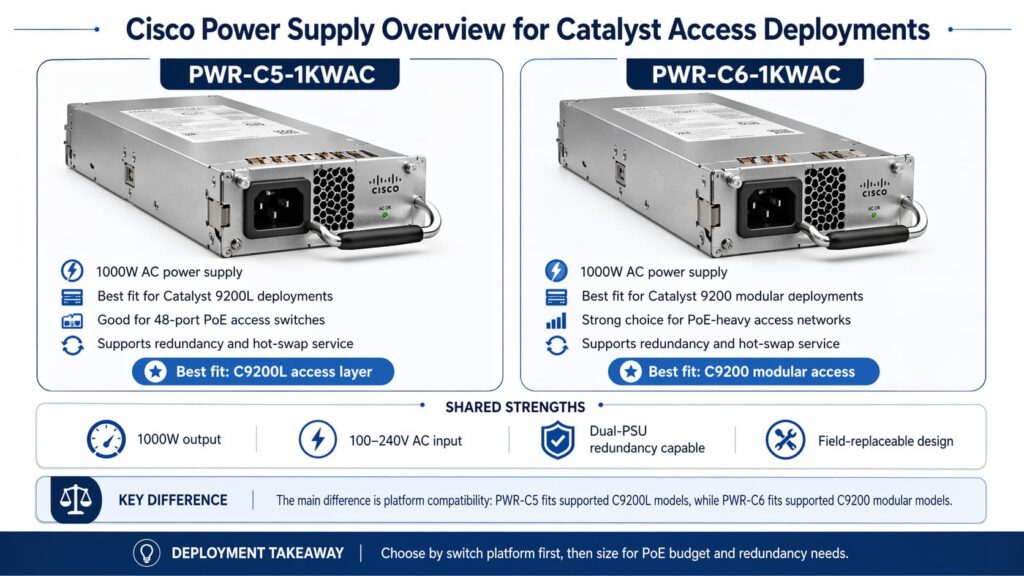
While the module comparison centers on Catalyst 9500 uplinks, the power supply comparison is more relevant to Catalyst 9200 and 9200L access switching, especially PoE-heavy deployments.
PWR-C5-1KWAC
PWR-C5-1KWAC is a 1000W AC power supply used with supported Catalyst 9200L access switches, especially 48-port PoE models. It is often chosen where higher PoE budget is needed for phones, cameras, wireless access points, and other edge devices.
In many branch upgrades, the 1000W C5 PSU is the right match for 9200L deployments that need solid PoE headroom and redundant power options.
PWR-C6-1KWAC
PWR-C6-1KWAC is also a 1000W AC power supply, but it aligns with supported Catalyst 9200 modular platforms rather than 9200L fixed models. Functionally, it delivers the same 1000W class output, but platform support is where the real difference appears.
For modular access builds, the 1000W C6 option is commonly considered for 48-port PoE switches that may later grow into stacked or high-device environments.
Key Differences Between PWR-C5 and PWR-C6
The biggest difference is not power output. It is platform fit.
| Feature | PWR-C5-1KWAC | PWR-C6-1KWAC |
| Output power | 1000W | 1000W |
| Input range | 100–240 VAC | 100–240 VAC |
| Typical output | 54V @ 16.5A | 54V @ 16.5A |
| Best fit | Catalyst 9200L 48-port PoE models | Catalyst 9200 modular 48-port PoE models |
| Use in 9200L | Supported | Not supported |
For many buyers, this is where confusion starts: same wattage, very similar electrical profile, but different switch families.
Power Redundancy and Availability Planning
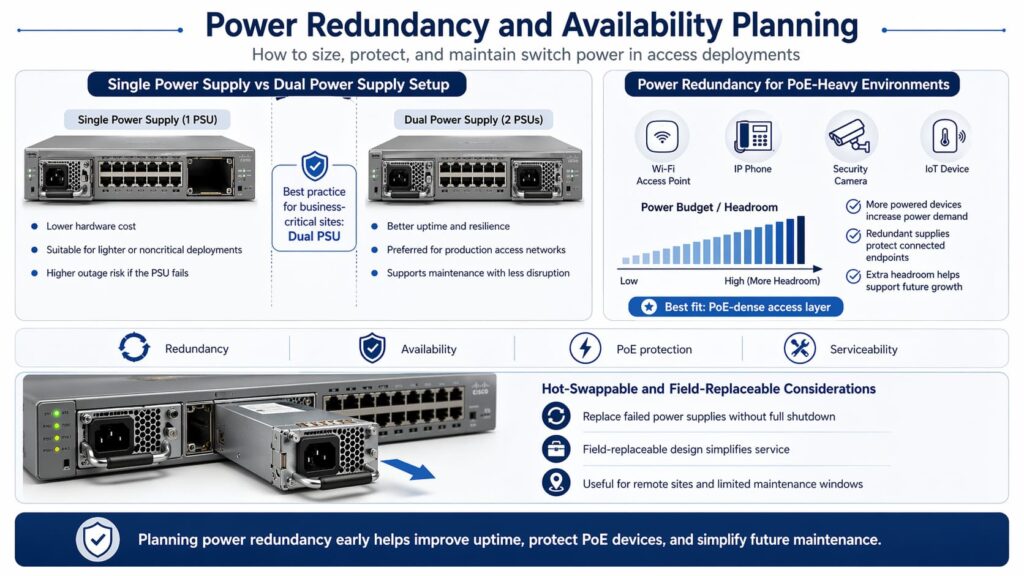
Power planning is not only about turning the switch on. It is about keeping PoE endpoints alive during a power supply failure or maintenance event.
Single Power Supply vs Dual Power Supply Setup
A single PSU setup can work for light environments, but it adds risk in sites where the switch supports phones, cameras, and APs. A dual PSU design gives you better uptime and better operational protection.
Choose dual supplies when:
- The switch carries production voice or wireless traffic
- The site has many powered edge devices
- You want maintenance without service disruption
- The branch has limited local hands support
Power Redundancy for PoE-Heavy Environments
In PoE-heavy access layers, dual power supplies do more than add backup. They can increase available PoE budget depending on the switch model. That matters more now because wireless and edge density continues to rise as enterprise WLAN spending grows.
This is one reason many organizations reviewing broader networking hardware also revisit PSU sizing instead of treating it as an afterthought.
Hot-Swappable and Field-Replaceable Considerations
These power supplies are built for serviceability. In supported platforms, they are hot-swappable and field-replaceable, which helps reduce downtime during replacement. That is especially useful in remote branch networks where scheduled outages are harder to arrange.
Deployment Setup for Real-World Network Environments
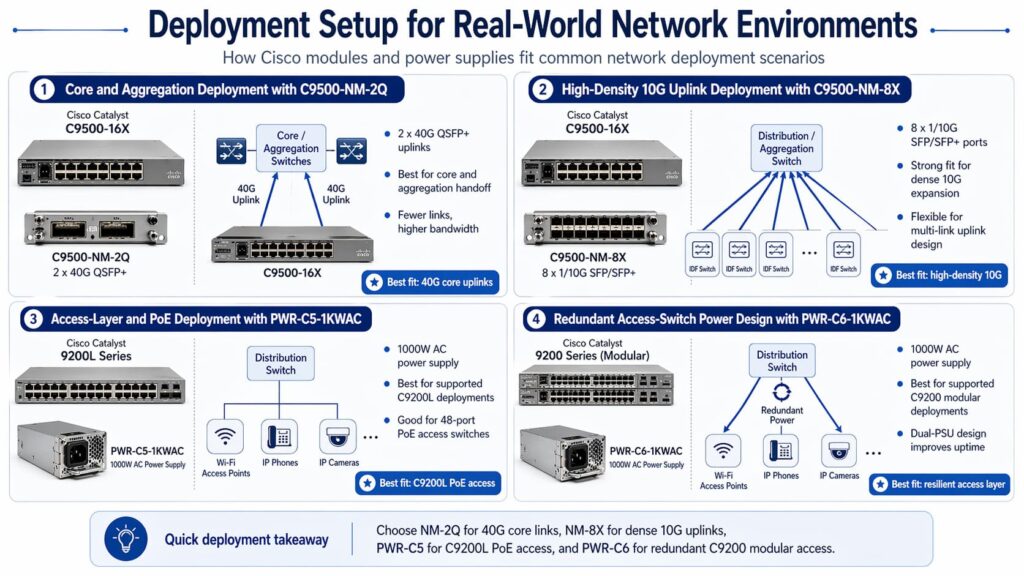
Core and Aggregation Deployment with C9500-NM-2Q
NM-2Q makes the most sense when a C9500-16X is acting as an aggregation switch feeding larger upstream devices through 40G links. It can simplify port planning and reduce the number of optics and fibers needed for high-throughput paths.
Best fit examples:
- Small to mid-size campus core uplinks
- Aggregation to higher-capacity distribution gear
- Short-run 40G backbone links
- Environments standardizing on QSFP+
High-Density 10G Uplink Deployment with C9500-NM-8X
NM-8X fits better when many 10G links are needed. That includes multiple IDF uplinks, server attachments, storage links, or staged migrations from older 1G to 10G environments.
This is often the better choice where growth will happen one uplink at a time rather than through a full 40G jump.
Access-Layer and PoE Deployment with PWR-C5-1KWAC
PWR-C5-1KWAC is a practical fit in 9200L 48-port PoE sites such as:
- School buildings
- Retail branches
- Healthcare offices
- Mid-size office floors with many APs and phones
Redundant Access-Switch Power Design with PWR-C6-1KWAC
PWR-C6-1KWAC is usually more suitable for modular Catalyst 9200 environments where dual power and stronger PoE planning are required. It works well in high-availability access stacks where service continuity matters.
C9500-NM-2Q vs C9500-NM-8X
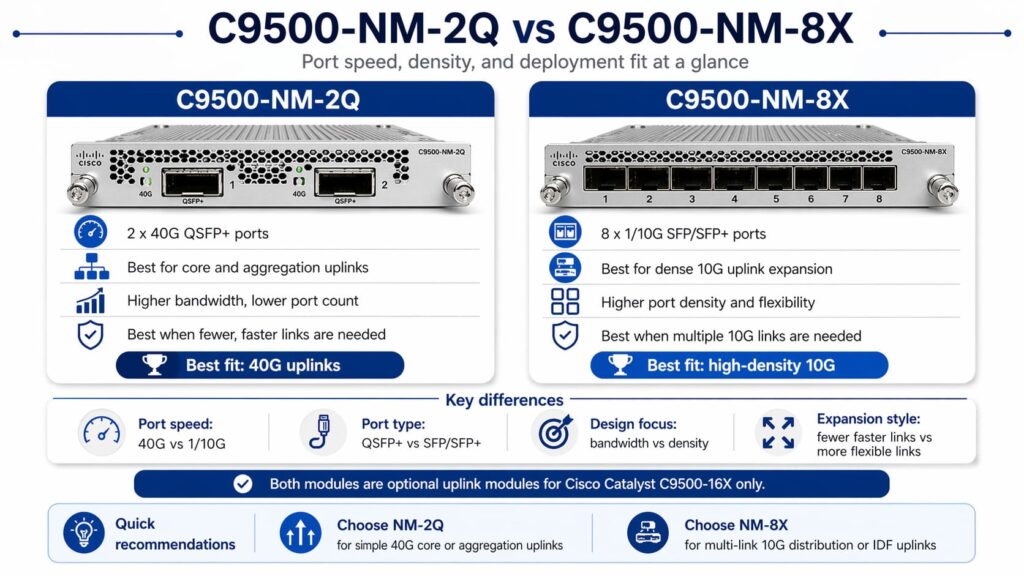
Port Density and Speed Comparison
NM-2Q gives you fewer ports with much more bandwidth per link. NM-8X gives you many more ports with lower speed per link. The right answer depends on whether the design is bandwidth-led or connection-led.
Best Fit by Network Design Scenario
Choose C9500-NM-2Q when:
- You need 40G uplinks
- The upstream side already uses QSFP+
- You want fewer physical uplinks with more throughput
Choose C9500-NM-8X when:
- You need many 10G links
- You want SFP/SFP+ flexibility
- You are growing in stages
Which Module Is Better for Future Expansion
For future bandwidth, NM-2Q is stronger. For future link count, NM-8X is stronger. Most enterprises expanding cabinet count or distribution reach will benefit from NM-8X, while sites consolidating traffic into higher-speed core paths may get more value from NM-2Q.
PWR-C5-1KWAC vs PWR-C6-1KWAC
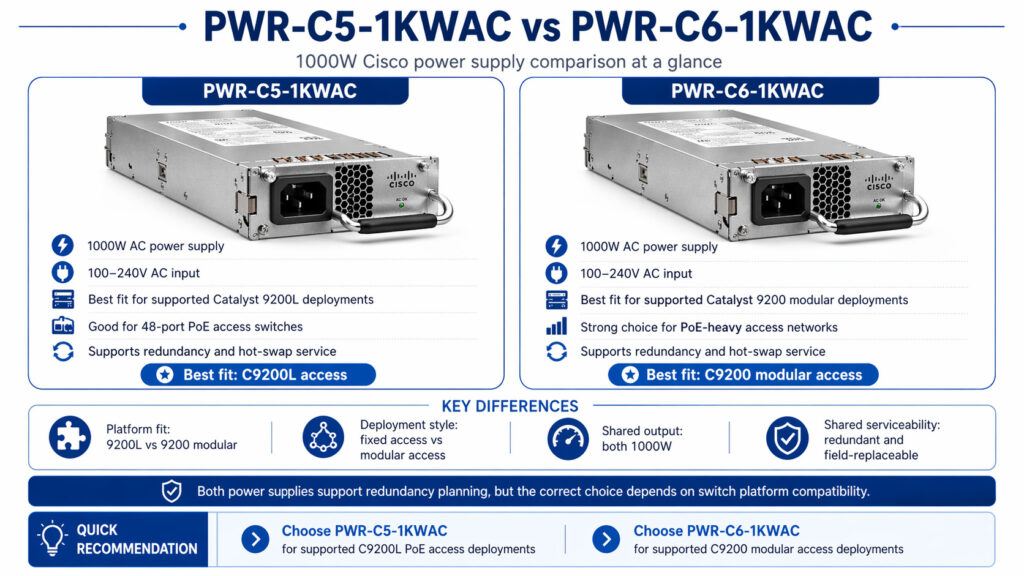
Output, Input, and Redundancy Comparison
Electrically, these two 1000W units are very close. Both operate in the same power class and support redundant deployment in compatible switches. The key difference is hardware family support.
Platform Compatibility and Deployment Fit
- PWR-C5-1KWAC: best for supported Catalyst 9200L 48-port PoE models
- PWR-C6-1KWAC: best for supported Catalyst 9200 modular 48-port PoE models
Which 1000W Power Supply Is the Better Choice
Neither is universally better. The correct choice is the one your switch actually supports. In real deployments, compatibility should override all other factors.
Similar and Nearest Product Comparisons
C9500-NM-2Q vs Nearest Alternative Uplink Module
The nearest alternative is C9500-NM-8X. NM-2Q is better when 40G density matters more than port count.
C9500-NM-8X vs Nearest Alternative Uplink Module
The nearest alternative is C9500-NM-2Q. NM-8X is better when the network still runs heavily on 10G and needs more individual uplink connections.
PWR-C5-1KWAC vs Lower-Wattage Config 5 Alternatives
Lower-wattage C5 options may fit non-PoE or lighter PoE environments, but they leave less room for expansion. For 48-port PoE deployments, 1KW usually gives safer headroom.
PWR-C6-1KWAC vs Lower-Wattage Config 6 Alternatives
The same logic applies on the C6 side. Lower-wattage options can work for lower draw, but they may limit growth or dual-PSU PoE planning.
How to Choose the Right Module or Power Supply
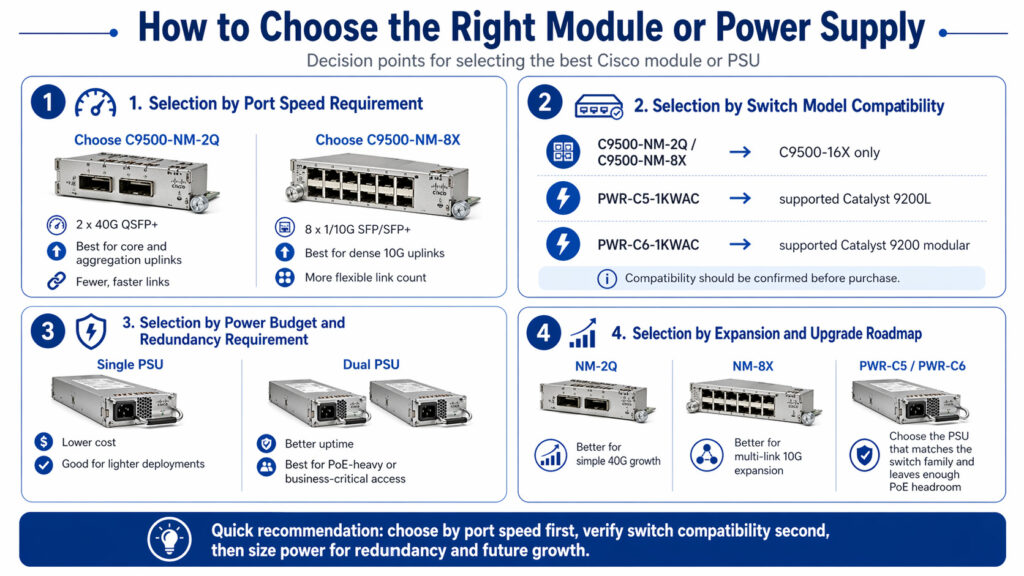
Selection by Port Speed Requirement
- Choose NM-2Q for 40G
- Choose NM-8X for 1G/10G flexibility
Selection by Switch Model Compatibility
- Use NM-2Q or NM-8X only with C9500-16X
- Use PWR-C5-1KWAC with supported 9200L 48-port PoE models
- Use PWR-C6-1KWAC with supported 9200 modular 48-port PoE models
Selection by Power Budget and Redundancy Requirement
If the site supports many APs, cameras, or phones, plan around dual PSUs and enough PoE budget from day one.
Selection by Expansion and Upgrade Roadmap
Buy for the next refresh stage, not only the current rack. Many teams sourcing refurbished Cisco modules and spare power hardware save time when they match the hardware to a two- to three-year growth path instead of a single project phase.
Models Covered in This Review
Cisco Catalyst 9500 Models Covered in This Review
| Product | Category | Main Role in This Article |
| C9500-16X | Catalyst 9500 switch | Primary module host platform |
| C9500-NM-2Q | Network module | 2 x 40G uplink option |
| C9500-NM-8X | Network module | 8 x 1/10G uplink option |
| PWR-C5-1KWAC | Power supply | 1000W PSU for supported C9200L access deployments |
| PWR-C6-1KWAC | Power supply | 1000W PSU for supported C9200 modular access deployments |
Hardware and Architecture Breakdown
C9500-48Y4C Port, Performance, and Architecture Snapshot
| Model | Fixed Ports | Uplink Style | Typical Use | Module Support |
| C9500-48Y4C | 48 x 1/10/25G SFP28 | 4 x 40/100G fixed uplinks | High-performance aggregation/core | No NM-2Q or NM-8X support |
C9500-48Y4C-A vs C9500-48Y4C-E
C9500-48Y4C-A vs C9500-48Y4C-E Feature and License Comparison
| Model | License Tier | Best Fit |
| C9500-48Y4C-A | Network Advantage | Advanced enterprise routing and services |
| C9500-48Y4C-E | DNA Advantage bundle context | Organizations aligning hardware with software-driven operations |
C9500-48Y4C vs C9500-32C-A
C9500-48Y4C vs C9500-32C-A Deployment Comparison
| Model | Strength | Best Deployment Style |
| C9500-48Y4C | High 1/10/25G port density with 40/100G uplinks | Aggregation with many access or server links |
| C9500-32C-A | Dense 100G switching | High-bandwidth core or data-intensive distribution |
Need the Right Cisco Module or Power Setup?
Catalyst Data Solutions Inc helps businesses source, match, and deploy Cisco Catalyst modules and power supplies for reliable, scalable network upgrades.
FAQs
Is C9500-NM-2Q compatible with all Catalyst 9500 switches
No. It is supported with C9500-16X, not across all Catalyst 9500 models.
When should you choose C9500-NM-8X instead of NM-2Q
Choose NM-8X when you need more uplink ports, 10G flexibility, or a smoother migration from existing SFP/SFP+ environments.
What is the difference between PWR-C5-1KWAC and PWR-C6-1KWAC
The main difference is supported platform family. Both are 1000W AC power supplies, but they are used with different Catalyst 9200 switch types.
Do PWR-C5-1KWAC and PWR-C6-1KWAC support redundant power
Yes, in compatible switches they can be used in dual power configurations for redundancy.
Can these power supplies be replaced without shutting down the switch
In supported hardware, they are designed as hot-swappable, field-replaceable units.
Which deployment setup is best for high-PoE environments
A dual power supply design with the correct 1000W unit for the switch platform is the safer approach for high-PoE sites.
Which product is better for future network expansion
For uplink growth, NM-8X is better for link count and NM-2Q is better for higher per-link bandwidth. For power growth, the better PSU is simply the one that matches the switch and leaves enough PoE headroom.