


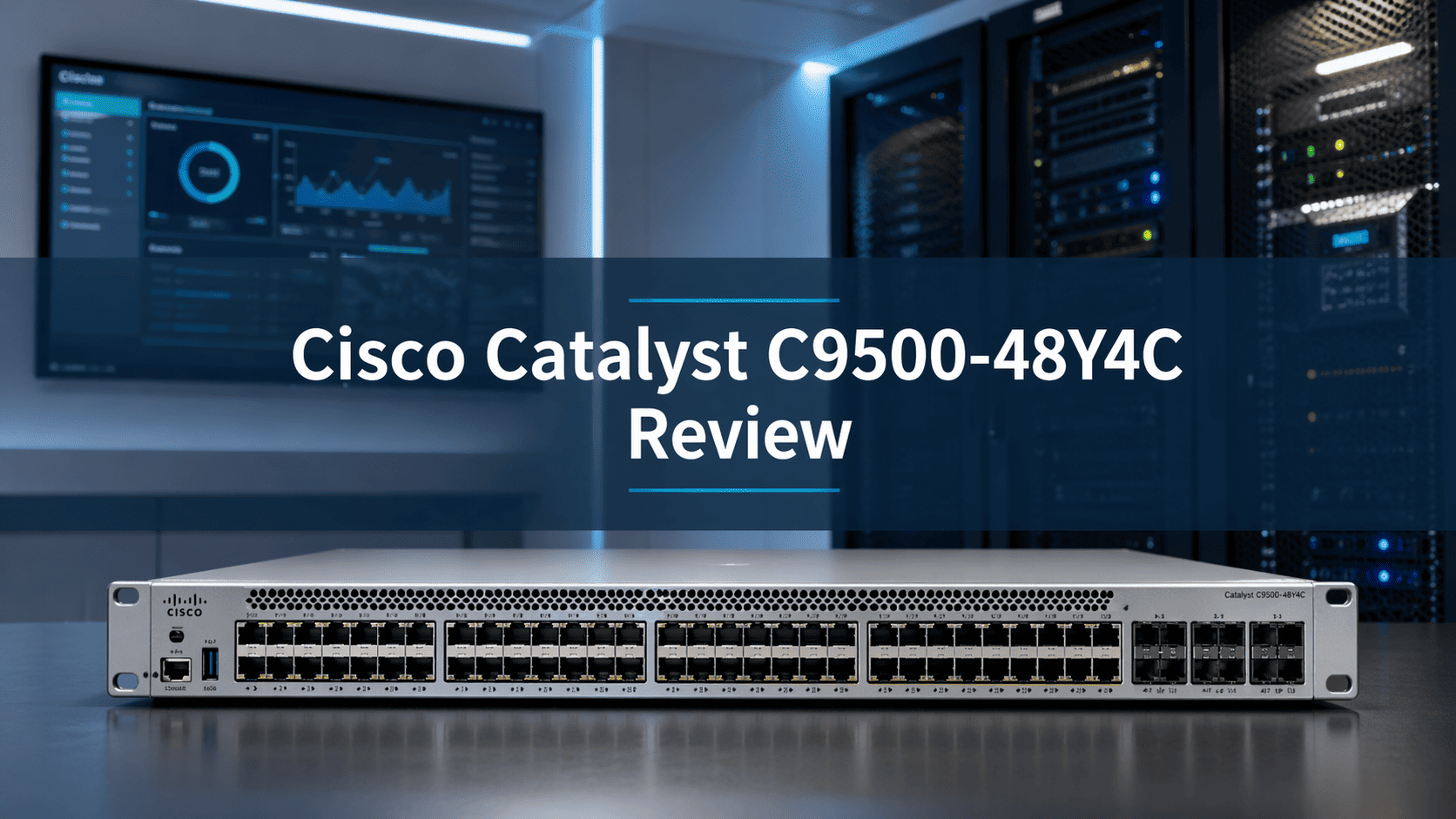
The Cisco Catalyst C9500-48Y4C is built for enterprise networks that need more speed, more fiber density, and more room to grow. It combines 48 flexible SFP28 ports with 4 high-speed QSFP28 uplinks, giving network teams a practical way to support 10G, 25G, and 100G connectivity in one platform.
For campus refresh projects, the value of this switch is not only performance. It is the balance between port density, routing strength, automation support, and high availability. That balance makes it a strong option for organizations planning broader network modernization.
Key Takeaways
- Cisco C9500-48Y4C offers 48 SFP28 1/10/25G ports and 4 QSFP28 40/100G uplinks for dense enterprise aggregation.
- It delivers up to 3.2 Tbps switching capacity and 1 Bpps forwarding for campus core and distribution workloads.
- C9500-48Y4C-A adds Network Advantage for advanced routing, MPLS, and segmentation; C9500-48Y4C-E suits simpler deployments.
- C9500-32C-A is better for dense 100G core designs, while C9500-48Y4C fits flexible 25G aggregation and mid-sized core roles.
Cisco Catalyst 9500 Series Positioning

The Catalyst 9500 family is designed for the core and aggregation layers of enterprise networks. These switches are not access-layer products. They are built for the part of the network that handles large traffic volumes, routing decisions, policy enforcement, and resilient uplinks between buildings, services, and data paths.
In the Catalyst 9500 lineup, the C9500-48Y4C stands out because it offers a very practical mix of high-density 25G fiber and fixed 100G uplinks. That makes it useful for organizations moving beyond older 10G designs without jumping straight into an all-100G backbone.
- It fits well in enterprise campus backbones
- It supports both aggregation and selected core roles
- It gives network teams a cleaner path from 10G to 25G and 100G
- It aligns well with broader campus networking planning
Where the C9500-48Y4C Fits in the Catalyst 9500 Portfolio
The C9500-48Y4C fits best as a high-density aggregation or distribution switch, though it can also serve as a core switch in mid-sized enterprise environments. It is especially attractive for deployments that need many fiber connections at 10G or 25G, plus a smaller number of high-speed 100G uplinks.
Within the portfolio, it sits between simpler aggregation models and more backbone-focused platforms such as the C9500-32C-A. That makes it a strong middle-ground option for enterprises that want flexibility without overbuilding the core too early.
Core vs Aggregation Role in Enterprise Network Design
In simple terms, aggregation switches collect traffic from access layers, remote closets, and edge systems. Core switches move large volumes of traffic quickly between major parts of the network. The C9500-48Y4C can do both, but it is often strongest in aggregation-heavy environments.
It is a good fit when many access or distribution links need to be brought together, especially in fiber-rich campus environments. In smaller or mid-sized networks, it can also work well as a core switch where port flexibility matters more than having a very large number of native 100G interfaces.
Why 25G/100G Matters for Modern Campus Backbones
Enterprise traffic patterns have changed. Wireless growth, security tools, video traffic, virtualization, and modern application use all put more load on the network core. Cisco forecast 29.3 billion networked devices globally by 2023, with 3.6 devices and connections per capita, showing why older 10G campus designs can become a bottleneck faster than expected.
That pressure is easier to understand when the worldwide enterprise WLAN market reached $10.5 billion in 2025, up 11.4% year over year, showing how quickly organizations are investing in faster wireless infrastructure.
That is where 25G and 100G matter. A switch like the C9500-48Y4C gives enterprises a cleaner upgrade path by supporting higher edge and aggregation bandwidth while still keeping the platform manageable. For many organizations, that is a smarter step than forcing a full redesign all at once.
Models Covered in This Review

This review focuses on three related models. Two share the same hardware but differ by software license, while the third is an adjacent model better suited to high-speed core environments.
Cisco Catalyst 9500 Models Covered in This Review
| Model | Base Focus | License Tier | Port Profile | Best Fit |
| C9500-48Y4C-A | Advanced enterprise routing and segmentation | Network Advantage | 48x 1/10/25G SFP28 + 4x 40/100G QSFP28 | Aggregation, advanced campus core |
| C9500-48Y4C-E | Standard enterprise aggregation and routing | Network Essentials | 48x 1/10/25G SFP28 + 4x 40/100G QSFP28 | Aggregation, simpler campus core |
| C9500-32C-A | High-speed backbone/core | Network Advantage | 32x 100G QSFP28 | Dense 100G core and service edge |
C9500-48Y4C-A
The C9500-48Y4C-A includes the Network Advantage license. This version is the better fit when a deployment needs stronger Layer 3 capability, broader segmentation features, and more advanced enterprise services.
For buyers who want long-term flexibility, the Advantage model is usually the safer choice.
C9500-48Y4C-E
The C9500-48Y4C-E uses Network Essentials. The hardware remains the same, but the software scope is more limited. This model is often more attractive to buyers who want the same physical platform but do not need the broader routing and service set included in Advantage.
C9500-32C-A
The C9500-32C-A is a different type of switch. Instead of focusing on 25G density, it is built around 32 native 100G ports. That makes it better for high-speed backbone roles, pure core transport, and designs centered on heavy 100G connectivity.
Hardware and Architecture Breakdown

The hardware is one of the main reasons this switch is appealing. It delivers strong density and high-speed uplinks in a 1RU form factor, while also supporting enterprise features that matter in real production networks.
C9500-48Y4C Port, Performance, and Architecture Snapshot
| Specification | C9500-48Y4C |
| Downlink ports | 48x SFP28 supporting 1/10/25GbE |
| Uplink ports | 4x QSFP28 supporting 40/100GbE |
| Switching capacity | Up to 3.2 Tbps |
| Forwarding rate | Up to 1 Bpps |
| Form factor | 1RU fixed switch |
| OS | Cisco IOS XE |
| Architecture | x86 CPU with enterprise switching architecture |
| High availability | Redundant power supplies, redundant fan design, StackWise Virtual support |
48x 25G SFP28 and 4x 100G QSFP28 Design
This port layout is a major strength. The 48 SFP28 ports let organizations support 1G, 10G, and 25G use cases on the same switch, which helps during phased upgrades. The 4 QSFP28 uplinks give enough high-speed connectivity for core uplinks, data center handoff, or inter-switch design.
That mix makes the switch highly practical for fiber-rich campus networks and high-density distribution layers. It is especially useful when many access or distribution links need to roll up into a compact switching layer.
Switching Capacity, Forwarding, and UADP 3.0 Architecture
The C9500-48Y4C delivers up to 3.2 Tbps switching capacity and up to 1 Bpps forwarding. Those numbers place it firmly in enterprise core and aggregation territory. It is not just a refresh of older 10G thinking. It is built to handle larger traffic volumes and heavier east-west movement inside modern campus networks.
The platform also benefits from Cisco’s enterprise architecture approach, combining strong forwarding with programmability and operational stability. That gives it good staying power for organizations planning multi-year upgrades.
IOS XE, Automation, and Programmability
IOS XE is an important part of the switch’s value. It supports automation, telemetry, API-based management, and broader integration with software-driven network operations. That matters because many enterprise refresh projects now focus on both hardware performance and operational efficiency.
For IT teams trying to reduce manual work and improve consistency, the C9500-48Y4C supports that direction well. It is not only a faster switch. It is also a more manageable one.
Redundancy, StackWise Virtual, and High Availability
High availability is another reason this platform fits enterprise environments. The switch supports redundant platinum-rated power supplies, redundant fan designs, and StackWise Virtual. With StackWise Virtual, two physical switches can operate as one logical system, improving resiliency and simplifying management.
That is valuable in core and aggregation designs where uptime matters as much as throughput.
Core vs Aggregation: Which Role Fits Best

The C9500-48Y4C is flexible, but not every deployment should use it the same way. The best fit depends on what kind of traffic the network carries and how the backbone is designed.
When the C9500-48Y4C Is Better for Aggregation
This model is especially strong for aggregation when the design includes:
- Many 10G or 25G fiber uplinks from access switches
- Building-level or floor-level distribution
- High-density wireless traffic concentration
- Segmented campus environments with policy control
- A need for smooth migration from older fiber designs
In these cases, the port mix works in the switch’s favor. It gives enough density to collect traffic at scale without wasting high-speed backbone ports on lower-speed edge connections.
When the C9500-32C-A Is Better for Core
The C9500-32C-A is better when the core is mainly about moving large volumes of 100G traffic. If the design calls for many native 100G links, fewer lower-speed interfaces, and a more backbone-centric role, the 32C-A is often the cleaner choice.
That makes it more suitable for high-speed core fabrics, data center interconnect paths, and service edge roles where 100G density matters more than 25G fan-in.
How License Tier Changes Deployment Scope
License tier shapes how far the switch can go in real enterprise deployments. Network Essentials is more suitable for standard aggregation and basic routing. Network Advantage is the stronger option for advanced routing, broader segmentation, and more complex services.
For many buyers, that means the license choice affects not just features but also how much responsibility the switch can take in the network.
Enterprise Use Cases
Campus Core and Distribution
In mid-sized enterprise campuses, the C9500-48Y4C can function as a core or distribution switch that connects access layers, service blocks, and upstream systems. It works well where performance, stability, and flexibility matter more than having very large native 100G counts.
That role has become more important as Cisco projected 3.6 global devices and connections per capita and 110 Mbps average fixed broadband speed by 2023, both of which point to sustained growth in traffic across enterprise environments.
High-Density Fiber Aggregation
This is one of the clearest use cases for the platform. Organizations with many fiber runs coming from multiple closets, buildings, or operational zones benefit from the 48-port SFP28 design. It provides scale without pushing the network into a more expensive backbone-first architecture too early.
A 25G uplink switch like this is often a practical fit for those environments.
SD-Access and Secure Segmentation
The C9500-48Y4C is also a strong fit for SD-Access and segmented campus networks. With the right software tier, it can support policy-based traffic separation, automation, and stronger control over how users and systems interact across the network.
This makes it useful for organizations aligning switching with broader zero trust planning.
Data Center Interconnect and Service Edge Scenarios
While this is not a dedicated data center leaf platform, it can still support selected data center interconnect, service edge, and high-bandwidth handoff scenarios. Enterprises that want consistent operations across campus and service-edge environments may find this appealing.
C9500-48Y4C-A vs C9500-48Y4C-E

The hardware is the same in both models. The real difference is the software scope and how advanced the deployment needs to be.
C9500-48Y4C-A vs C9500-48Y4C-E Feature and License Comparison
| Feature Area | C9500-48Y4C-A | C9500-48Y4C-E |
| Base license | Network Advantage | Network Essentials |
| Hardware | Same | Same |
| Port count | Same | Same |
| Advanced routing depth | Broader | More limited |
| MPLS-related capability | Better aligned | Less suitable |
| Advanced segmentation and services | Better fit | Basic to moderate fit |
| Best buyer | Complex enterprise core/aggregation | Standard enterprise aggregation |
Network Advantage vs Network Essentials
Network Essentials is enough for standard enterprise routing and aggregation. Network Advantage expands the deployment scope by adding stronger support for advanced routing, MPLS-related features, and more capable segmentation.
For straightforward rollups and common routing needs, Essentials may be enough. For networks with more policy depth or long-term complexity, Advantage is usually the better investment.
Routing, MPLS, Segmentation, and Advanced Services
This is where the A model becomes more appealing. If the switch is expected to support advanced enterprise routing, secure segmentation, or broader service integration, the Advantage version offers more room to grow.
Which Buyer Should Choose A vs E
Choose the A model if:
- The network has advanced routing needs
- Segmentation is a major priority
- Long-term flexibility matters more than short-term savings
Choose the E model if:
- The deployment is more straightforward
- Aggregation is the main role
- Budget control is a stronger factor
C9500-48Y4C vs C9500-32C-A

These two switches belong to the same general family, but they solve different design problems.
C9500-48Y4C vs C9500-32C-A Deployment Comparison
| Comparison Point | C9500-48Y4C | C9500-32C-A |
| Primary strength | Dense 25G aggregation | Dense 100G core |
| Downlink profile | 48x 1/10/25G SFP28 | 32x 100G QSFP28 |
| Uplink profile | 4x 40/100G | All high-speed ports |
| Switching capacity | Up to 3.2 Tbps | Higher high-speed backbone capacity |
| Best fit | Campus aggregation, flexible core | High-speed backbone, core transport |
| Ideal buyer | Migrating from 10G/25G | Building around 100G from the start |
25G Server and Access Aggregation vs High-Speed Core Uplinks
The C9500-48Y4C is built for environments where many lower-speed fiber links need to feed into a smaller number of higher-speed uplinks. The C9500-32C-A is built for environments where the core itself needs to be dense with 100G connectivity.
Port Strategy, Scalability, and Backbone Design
If the design needs many edge-facing ports, the 48Y4C is usually the better answer. If the design is centered on high-speed core transport with large 100G trunks, the 32C-A is stronger.
Best-Fit Deployment Scenarios
The 48Y4C is best for aggregation-heavy enterprise campuses and flexible core roles. The 32C-A is better for high-speed fiber core environments with more demanding backbone requirements.
Strengths, Limitations, and Buying Considerations
Key Strengths for Enterprise Core and Aggregation
The C9500-48Y4C has several clear strengths:
- High-density 25G fiber connectivity
- Useful 100G uplinks for core or upstream handoff
- Strong enterprise routing and automation support
- Redundant power and fan design
- StackWise Virtual for resilient deployments
- Good fit for both aggregation and selected core roles
No PoE, Optics Notes, and Transceiver Constraints
Buyers should also understand its limits. This is not a PoE switch, so it is not designed for direct user-edge powering. It is meant for core and aggregation roles. Optics planning also matters. Certain uplink and transceiver combinations need to be reviewed carefully during design and procurement.
That is why many organizations pair product selection with broader switch sourcing decisions.
Licensing and Subscription Considerations
Licensing is an important buying factor. The difference between Essentials and Advantage affects the switch’s long-term usefulness. Buyers should also confirm what subscription elements apply in their purchasing plan, especially if they want tighter integration with Cisco’s broader software ecosystem.
Who Should Buy Which Model

Best Choice for Campus Aggregation
The C9500-48Y4C-E is a strong choice for campus aggregation where the main need is high-density fiber connectivity, strong performance, and standard enterprise routing.
Best Choice for Advanced Enterprise Core
The C9500-48Y4C-A is the better choice for buyers who want more advanced routing, stronger segmentation capability, and more deployment flexibility over time.
Best Choice for High-Speed Fiber Core Environments
The C9500-32C-A is the better fit when the environment is built around dense 100G connectivity and more demanding core traffic patterns.
Conclusion
The Cisco Catalyst C9500-48Y4C is a strong enterprise-class switch for organizations upgrading campus core and aggregation networks. Its mix of 48 flexible 1/10/25G ports, 4 fixed 100G uplinks, high throughput, IOS XE automation, and resilient hardware design makes it one of the more practical choices in the Catalyst 9500 family.
For many buyers, the decision comes down to role and license. The C9500-48Y4C-E works well for standard aggregation. The C9500-48Y4C-A is the better fit for more advanced enterprise deployments. If the network is moving toward a heavier 100G backbone, the C9500-32C-A becomes the stronger option.
Need the Right Cisco Catalyst 9500 for Your Network?
Catalyst Data Solutions Inc helps businesses source and deploy Cisco Catalyst 9500 switches for core, aggregation, and high-speed campus network environments.
FAQs
Is the Cisco C9500-48Y4C better for core or aggregation switching?
It is usually better for aggregation. Its 48 SFP28 ports make it ideal for collecting many 10G and 25G links, while its 100G uplinks still allow it to serve as a core switch in mid-sized enterprise environments.
What is the difference between C9500-48Y4C-A and C9500-48Y4C-E?
The hardware is the same. The difference is the software license. The A model includes Network Advantage, while the E model includes Network Essentials.
How does the C9500-48Y4C compare to the C9500-32C-A?
The C9500-48Y4C is better for dense 25G aggregation and flexible campus deployments. The C9500-32C-A is better for high-speed 100G core and backbone designs.
Is the C9500-48Y4C a good choice for enterprise campus networks?
Yes. It is a strong fit for enterprise campus environments that need fiber density, modern uplinks, strong routing, and reliable high availability.
What should I know before buying the Cisco Catalyst C9500-48Y4C?
Focus on three things first: license tier, optics planning, and deployment role. Make sure the model matches whether your design is aggregation-heavy, advanced core-focused, or moving toward a denser 100G backbone.