


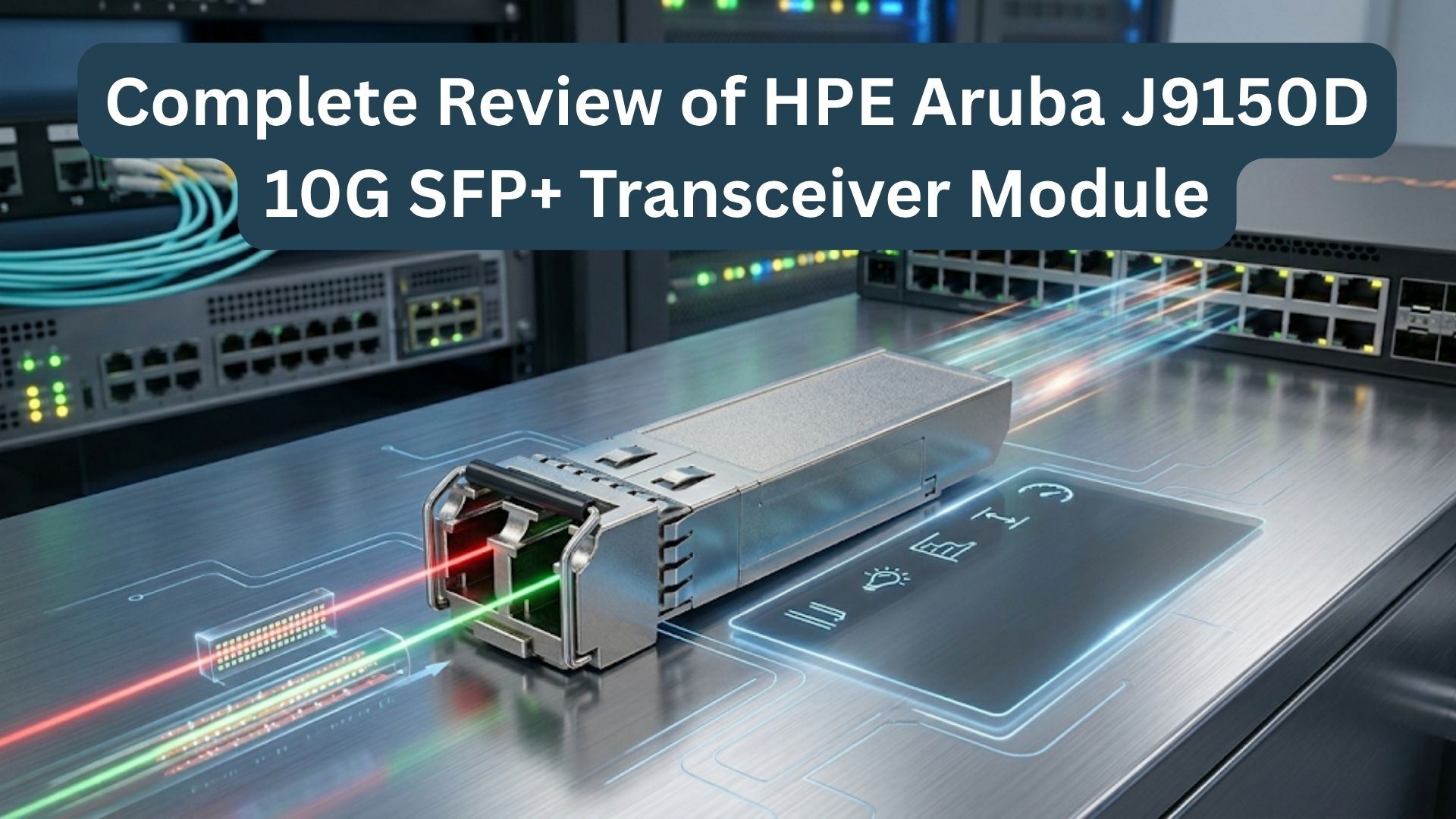
10 Gigabit Ethernet (10GbE) SFP+ SR optics remain a core component in modern enterprise and data center networks. Even as higher-speed interfaces evolve, short-range 10G connectivity continues to support switch uplinks, server communication, and aggregation layers with predictable performance and cost efficiency. In environments where infrastructure stability matters, these optics still serve as a practical foundation.
The HPE Aruba J9150D is a deployment-focused 10GBASE-SR transceiver designed for Aruba switching ecosystems. It combines standardized multimode fiber performance with strong platform compatibility and is optimized for short-range 10GbE links across Aruba switch families, including 2530, 2930F, 6300, and 8400X.
For organizations working with scalable compute systems or integrating GPU clusters built on AI-ready infrastructure and modern AI/HPC platforms, short-range optics such as the J9150D remain essential for internal high-speed links.
Delays in transceiver selection can slow switch deployment and add troubleshooting time. Choosing the right optic early helps reduce compatibility issues and ensures smoother expansion, especially in Aruba-based networks where vendor-coded optics influence deployment predictability.
Key Takeaways:
- 10GBASE-SR SFP+ transceiver operating at 850 nm for short-range multimode fiber links up to 300m.
- Compatible with Aruba switch families including 2530, 2930F, 6300, and 8400X with reliable vendor-coded recognition.
- Supports DOM/DDM monitoring for real-time optical diagnostics, improving network visibility and proactive maintenance.
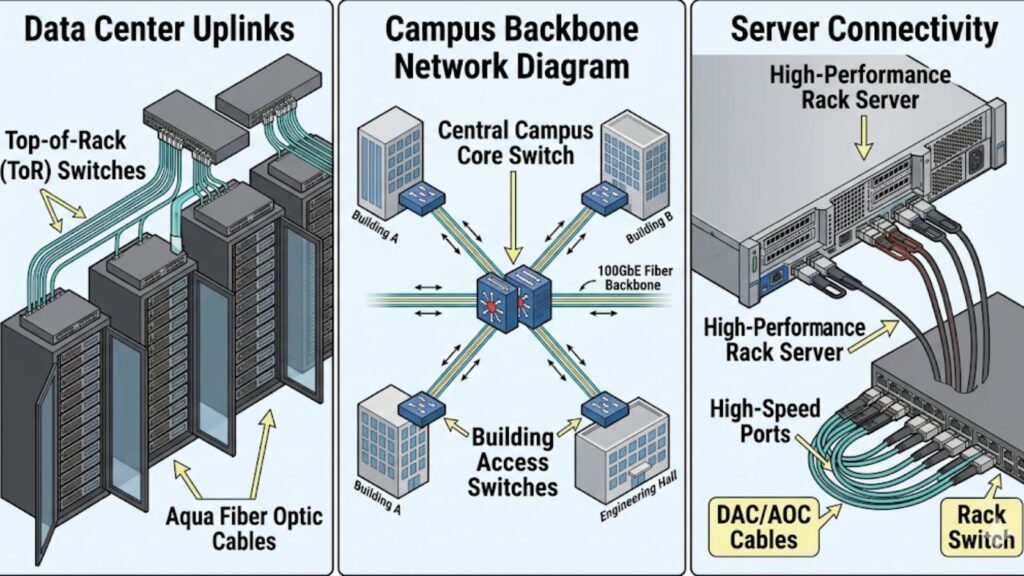
- Hot-swappable, energy-efficient design suited for data center uplinks, server connectivity, and campus backbone networks.
Overview of HPE Aruba J9150D
What Is the HPE Aruba J9150D
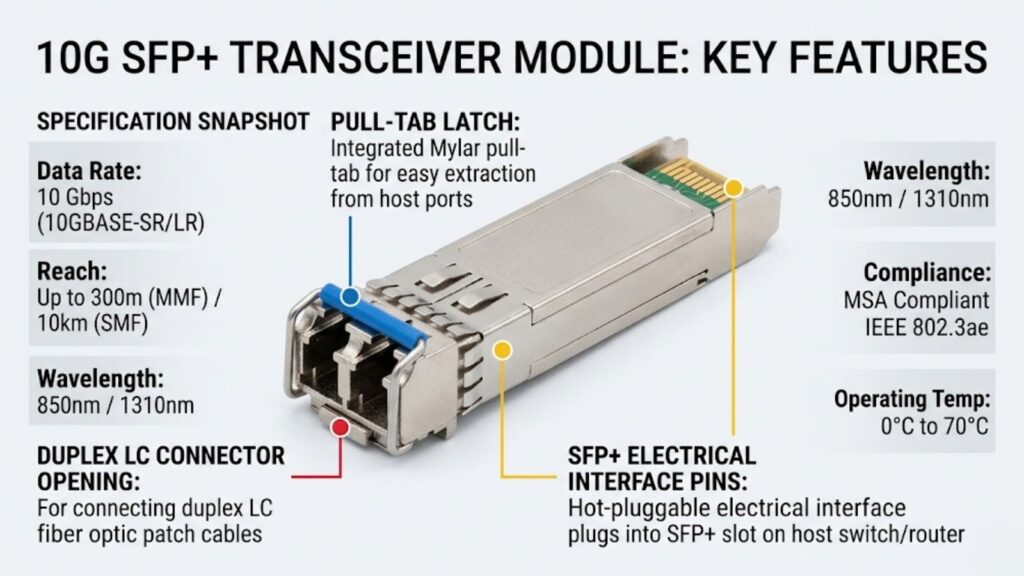
The HPE Aruba J9150D is a 10G SFP+ SR optical transceiver module designed for high-speed short-range communication over multimode fiber. It is widely used to connect switches, servers, and storage systems in enterprise and data center environments.
Operating under the 10GBASE-SR standard, it supports distances up to 300 meters on OM3 fiber and extended reach on OM4. It is specifically optimized for short-range multimode fiber connectivity and is hot-swappable, making it suitable for production environments where uptime is critical.
Key Specifications Snapshot
| Specification | Details |
| Data Rate | 10 Gbps |
| Wavelength | 850 nm |
| Connector Type | Duplex LC |
| Fiber Type | Multimode Fiber (MMF) |
| Max Distance | 300 m (OM3), up to 400 m (OM4) |
| Monitoring | DOM/DDM supported |
| Form Factor | SFP+ |
| Hot-Swappable | Yes |
“As a 10G SFP+ SR optic, the J9150D uses an 850 nm wavelength and LC duplex connectivity, which places it in the standard short-range multimode category used for switch uplinks, server connectivity, and campus backbone links.”
Key Features at a Glance
- Optimized for short-range multimode fiber links
- Supports 10G Ethernet up to 300 meters
- Hot-swappable for simplified maintenance
- Compatible across Aruba switch platforms
- Supports DOM/DDM for real-time monitoring
Target Environments and Buyers
The J9150D is designed for:
- Enterprise IT teams managing Aruba-based networks
- Data center operators requiring short-range fiber links
- Network engineers upgrading to 10G infrastructure
- Organizations prioritizing compatibility and vendor support
In environments scaling compute workloads, including GPU clusters shaped by modern GPU deployment design, consistent short-range connectivity plays a critical role in maintaining performance between nodes.
Architecture and Optical Design Analysis
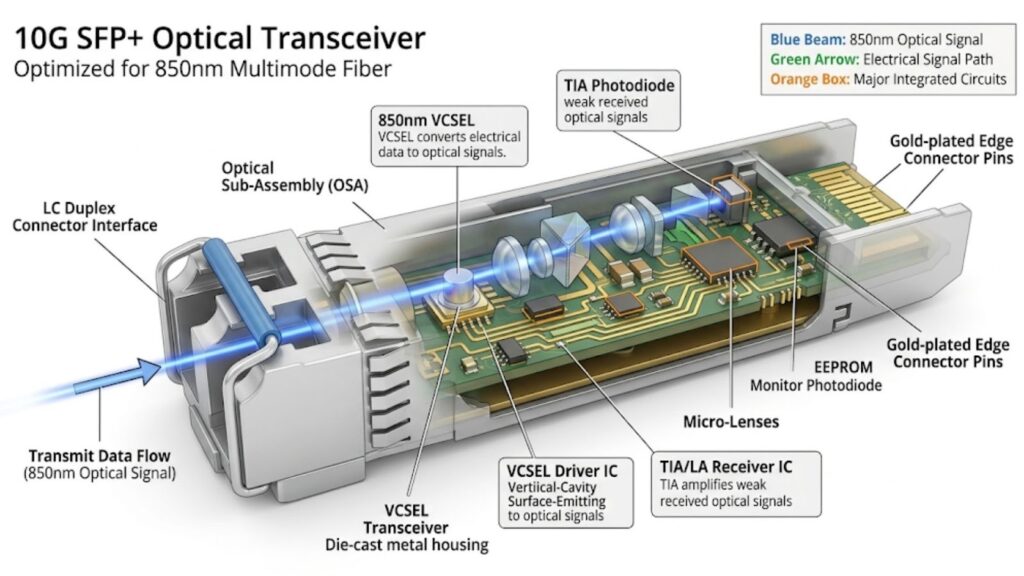
10GBASE-SR Optical Standard and Short-Range Role
The J9150D follows the 10GBASE-SR standard, which is optimized for short-distance communication over multimode fiber. This makes it ideal for high-density environments where low latency and predictable performance are required.
Short-range optics are commonly deployed in structured data center environments where cable distances are controlled and multimode fiber infrastructure is already in place.
Duplex LC Connectivity and Multimode Fiber Operation
The module uses duplex LC connectors, which support:
- High port density
- Standardized cabling
- Efficient cable management
Multimode fiber (MMF) compatibility ensures cost-effective deployment compared to single-mode alternatives.
DOM/DDM Monitoring and Network Visibility
With Digital Optical Monitoring (DOM/DDM), administrators gain visibility into:
- Temperature
- Voltage
- Optical signal strength
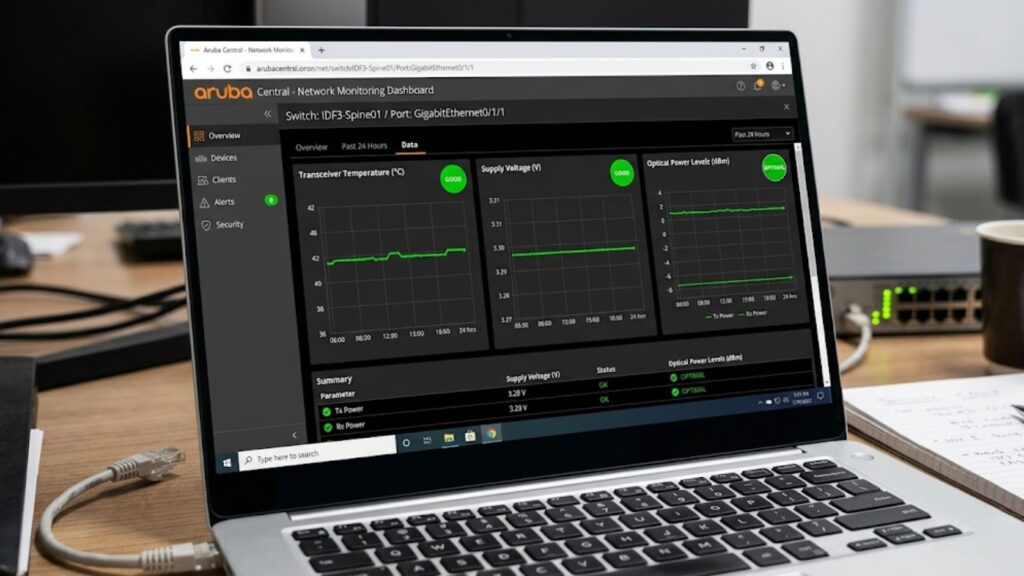
This allows proactive monitoring and faster troubleshooting in production networks. These metrics are often integrated into centralized network management platforms such as Aruba Central to provide real-time visibility into optical link performance.
How J9150D Fits Into Switch, Server, and Storage Links
The J9150D is commonly used in:
- Switch uplinks within racks
- Server-to-switch connections
- Storage and aggregation layer interconnects
Its role is to provide stable, high-speed communication across short distances.
Key Specifications and Fiber Performance
10 Gbps Data Rate and 850 nm Wavelength
The module operates at 10 Gbps using an 850 nm wavelength, which is standard for SR optics and enables efficient transmission over multimode fiber.
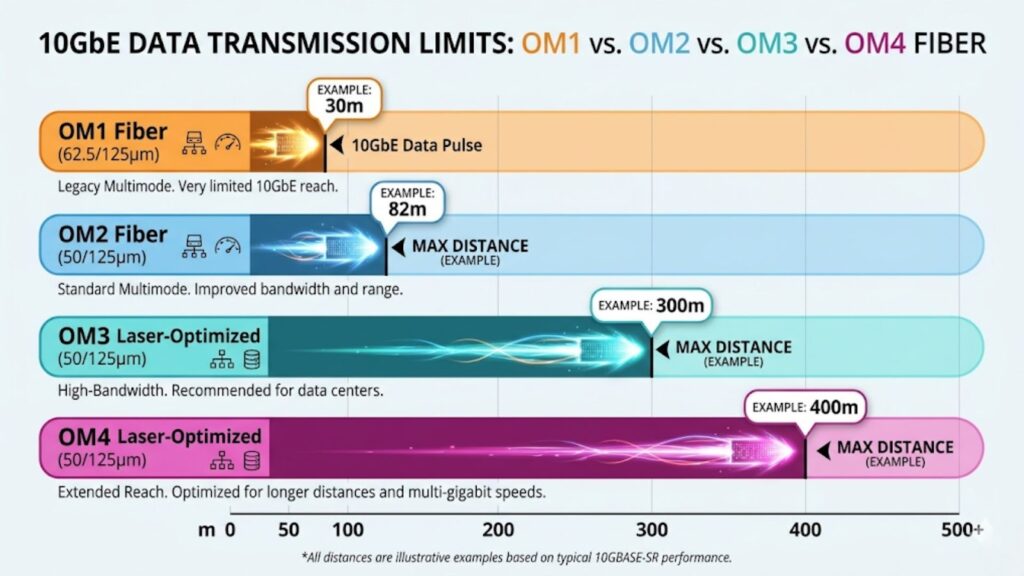
Distance Support on OM3, OM4, OM2, and OM1 Fiber
| Fiber Type | Maximum Distance |
| OM1 | ~33 m |
| OM2 | ~82 m |
| OM3 | 300 m |
| OM4 | Up to 400 m |
“The J9150D is positioned for short-range 10GbE links, with Aruba documentation showing support that aligns with 10G SR multimode deployments, including 300 meters on OM3 and higher reach on newer OM4-class optics in the same family.”
Hot-Swappable Design and Operational Efficiency
The hot-swappable capability allows installation and replacement without powering down devices. This reduces downtime and simplifies maintenance in enterprise environments.
Power and Form-Factor Considerations
The SFP+ form factor supports:
- High-density switch configurations
- Energy-efficient operation in dense environments
- Improved airflow in switch and server racks
Compatibility and Platform Analysis

Supported Aruba and HPE Switch Families
| Switch Series |
| Aruba 2530 |
| Aruba 2920 |
| Aruba 2930F |
| Aruba 6200 |
| Aruba 6300 |
| Aruba 6400 |
| Aruba 8400X |
Recognition on Newer Aruba CX and Legacy Platforms
The J9150D is designed for seamless recognition on newer Aruba CX switches, while also maintaining compatibility with legacy platforms.
Why Vendor Coding Matters in Optical Compatibility
Vendor-coded optics ensure:
- Accurate device recognition
- Firmware compatibility
- Reduced deployment risk
Choosing Aruba-coded modules helps prevent compatibility issues that can delay deployments.
What Buyers Should Check Before Deployment
Before deployment:
- Verify switch compatibility
- Confirm firmware versions
- Match fiber type and distance requirements
For short-range 10G upgrades, predictable compatibility often matters as much as raw specs.
Performance Review and Real-World Deployment Value
Plug-and-Play Installation Experience
The J9150D is widely recognized for its plug-and-play behavior. Most Aruba switches detect the module instantly without requiring manual configuration.
Reliability in Continuous Enterprise Operation
In enterprise environments, the module delivers reliable, continuous operation with:
- Stable long-term operation
- Consistent throughput
- Minimal signal loss
This aligns with requirements in infrastructure setups built around modern enterprise server systems, where continuous uptime is critical.
Thermal Behavior and High-Density Use
Some users note that the module can run warm under heavy workloads. However, this does not typically impact performance when deployed in properly ventilated racks.
Thermal behavior also matters in denser racks, particularly in facilities already planning cooling design choices for AI and high-performance compute zones.
Practical Strengths in Short-Range 10G Networks
The module performs well in:
- Rack-level connectivity
- Aggregation layers
- Campus backbone links
It is optimized for reliable short-range deployments.
Common Use Cases for HPE Aruba J9150D
Data Center Uplinks
Used for connecting switches within racks or across rows in structured environments.
Enterprise Campus Backbone Links
Supports core-to-access layer communication in campus networks.
Switch-to-Server Connectivity
Provides high-speed links between servers and switches, especially in compute-heavy environments.
Storage and Aggregation Layer Interconnects
Used in storage networks and aggregation layers requiring stable throughput.
HPE Aruba J9150D vs J9150A
Why J9150A Is the Nearest Comparable Product
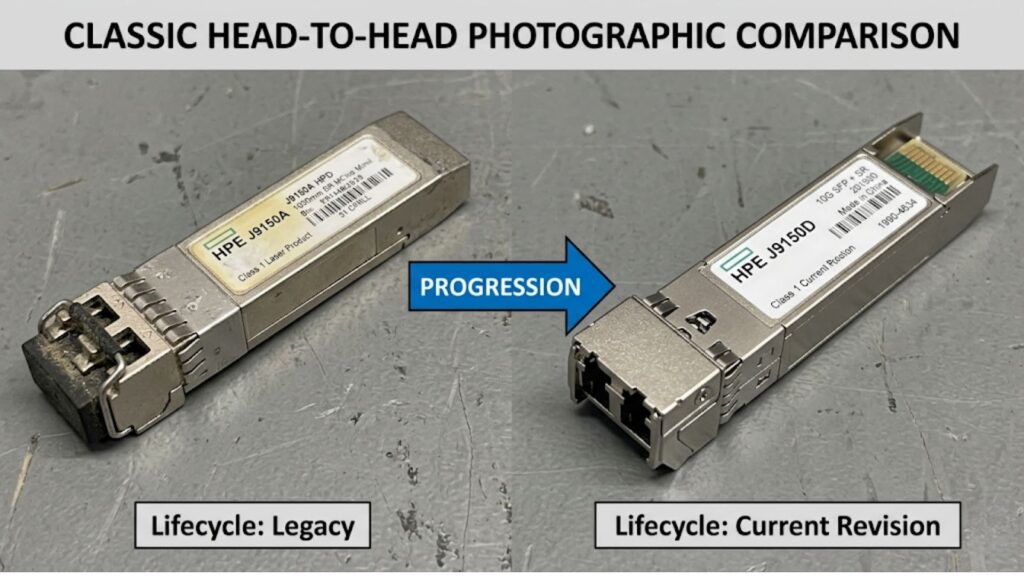
The J9150A is the earlier version of the same SR transceiver.
Shared Optical Specifications and Use Case Overlap
| Feature | J9150D | J9150A |
| Data Rate | 10 Gbps | 10 Gbps |
| Wavelength | 850 nm | 850 nm |
| Connector | LC | LC |
| Fiber Type | MMF | MMF |
Lifecycle and Revision Differences
| Aspect | J9150D | J9150A |
| Status | Current | End-of-sale |
| Coding | Updated | Older |
| Compatibility | New + Legacy | Legacy focused |
“For buyers comparing nearest alternatives, Aruba’s transceiver guide lists the older J9150A as EOS while placing J9150D in the current Aruba 10G SR family, making J9150D the more relevant choice for present-day deployments.”
Which Model Makes More Sense for Current Deployments
The J9150D is the more practical choice due to better compatibility with modern Aruba switches and ongoing support.
Competitor Analysis and Comparison
HPE Aruba J9150D vs Cisco SFP-10G-SR
| Feature | J9150D | Cisco SFP-10G-SR |
| Vendor | Aruba | Cisco |
| Compatibility | Aruba switches | Cisco switches |
| Standard | 10GBASE-SR | 10GBASE-SR |
| Distance | Similar | Similar |
HPE Aruba J9150D vs Aruba-Compatible Third-Party Modules
Third-party modules may offer cost savings but can vary in compatibility and support.
OEM vs Compatible Optics for Enterprise Buyers
| Factor | OEM (J9150D) | Third-Party |
| Compatibility | High | Varies |
| Support | Vendor-backed | Limited |
| Cost | Higher | Lower |
| Risk | Low | Moderate |
Which Option Fits Different Budget and Support Priorities
- OEM optics: Suitable for production-critical environments
- Third-party: Suitable for cost-sensitive deployments
Buying Considerations and ROI Perspective
New vs Refurbished vs Certified Compatible
- New: Full warranty and support
- Refurbished: Lower cost with a limited warranty
- Compatible: Cost-effective alternative
Cost vs Compatibility Trade-Off
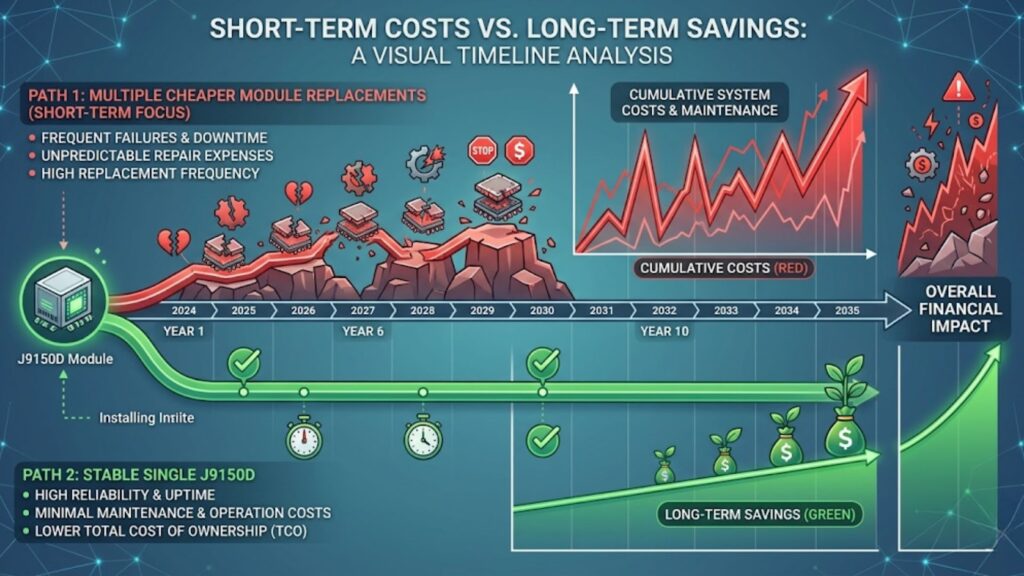
Lower-cost options may introduce compatibility risks, which can increase troubleshooting time and operational overhead.
Warranty, Support, and Sourcing Considerations
Buyers should evaluate:
- Warranty coverage
- Vendor reliability
- Certification standards
When OEM Optics Make More Sense
OEM optics are recommended when:
- Network uptime is critical
- Vendor support is required
- Compliance requirements must be met
Advantages and Limitations
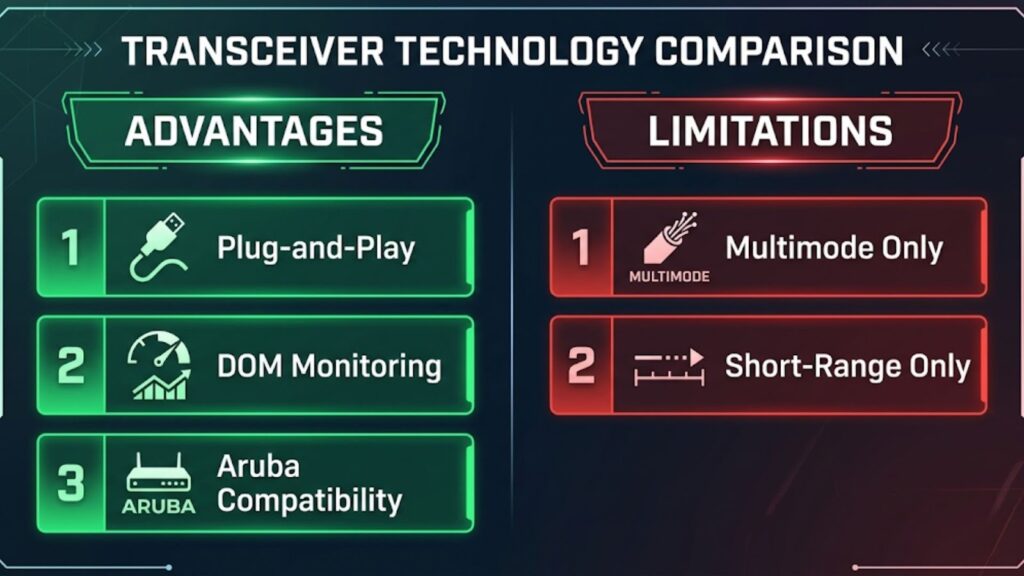
Key Strengths
- Reliable 10G short-range performance
- Broad Aruba compatibility
- Plug-and-play deployment
- DOM/DDM monitoring support
Practical Limitations
- Limited to short-distance applications
- Higher cost than some alternatives
- Not suitable for long-distance links
When J9150D Is Not the Right Optic
It may not be suitable when:
- Long-distance transmission is required
- Single-mode fiber is needed
- WAN connectivity is involved
The module is also designed for energy-efficient and reliable operation, making it suitable for high-density enterprise and data center deployments.
Final Verdict on HPE Aruba J9150D
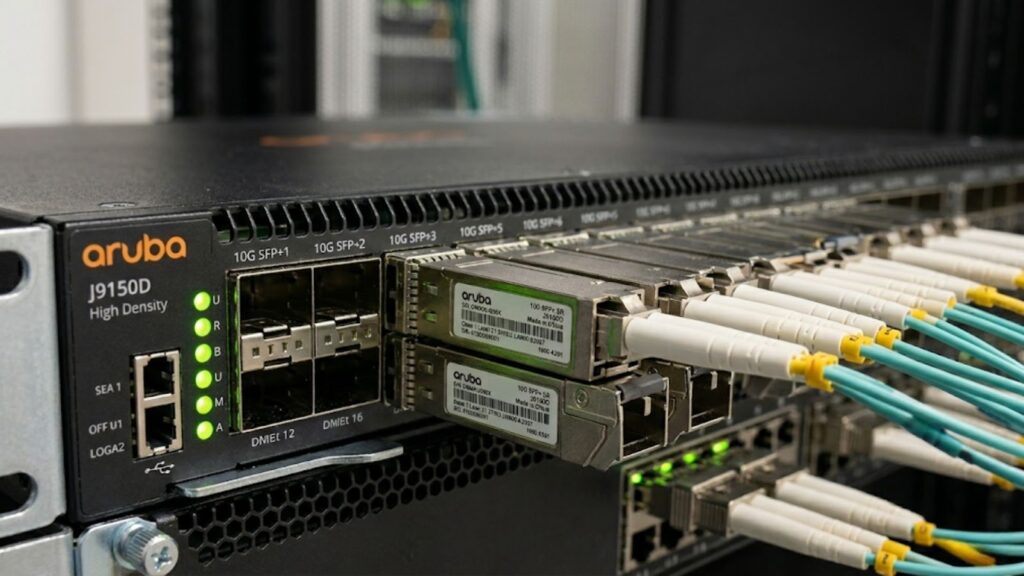
Best Fit for Aruba-Based 10G Networks
The J9150D is a strong fit for Aruba-based deployments where compatibility and stability are priorities.
Best Fit for Short-Range Multimode Deployments
It is well-suited for:
- Data centers
- Enterprise campuses
- High-density networking environments
Overall Recommendation by Buyer Type
- Enterprise IT teams: Reliable and supportable
- Data center operators: Practical for short-range links
- Budget-conscious buyers: Evaluate alternatives carefully
Need the Right Aruba 10G Optic for Your Network?
Looking to deploy reliable 10G fiber connectivity in an Aruba environment? Catalyst Data Solutions Inc. can help evaluate compatibility, sourcing options, and deployment requirements for HPE Aruba J9150D and related networking solutions.
FAQs
What is the maximum distance supported by HPE Aruba J9150D?
Up to 300 meters on OM3 fiber and up to 400 meters on OM4 fiber.
Is HPE Aruba J9150D compatible with Aruba CX switches?
Yes, it is compatible with Aruba CX and other Aruba switch series.
What is the difference between J9150D and J9150A?
J9150D is the newer revision with updated coding and better compatibility.
Does HPE Aruba J9150D support DOM or DDM?
Yes, it supports Digital Optical Monitoring.
Can J9150D work on OM4 fiber?
Yes, it supports extended distances on OM4 fiber.
Is HPE Aruba J9150D hot-swappable?
Yes, it supports hot-swapping for live environments.
Should I choose OEM J9150D or a third-party compatible module?
OEM is recommended for compatibility and support; third-party is suitable for cost savings.
Is HPE Aruba J9150D suitable for data center uplinks?
Yes, it is widely used for short-range data center uplinks.