


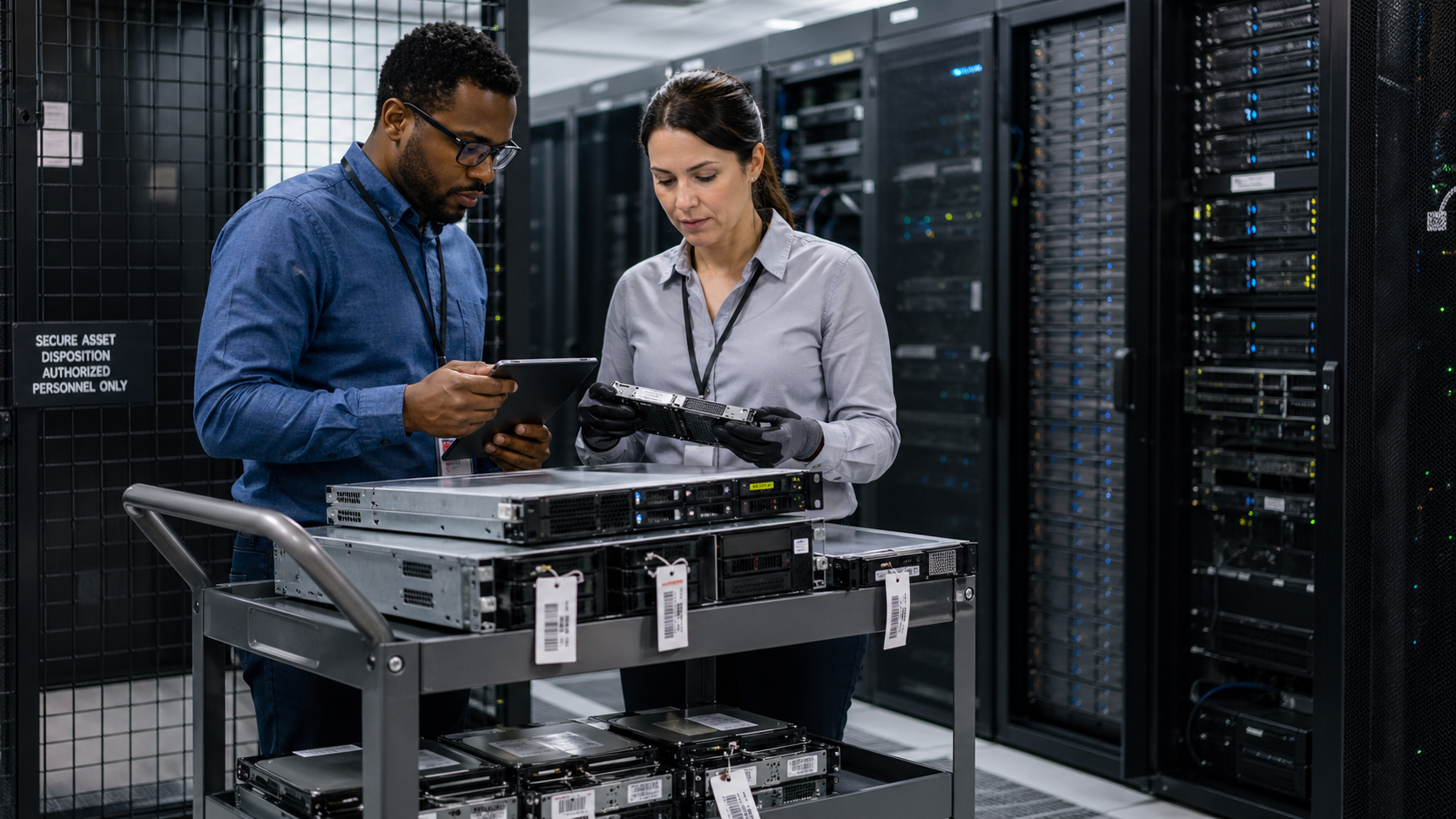
Enterprise IT teams are being asked to do more with less. Hardware costs remain high. Refresh cycles continue. Some product categories still face long lead times, especially when projects depend on specific server, storage, or networking platforms. At the same time, security teams, compliance teams, and sustainability leaders all expect better control over retired equipment.
For enterprises, IT asset disposition should be viewed as part of infrastructure lifecycle management. It affects security, compliance, cost recovery, procurement timing, and future deployment planning. When handled well, it helps organizations retire assets securely, recover value where possible, and make better decisions about what comes next.
What Is IT Asset Disposition and Why Does It Matter for Enterprises?
IT asset disposition, or ITAD, is the structured process of retiring IT hardware at the end of its useful life. That includes identifying assets, maintaining chain of custody, sanitizing or destroying data, evaluating reuse or resale potential, and recycling equipment that no longer has practical value.
For enterprise buyers, the need is not just secure disposal. It is flexibility.
Most organizations want an ITAD process that helps them:
- Reduce data security risk
- Meet internal and external compliance requirements
- Recover value from usable equipment
- Support ESG and waste-reduction goals
- Make cost-conscious decisions during refresh cycles
- Balance new and refurbished replacement options when supply is tight
That last point matters. In real procurement environments, ITAD does not happen in isolation. It often sits next to a migration, data center refresh, lease return, or infrastructure upgrade. In those situations, secure disposition and future sourcing decisions are part of the same business problem.
That is why ITAD works best when tied to broader hardware sourcing and lifecycle planning rather than treated as a one-time disposal event.
What Is the IT Asset Disposition Process?
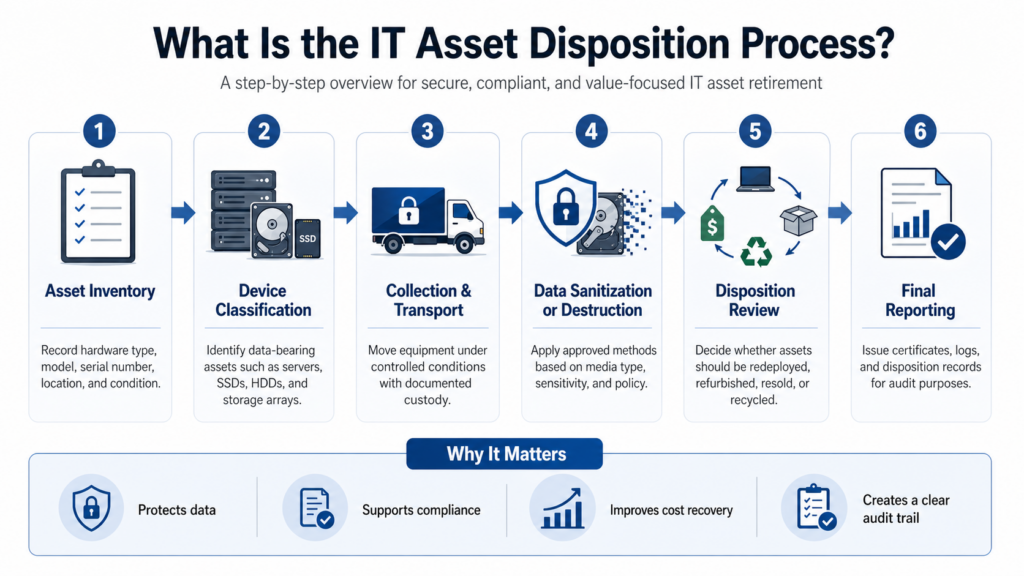
A sound IT asset disposition process should be easy to explain, easy to audit, and practical to execute across multiple teams.
The core process usually includes:
- Asset inventory
Record equipment type, model, serial number, location, and condition. - Device classification
Identify data-bearing devices such as servers, SSDs, HDDs, backup appliances, and storage arrays. - Collection and transport
Move assets under controlled conditions with documented custody. - Data sanitization or destruction
Apply approved methods based on media type, sensitivity, and policy. - Disposition review
Determine whether assets should be redeployed, refurbished, resold, or recycled. - Final reporting
Issue certificates, logs, and disposition records for audit purposes.
| ITAD process stage | Main objective | Enterprise result |
| Asset inventory | Establish control | Accurate asset tracking |
| Device classification | Identify risk | Proper handling of data-bearing equipment |
| Collection and transport | Protect chain of custody | Lower loss and handling risk |
| Sanitization or destruction | Secure data | Reduced breach and compliance exposure |
| Resale or recycling review | Optimize value | Better cost recovery and reuse decisions |
| Reporting | Support governance | Clear audit trail |
A mature process helps enterprises avoid common gaps such as missing serial records, weak pickup documentation, inconsistent wipe procedures, and poor visibility into downstream handling.
What Is the Difference Between ITAD, Recycling, and Resale?
This is one of the most important distinctions in the article because buyers often use these terms interchangeably.
ITAD is the full governance process. Recycling and resale are only two possible outcomes inside that process.
| Term | Meaning | Typical use case |
| IT asset disposition | Full end-of-life control process | Enterprise retirement of IT hardware |
| Recycling | Material recovery for non-usable assets | Obsolete or damaged equipment |
| Resale / remarketing | Sale of usable assets into secondary markets | Hardware with remaining market value |
| Refurbishment | Restoration for continued use | Cost-sensitive expansion or replacement |
| Redeployment | Reuse inside the organization | Labs, backup roles, secondary workloads |
This distinction matters for both cost and strategy.
A server removed from one production role may still be useful in another environment. A network device that no longer fits a primary deployment may still have remarketing value.
Some equipment may be better replaced with a lower-cost refurbished option if new hardware lead times are too long. That is why many enterprises connect ITAD planning with their refurbished process and longer-term infrastructure decisions.
What Security and Compliance Requirements Should an ITAD Program Meet?
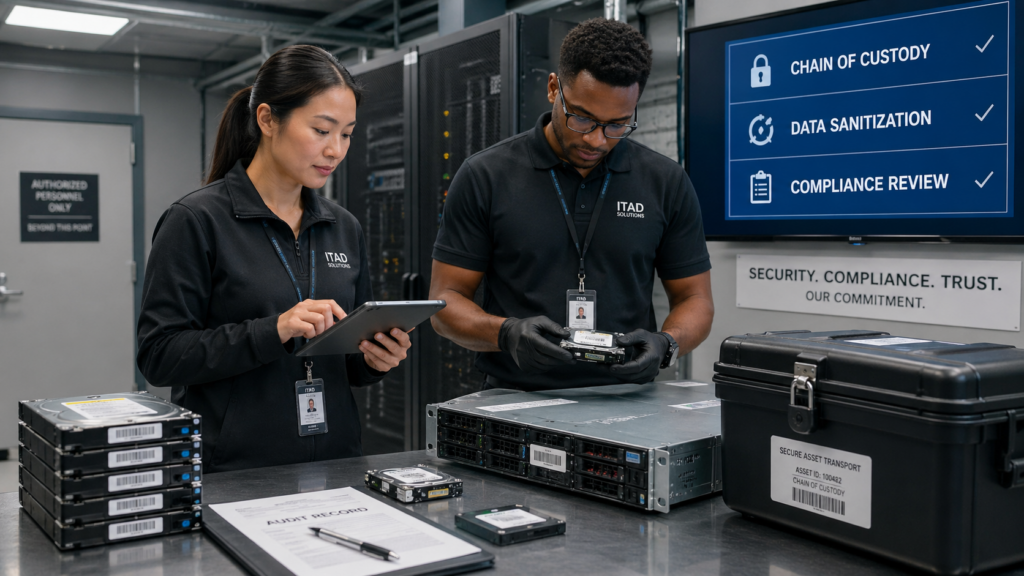
Security and compliance are not side issues in IT asset disposition. They are the reason many enterprise ITAD programs exist in the first place.
When servers, storage systems, laptops, backup devices, or networking appliances leave production, they can still contain sensitive data, regulated information, credentials, and configuration details. If those assets are not handled correctly, the risk does not end when the device is powered down. It simply moves to a different stage of the lifecycle.
A strong ITAD program should meet three requirements at the same time:
- Protect data before assets leave enterprise control
- Maintain clear documentation for audits and internal governance
- Support practical decision-making around reuse, resale, refurbishment, or recycling
That matters even more during refresh cycles, when teams are already dealing with procurement challenges, tight timelines, and replacement planning.
Data Destruction Standards
An ITAD program should use a defined data sanitization standard rather than relying on informal wipe procedures.
For most enterprise environments,NIST SP 800-88 Rev. 2 is the main benchmark for media sanitization. It gives organizations a structured way to decide whether media should be cleared, purged, or physically destroyed based on the type of device, the sensitivity of the data, and the intended next use of the asset.
Some organizations still reference DoD methods in internal documents or procurement language, but the bigger issue is consistency. A secure ITAD process should make it clear:
- which sanitization method applies to each device type
- when physical destruction is required
- how results are documented
- who approves exceptions or special handling cases
This becomes especially important in data center environments, where HDDs, SSDs, backup systems, and storage arrays may still hold recoverable data long after workloads have been migrated.
Security failures at this stage can be expensive. The average cost of a data breach has been reported at $4.88 million, which is why many enterprises treat media sanitization as a governance issue, not just an operational task.
Chain of Custody and Audit Control
Data destruction standards are only one part of the process. An ITAD program also needs a reliable chain of custody.
Chain of custody means every asset is tracked from collection through transport, processing, and final disposition. If an organization cannot show where an asset was, who handled it, and what happened to it at each step, the process is harder to defend during an audit or investigation.
A practical chain-of-custody process should include:
- serial-number tracking
- pickup documentation
- secure packaging and transport
- controlled intake procedures
- processing logs
- final disposition records
This level of control is important because enterprise ITAD often happens during larger refresh projects, lease returns, or consolidation efforts. In those situations, equipment may be moving quickly across teams, sites, or third-party providers. Without clear custody records, the chance of missing assets, undocumented handoffs, or compliance gaps increases.
Compliance Requirements Such as HIPAA and GDPR
A strong ITAD program should also align with the organization’s broader compliance obligations.
That may include requirements tied to:
- HIPAA for protected health information
- GDPR for personal data
- internal retention and destruction policies
- contractual data-handling obligations
- audit and governance requirements
The exact standard depends on the business, but the rule is consistent: if a device contains sensitive or regulated data, the organization is still responsible for how it is handled at end of life.
This is one reason ITAD should not be treated as a simple removal service. It should be connected to security policy, compliance review, infrastructure operations, and lifecycle planning. In many enterprise environments, that also means aligning ITAD with broader security strategy and infrastructure governance.
The compliance case is becoming harder to ignore. As of 2025, data privacy and protection regulations were in place in 144 countries, along with 20 U.S. states, which shows how widely data-handling expectations now apply across global and regional operations.
How Does IT Asset Disposition Work in Data Centers?
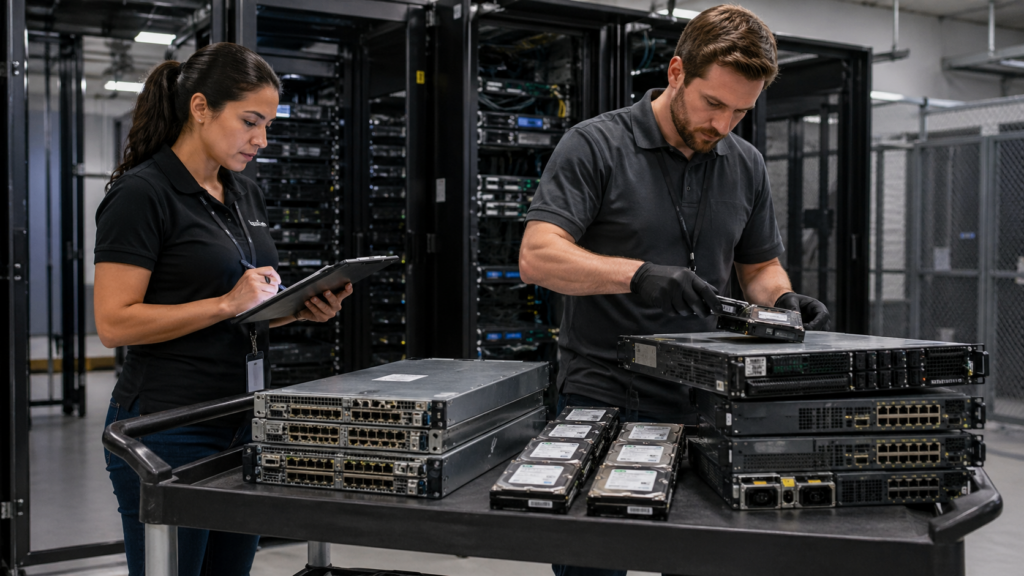
Data center IT asset disposition is more complex than endpoint disposal because the equipment is higher value, more tightly integrated, and more likely to contain sensitive data. It usually happens during a server refresh, storage migration, consolidation project, or facility change, where timing, documentation, and replacement planning all matter.
In practice, data center ITAD starts with controlled decommissioning. Teams first confirm workloads have been migrated, then document serial numbers, rack locations, and asset condition before equipment is removed.
This step is important because retired infrastructure may still have resale value, internal reuse potential, or support a refurbished replacement strategy when budgets are tight or new hardware availability is limited.
Server Decommissioning and Asset Tracking
For servers, the main questions are whether the systems should be redeployed, refurbished, remarketed, or retired. A proper process includes workload validation, asset documentation, serial tracking, and removal planning.
This helps enterprises reduce risk during refresh cycles while also identifying equipment that may still have value for reuse or secondary-market resale.
Storage and HDD or SSD Disposal
For storage, the priority is stronger media control. HDDs, SSDs, backup appliances, and arrays need clear handling rules because they may still hold recoverable data even after they leave production.
In many environments, the choice between sanitization and physical destruction depends on data sensitivity, internal policy, and data security compliance requirements. This is one of the most important parts of data center ITAD because storage devices usually carry the highest data risk.
Networking Equipment Lifecycle and Final Disposition
For networking equipment, the process often includes configuration removal, asset tracking, functional review, and a decision on reuse, resale, or recycling. Switches, routers, and appliances may still have internal or secondary-market value if they are removed properly, wiped, tested, and documented.
A practical data center ITAD program usually covers:
- Server decommissioning and asset tracking
- Storage and HDD or SSD handling
- Data sanitization or physical destruction based on policy
- Chain of custody from rack removal to final disposition
- Testing for reuse, resale, or refurbishment
- Recycling for assets that no longer have value or a safe reuse path
Global e-waste reached 62 million tonnes in 2022, which makes structured reuse, resale, and responsible recycling more important in enterprise IT environments. That is also why many organizations connect ITAD planning with hardware maintenance and broader infrastructure lifecycle decisions rather than treating retirement as a stand-alone task.
When handled well, data center ITAD supports more than secure retirement. It helps enterprises reduce disposal risk, recover value from usable infrastructure, and make better decisions about replacement timing, especially when procurement challenges, lead times, and supply constraints affect the next deployment.
How Do You Choose the Right ITAD Vendor?
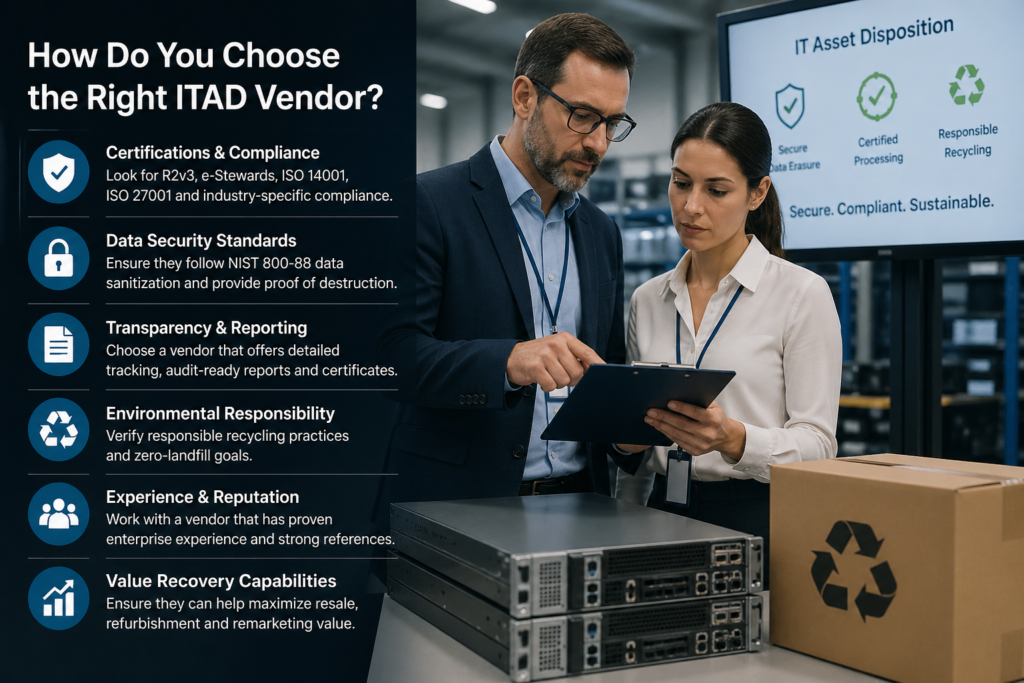
Choosing an ITAD provider should be treated as a business risk decision, not just a logistics purchase.
A strong provider should be able to support:
- Secure data handling
- Documented chain of custody
- Data center as well as endpoint equipment
- Practical resale or buyback options
- Responsible recycling
- Clear reporting for audits and governance
Enterprises should also look for a provider that understands procurement pressure, hardware availability issues, and lifecycle tradeoffs. That matters because many projects involve both retiring old equipment and planning the next environment at the same time.
What Should Be Included in an Enterprise ITAD Checklist?
An enterprise ITAD checklist helps buyers compare providers and avoid blind spots.
| Checklist area | What to confirm | Why it matters |
| Asset tracking | Serial-level records and custody logs | Supports control and audit readiness |
| Data sanitization | NIST-aligned methods and documentation | Reduces security risk |
| Chain of custody | Secure handling from pickup to final disposition | Limits loss and exposure |
| Data center capability | Servers, storage, and network gear experience | Supports complex environments |
| Value recovery | Redeployment, resale, or buyback options | Improves cost efficiency |
| Reporting | Certificates and final records | Helps with compliance and governance |
| Downstream handling | Responsible recycling practices | Supports ESG and risk management |
A practical enterprise checklist should also ask:
- Can the provider support multi-site or large refresh projects?
- Can they separate assets by reuse, resale, refurbishment, and recycling path?
- Can they support projects where new hardware lead times affect replacement timing?
- Do they understand how refurbished equipment fits into a broader lifecycle strategy?
What Are the Risks of Improper IT Disposal?
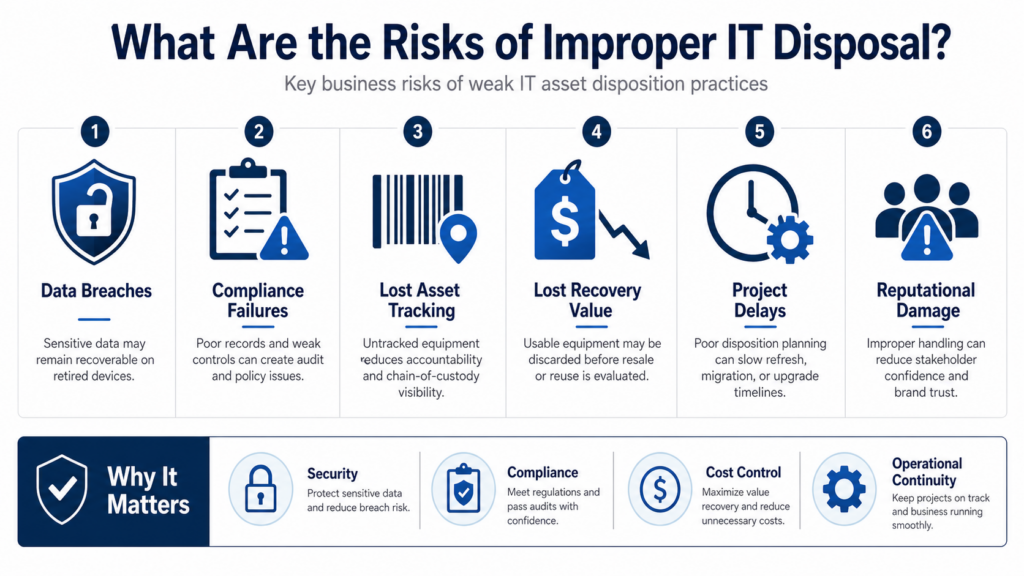
Improper IT disposal creates more than a security problem. It can affect compliance, operations, cost recovery, and brand trust at the same time.
For enterprise teams, the risk usually appears when retired equipment is moved too quickly, tracked poorly, or handed off without clear controls. What looks like a disposal task can quickly become a business issue.
Security and Compliance Risks
The first risk is data exposure. Servers, laptops, storage arrays, SSDs, HDDs, backup devices, and network appliances may still contain sensitive information even after they leave production.
If those assets are not sanitized, destroyed, or documented correctly, enterprises may face:
- Data breaches
- Compliance violations
- Weak audit trails
- Lost chain-of-custody records
- Regulatory review or internal escalation
This risk becomes more serious in environments that handle customer data, healthcare records, financial information, or internal credentials.
Common failure points include:
- Incomplete data wiping
- Untracked asset movement
- Missing serial-number records
- Poor handoff between teams or vendors
- No proof of final disposition
Operational and Financial Risks
Improper disposal also creates operational and financial problems. When assets are not reviewed carefully, organizations can lose resale value, miss reuse opportunities, or delay refresh projects.
This often affects teams already dealing with procurement challenges, long lead times, and budget constraints.
Common business impacts include:
- Lost recovery value from usable assets
- Delays in upgrades or data center refreshes
- Unplanned replacement costs
- Poor visibility into what was retired
- Reduced flexibility for reuse or refurbishment
- Reputational damage from poor handling practices
In many cases, equipment that is scrapped too early could have been redeployed, remarketed, or evaluated through a controlled refurbished process.
| Risk area | What can go wrong | Business impact |
| Data security | Drives or systems leave without proper sanitization | Data exposure and internal escalation |
| Compliance | Missing records or weak controls | Audit issues and policy violations |
| Asset tracking | Equipment cannot be traced | Loss of accountability |
| Value recovery | Usable hardware is discarded too quickly | Lower cost recovery |
| Operations | Disposition is poorly coordinated with refresh timing | Project delays and replacement gaps |
| Reputation | Disposal practices do not meet expectations | Reduced trust with stakeholders |
A stronger ITAD process reduces these risks by putting control around each step of retirement. That includes tracking assets, applying the right sanitization method, documenting custody, and reviewing whether equipment should be reused, resold, refurbished, or recycled.
The goal is not only to avoid loss. It is to make better end-of-life decisions that support security, cost control, and infrastructure planning.
Need a More Practical Plan for IT Asset Disposition?
Catalyst Data Solutions works with leading OEMs such as Cisco, Arista, HPE, and NVIDIA to help organizations make practical infrastructure decisions across the full lifecycle. As a vendor-agnostic partner, Catalyst supports secure ITAD programs, new deployments, and a balanced mix of new and refurbished equipment based on each environment’s needs.
Since 2017, Catalyst has supported enterprise buyers through channel relationships, OEM access, distribution reach, and real-world experience across procurement, maintenance, and lifecycle planning. The focus is on helping organizations choose the right path based on performance, budget, availability, and timeline.
FAQs
Q: What is ITAD and why is it important for enterprises?
IT Asset Disposition (ITAD) is the process of securely retiring, sanitizing, reselling, refurbishing, or recycling IT equipment at the end of its lifecycle. It is important for enterprises because improper disposal can create data security risk, compliance exposure, and unnecessary financial loss.
ITAD is often part of a larger infrastructure decision, especially during a 3–5 year data center refresh cycle. In real-world environments, enterprises are also managing procurement challenges, budget constraints, and availability issues at the same time.
A structured ITAD program helps organizations reduce risk, recover value from usable equipment, and make more practical decisions about what should be redeployed, resold, refurbished, or retired.
Q: How does ITAD improve data security?
ITAD improves data security by ensuring that data-bearing devices are properly wiped, destroyed, or sanitized before they leave enterprise control. This is typically done using recognized standards such as NIST 800-88, while some organizations still reference DoD methods in policy or procurement documents.
This matters because storage devices, servers, and backup systems can still hold sensitive data even after they are removed from production. Without a documented ITAD process, that data may remain recoverable.
In practice, strong ITAD programs also reduce operational risk during refresh projects, when teams are already dealing with lead times, asset availability issues, and pressure to move equipment out of the environment quickly.
Q: What happens to old servers after a data center upgrade?
After a data center upgrade, old servers are typically redeployed, resold, refurbished, or securely recycled depending on condition, workload fit, and residual value. Most enterprises do not send every retired server directly to scrap.
Typical paths include:
- Redeployment for secondary workloads or lab environments
- Resale or refurbishment for continued use
- Secure recycling or disposal for obsolete or non-usable systems
This decision is often influenced by budget constraints, replacement lead times, and current hardware availability. Refurbished infrastructure is often chosen when organizations need to extend value or bridge delays, and it can reduce upfront costs by 30–70% compared to new hardware.
Q: What role does Catalyst play in IT hardware lifecycle management?
Catalyst is often involved across multiple stages of the hardware lifecycle, including procurement, upgrades, and refresh planning. This includes helping organizations evaluate when to replace, reuse, or redeploy equipment, as well as supporting decisions around cost optimization and infrastructure scalability. This lifecycle perspective is especially relevant in environments with frequent refresh cycles or evolving performance requirements.
Q: Can companies recover value from decommissioned IT hardware?
Yes, many organizations recover 10–40% of original hardware value through resale, depending on age, condition, and market demand. Servers, networking gear, and GPUs often retain value in secondary markets, especially within 3–5 year lifecycle windows.
Q: Does Catalyst Data Solutions buy back used IT equipment?
Yes, Catalyst supports ITAD and buyback programs where organizations can sell decommissioned hardware. This helps offset upgrade costs while ensuring equipment is properly handled, resold, or recycled through controlled processes.
Q: What is the safest way to dispose of enterprise IT hardware?
The safest approach includes:
- Certified data destruction (NIST standards)
- Asset tracking and chain of custody
- Proper recycling or resale channels
Working with an experienced ITAD partner reduces compliance and data risk.
Q: How can organizations start an ITAD or buyback process?
Organizations typically begin by:
- Auditing existing hardware
- Identifying resale or disposal value
- Requesting a quote from an ITAD partner