


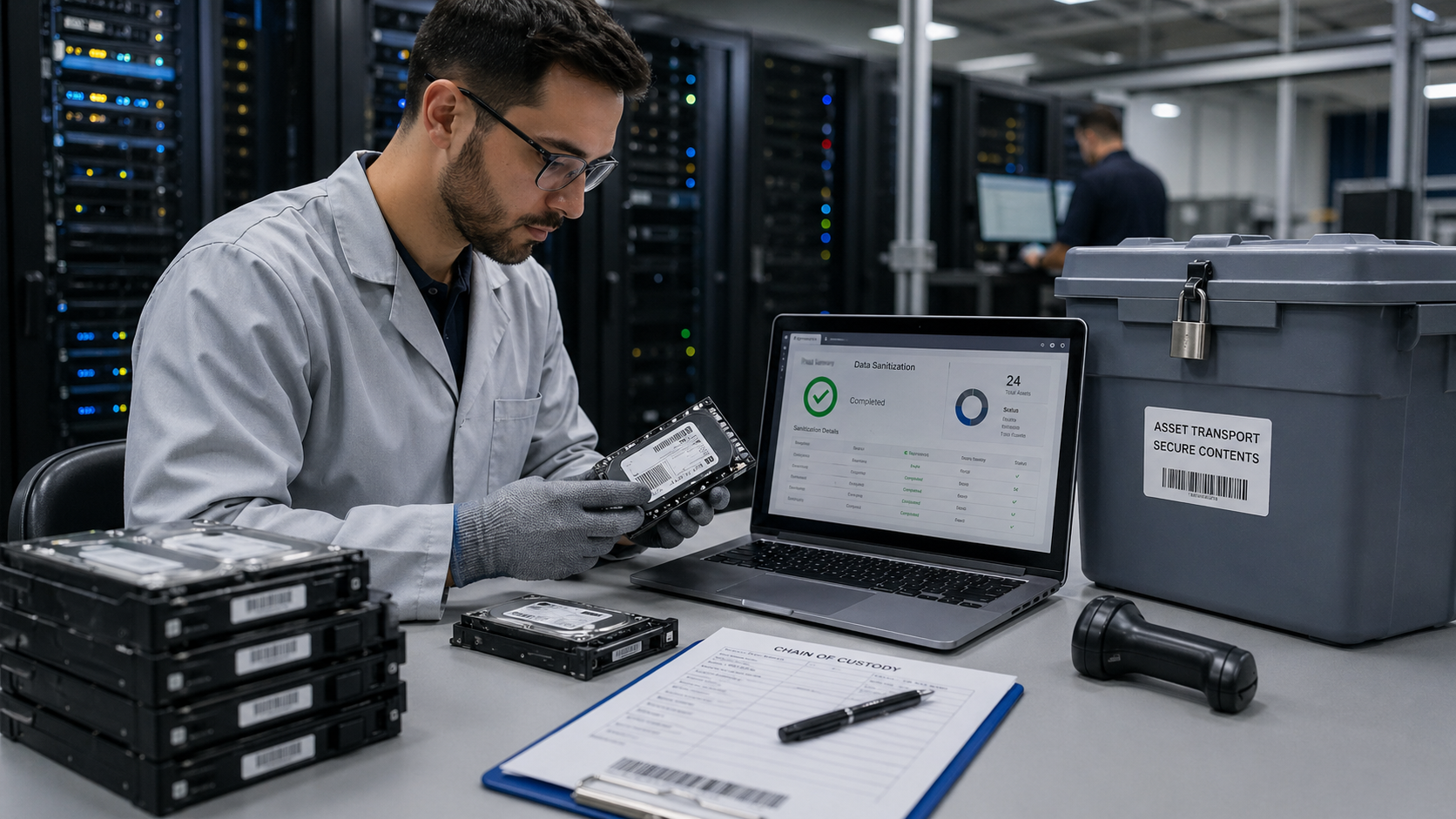
Enterprise hardware does not stop creating risk when it leaves the rack. Servers, laptops, storage arrays, networking devices, and drives may still contain sensitive business data long after they are removed from production. That is why ITAD data security compliance matters.
ITAD data security compliance is the process of retiring IT assets in a way that protects data, follows regulatory requirements, proves chain of custody, and supports secure reuse, resale, or recycling.
For many organizations, the challenge is bigger than disposal. IT teams are under pressure to reduce costs, manage hardware shortages, shorten lead times, support refresh cycles, and avoid unnecessary e-waste. A compliant IT asset disposition program helps balance those needs without exposing the business to data loss or audit risk.
Organizations that manage infrastructure across data centers, branch offices, hybrid cloud environments, and distributed workforces need more than a recycling vendor. They need a lifecycle process that connects procurement, deployment, refresh planning, secure data destruction, and asset recovery.
Why ITAD Data Security Compliance Matters

When equipment is decommissioned, the data risk does not disappear. A server pulled from a rack, a drive removed from a storage system, or a laptop returned after a refresh may still contain customer records, credentials, financial data, intellectual property, or regulated information.
This is where ITAD becomes part of a broader security and compliance strategy. Secure disposition should align with internal controls, cyber policies, and infrastructure lifecycle planning. Companies that already follow a security compliance checklist should treat asset disposal as another control point, not an afterthought.
Poor ITAD processes can create risk in several ways:
- Data remains recoverable on retired drives
- Assets are lost during transport or staging
- Chain-of-custody records are incomplete
- Disposal methods do not meet regulatory expectations
- Equipment is resold without verified data sanitization
- Recycling partners cannot prove final handling
The financial impact can be serious. IBM’s 2025 report found that the global average cost of a data breach was USD 4.44 million. In the United States, the average cost reached USD 10.22 million. These figures show why secure handling of retired assets should be treated as a business risk, not only an IT task.
| ITAD Risk Area | What Can Go Wrong | Compliance Impact |
| Data-bearing devices | Drives are wiped incorrectly or not wiped at all | Data breach, privacy violation, audit failure |
| Chain of custody | Assets are moved without tracking | Loss of accountability |
| Vendor handling | Third party lacks secure controls | Increased legal and operational risk |
| Documentation | Certificates or reports are missing | Weak audit evidence |
| Resale or recycling | Assets enter secondary markets too early | Exposure of sensitive data |
Key Data Security Risks in IT Asset Disposal
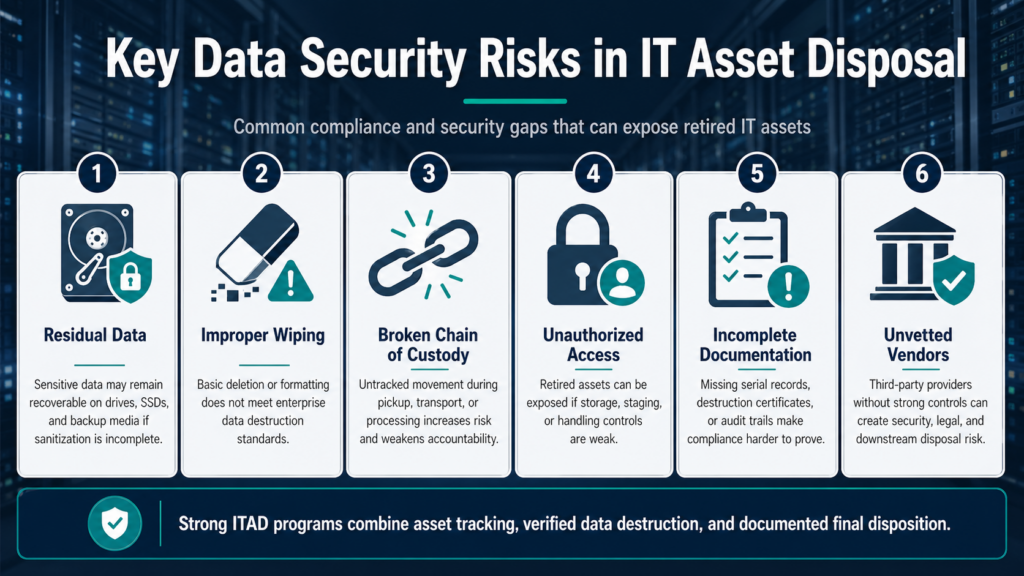
The biggest ITAD risks usually happen during transitions. These include equipment refreshes, office closures, data center migrations, cloud shifts, and hardware upgrades.
Common data security risks include:
- Residual data on drives: Files, databases, logs, backups, and cached credentials can remain recoverable.
- Improper wiping tools: Basic deletion or formatting does not meet enterprise sanitization requirements.
- Untracked assets: Devices can be misplaced during pickup, transport, storage, or processing.
- Mixed asset handling: Data-bearing and non-data-bearing equipment may be handled together without proper controls.
- Weak vendor oversight: A vendor may subcontract work without clear security controls.
- Incomplete audit trails: Missing serial numbers, timestamps, or destruction records make compliance harder to prove.
These risks increase when organizations are moving quickly. Long OEM lead times, budget limits, and supply chain disruptions often push teams to refresh, redeploy, or resell equipment faster. A structured ITAD process keeps speed from creating security gaps.
For companies building a broader enterprise security plan, ITAD should connect with endpoint protection, identity controls, asset management, and incident response planning.
Core ITAD Data Security Compliance Standards
ITAD compliance is not based on one single rule. It often involves a mix of data privacy laws, industry regulations, internal security policies, environmental requirements, and recognized data destruction standards.
The right framework depends on the type of data, the industry, the asset category, and where the organization operates.
| Standard or Requirement | What It Covers | Why It Matters in ITAD |
| NIST SP 800-88 | Media sanitization guidance | Defines clear methods for clearing, purging, and destroying data |
| DoD 5220.22-M | Legacy overwrite method | Still referenced by some buyers, though NIST is more current |
| GDPR | Personal data protection | Requires secure handling of personal data during disposal |
| HIPAA | Protected health information | Applies to healthcare data on retired devices |
| GLBA | Financial customer information | Relevant for banks, lenders, and financial service firms |
| SOC 2 controls | Security and process assurance | Supports vendor trust and audit readiness |
| R2v3 / e-Stewards | Responsible electronics recycling | Helps prove environmental and downstream handling controls |
NIST vs DoD Data Destruction Standards
Two standards are often discussed in ITAD: NIST SP 800-88 and DoD 5220.22-M.
NIST SP 800-88 is widely used for modern media sanitization. It defines three main outcomes:
- Clear: Logical methods such as overwriting to protect against basic recovery.
- Purge: Stronger methods such as cryptographic erase or block erase.
- Destroy: Physical destruction such as shredding, crushing, or disintegration.
DoD 5220.22-M is an older overwrite method often associated with multi-pass wiping. Some organizations still request it, but many compliance programs now prefer NIST-based sanitization because it better reflects modern storage technology.
A compliant ITAD program should match the method to the asset type. For example, SSDs, HDDs, tapes, and encrypted devices may require different handling. The process should also produce clear documentation.
IT Asset Lifecycle & Compliance Workflow
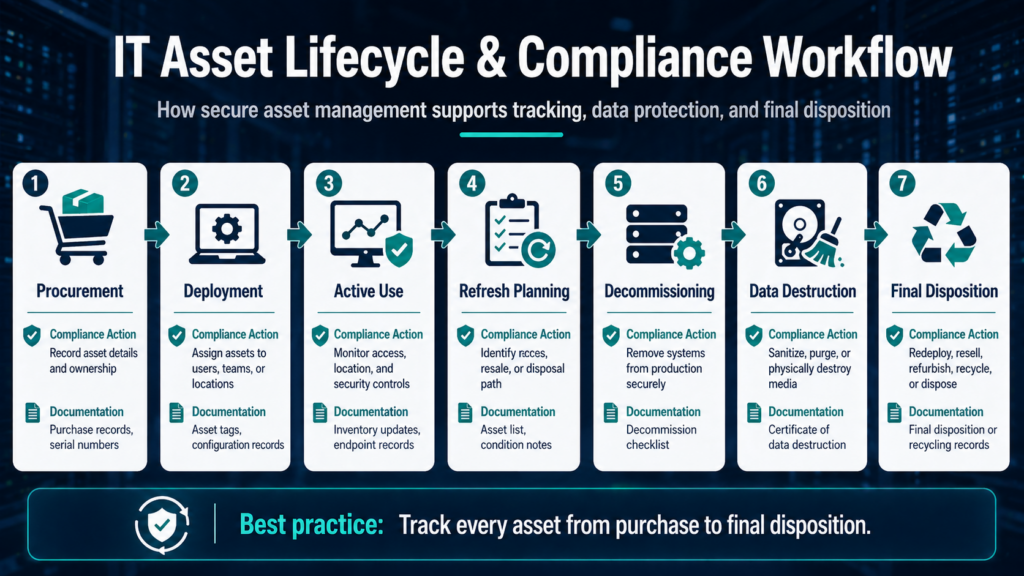
ITAD data security compliance works best when it is built into the full asset lifecycle. Waiting until equipment is already retired creates gaps in tracking, ownership, and documentation.
A strong lifecycle workflow connects procurement, deployment, refresh planning, decommissioning, sanitization, resale, reuse, and recycling.
IBM’s 2025 Cost of a Data Breach Report found that the global average cost of a data breach reached USD 4.44 million, which makes verified tracking and destruction records important for compliance and risk reduction.
| Lifecycle Stage | Compliance Action | Documentation Needed |
| Procurement | Record asset details and ownership | Purchase records, serial numbers |
| Deployment | Assign assets to users, teams, or locations | Asset tags, configuration records |
| Active use | Monitor security and access controls | Inventory updates, endpoint records |
| Refresh planning | Identify reuse, resale, or disposal path | Asset list, condition notes |
| Decommissioning | Remove systems from production securely | Decommission checklist |
| Data destruction | Sanitize or destroy media | Certificate of data destruction |
| Remarketing or recycling | Resell, reuse, or recycle responsibly | Settlement report, recycling records |
This workflow also supports cost-conscious decision-making. Not every asset should be scrapped. Some equipment can be redeployed internally.
Some can be refurbished and resold. Some should be destroyed or recycled. The key is making those decisions after data security is complete.
This lifecycle view also supports zero trust controls because retired devices should not retain trusted access, credentials, certificates, or unmanaged data.
How to Choose a Compliant ITAD Vendor
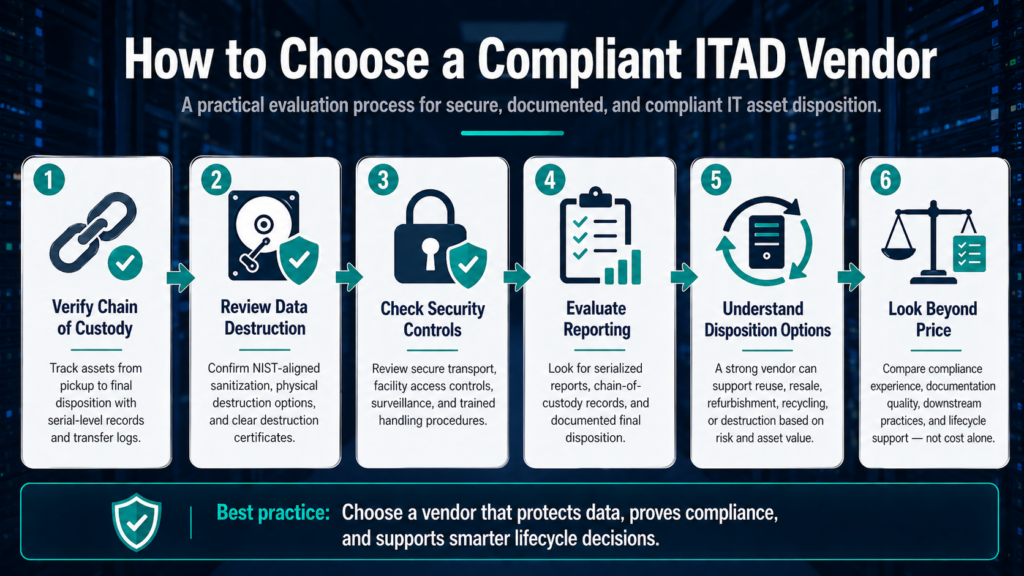
Choosing an ITAD vendor is not just a purchasing decision. It is a risk management decision. The provider may handle retired assets that still contain sensitive data, regulated information, licensed software, or resale value.
For organizations formalizing secure retirement workflows, a mature ITAD services partner can help connect disposal, reporting, and asset recovery into one controlled process.
1. Verify Chain-of-Custody Tracking
A compliant ITAD vendor should track assets from pickup to final disposition. Look for serial-number-level records, pickup logs, transfer records, and final asset status reports.
This helps IT, compliance, and procurement teams prove where each asset went and how it was handled.
2. Review Data Destruction Methods
The vendor should support NIST-aligned data sanitization and physical destruction when required.
Certificates of data destruction should clearly show the asset, method used, date, and result. This is especially important for servers, drives, storage arrays, laptops, and backup media.
3. Check Security Controls
Review how the vendor protects equipment during transport, storage, and processing. Secure logistics, facility access controls, surveillance, restricted processing areas, and trained staff all reduce the risk of asset loss or data exposure.
These controls should align with the organization’s broader enterprise security planning, especially when retired assets contain regulated or high-value data.
4. Evaluate Reporting Quality
Strong reporting makes compliance easier to defend. The vendor should provide serialized asset reports, chain-of-custody records, destruction certificates, recycling records, and resale or settlement reports when applicable.
5. Understand Disposition Options
Not every asset should be handled the same way. Some equipment should be destroyed, while other assets may be reused, refurbished, resold, or recycled. A strong ITAD partner helps classify assets by data risk, condition, market value, and lifecycle stage.
6. Look Beyond Price
Low-cost disposal can create higher risk if tracking, security, or documentation is weak.
Compare vendors based on compliance experience, data center and endpoint expertise, downstream recycling practices, insurance coverage, and ability to support secure lifecycle decisions.
Common ITAD Compliance Mistakes

Most ITAD compliance issues happen when asset retirement is rushed, poorly documented, or treated as basic equipment removal. These are the most common mistakes to avoid.
1. Starting ITAD Planning Too Late
Many organizations wait until old assets are already removed or stored. This creates pressure to dispose of equipment quickly.
ITAD planning should begin during the refresh cycle, so teams can identify data-bearing assets, resale value, and destruction requirements early.
2. Using One Process for Every Asset
Different assets carry different risks. A laptop, loose drive, storage array, and switch should not always follow the same disposal path.
Classify assets by data sensitivity, condition, age, and reuse potential before deciding whether to wipe, destroy, resell, redeploy, or recycle them.
3. Relying on Basic Deletion or Factory Reset
Deleting files or resetting a device does not prove secure data removal. Data may still be recoverable.
Use approved methods such as NIST-aligned wiping, cryptographic erase, or physical destruction for data-bearing assets.
4. Missing Chain-of-Custody Records
If assets are not tracked after pickup, accountability becomes weak. This creates audit and security risk.
Each asset should have serialized tracking from pickup through final disposition, including transfer records and processing status.
5. Accepting Weak Vendor Documentation
Vague certificates or summary reports may not satisfy audit requirements.
Documentation should include serial numbers, destruction method, processing date, final disposition, and recycling or resale records when applicable.
6. Prioritizing Resale Before Security
Recovering value from retired hardware is useful, but data security must come first.
Need Help Making ITAD Compliance Practical?
Catalyst Data Solutions works closely with leading OEMs like Cisco, Arista, HPE, and NVIDIA to help organizations source the right infrastructure for their needs. As a vendor-agnostic partner, Catalyst supports practical lifecycle decisions across new hardware, refurbished options, hard-to-find equipment, and retired asset recovery.
For teams managing upgrades, data center refreshes, or secure disposal projects, Catalyst helps align ITAD with security, budget, availability, and compliance goals. Catalyst’s ITAD service model can support compliant asset recovery, secure handling, and better lifecycle planning.
FAQs
1. What should I look for in a compliant ITAD partner?
Look for an ITAD partner that provides secure chain-of-custody tracking, NIST-aligned data destruction, serialized reporting, and clear final disposition records. The provider should understand both data security and asset recovery, especially for servers, storage, networking equipment, and endpoint devices.
2. How does ITAD improve data security?
ITAD improves data security by ensuring retired assets are properly tracked, sanitized, destroyed, or recycled through a controlled process. This reduces the risk of sensitive data remaining on drives, laptops, storage arrays, or other data-bearing equipment after removal from production.
3. What is the safest way to dispose of enterprise hardware?
The safest approach is to classify assets by data sensitivity, then use verified wiping, cryptographic erase, or physical destruction where required. A compliant process should also include chain-of-custody records, certificates of data destruction, and responsible recycling or resale documentation.
4. What happens to old servers after a data center upgrade?
After a data center upgrade, old servers are usually redeployed, refurbished, resold, recycled, or securely destroyed. The right path depends on data sensitivity, hardware condition, resale value, and whether the equipment can still support secondary workloads.
5. What role does Catalyst Data Solutions play in ITAD and hardware lifecycle management?
Catalyst Data Solutions supports organizations across procurement, refresh planning, asset recovery, and IT asset disposition. This lifecycle approach helps teams decide which assets should be reused, resold, refurbished, recycled, or securely destroyed while keeping data security, compliance, budget, and infrastructure needs aligned.
6. Does Catalyst Data Solutions support secure ITAD and buyback programs?
Yes, Catalyst Data Solutions supports ITAD and buyback programs for organizations retiring servers, storage, networking equipment, GPUs, and other enterprise hardware. This helps offset upgrade costs while ensuring retired assets are handled through controlled processes for secure data removal, resale, recycling, or final disposition.