



Enterprise IT teams are under pressure to do more with tighter budgets, shorter timelines, and less predictable hardware availability. Server refresh projects that once followed a clear plan can now face higher costs, delayed shipments, and limited access to the right configurations.
The challenge is not only finding servers. It is finding reliable infrastructure that fits the workload, budget, and deployment schedule without adding supply risk. A stronger refurbished devices supply chain gives enterprise buyers another path forward.
When servers are properly sourced, tested, and configured, refurbished hardware can support upgrades, expansion, backup, lab, hybrid cloud, and short-term capacity needs with more flexibility and better lifecycle control.
What Is the Current Market Overview for Refurbished Server Buyers?
The server market is expanding fast, but growth is not evenly felt by every buyer. IDC reported that worldwide server market spending grew 52.4% year over year in Q4 2025, while server unit shipments grew 10.3%. AI infrastructure demand was a major driver of this growth.
This matters because fast spending growth can create pressure on pricing, stock, and delivery times. A buyer may have budget approval but still struggle to get the right server model, GPU configuration, memory, or storage on time.
Enterprise buyers often face these issues:
- New server lead times that do not match project dates
- Higher prices for GPUs, memory, storage, and complete systems
- Limited availability of specific server generations
- Budget limits during refresh cycles
- Internal pressure to reduce e-waste
- Difficulty matching new hardware to older environments
Refurbished servers help address some of these issues. They can provide faster access to tested equipment, support existing platforms, and reduce capital cost when the latest generation is not required.
A strong sourcing plan should consider refurbished server options early in the buying process, not only after new equipment becomes delayed.
| Market Factor | What It Means for Buyers | How Refurbished Servers Help |
| AI server demand | More pressure on GPUs, memory, and power-dense systems | Previous-generation systems may support test, lab, or smaller AI workloads |
| Long lead times | Projects can miss deadlines | Ready-to-ship inventory can reduce delay |
| Budget pressure | Teams need lower-cost infrastructure | Refurbished servers can reduce upfront cost |
| Refresh cycles | Older systems leave production | Usable servers can enter the secondary market |
| Supply uncertainty | Buyers need backup sourcing paths | Multi-channel sourcing improves flexibility |
How Do Lifecycle and Upgrade Cycles Shape Refurbished Server Supply?
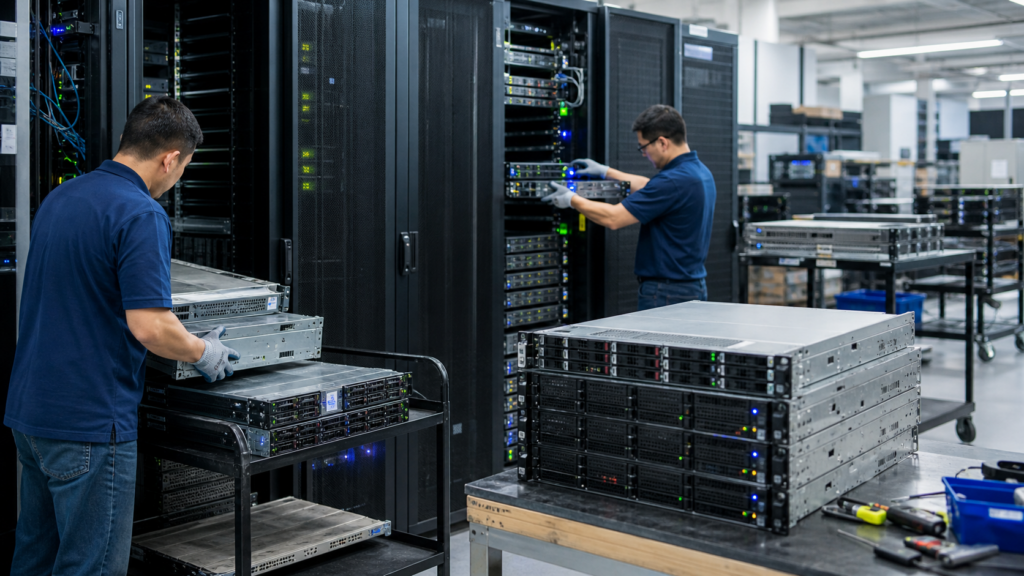
Most enterprise servers move through planned refresh cycles. Many organizations replace or upgrade systems every 3–5 years, depending on performance needs, warranty status, workload growth, and budget.
When servers leave one environment, they do not always lose value. A system that no longer fits a high-demand production workload may still work well for backup, testing, virtualization, disaster recovery, or edge use.
Why Enterprise Refresh Cycles Create Supply
Refurbished supply often starts with enterprise upgrades. Data centers, cloud providers, financial firms, healthcare groups, universities, and large companies remove equipment when business needs change.
Servers may leave production because:
- The company needs newer CPU generations
- AI workloads require GPU-heavy systems
- Warranty coverage has ended
- Memory or storage needs have changed
- Some workloads moved to cloud
- Power and density targets changed
- A data center was consolidated
This creates a useful link between ITAD, resale, and procurement. One company’s upgrade can become another company’s cost-saving supply source.
The market for servers after upgrades depends on timing, system condition, configuration, and demand for that generation.
Buyers should not assume older means unusable. The better question is whether the server fits the workload, lifecycle, support plan, and deployment timeline.
What Is the Secondary Market for IT Equipment?
The secondary market for IT equipment includes hardware sold after its first use. It covers refurbished servers, networking equipment, storage systems, GPUs, drives, memory, power supplies, and other enterprise parts.
This market exists because enterprise hardware often keeps value after its first deployment. A server may no longer meet one company’s needs but still offer strong performance for another organization.
The secondary market helps buyers who need:
- Faster access to hardware
- Lower capital cost
- Replacement parts for existing systems
- Support for older platforms
- Expansion without redesign
- Backup or non-critical infrastructure
- Hardware during OEM delays
The secondary market also supports circular IT goals. Reusing working servers can reduce e-waste and extend the life of materials already produced.
Still, not all secondary market equipment is equal. Enterprise buyers should avoid unknown sellers when risk is high. They should work with suppliers that can explain sourcing, testing, configuration, and warranty terms.
A strong supplier can explain how hardware is sourced and why some systems are better suited for enterprise use than others.
How Does the Global IT Hardware Supply Chain Affect Refurbished Servers?

The global IT hardware supply chain affects both new and refurbished markets. Servers depend on CPUs, GPUs, DRAM, NAND, storage controllers, network cards, power supplies, chassis, rails, and other parts.
When demand rises in one area, it can affect many buyers. AI growth is a clear example. Strong demand for accelerated servers can increase pressure on GPUs, memory, storage, and power-dense infrastructure. IDC also reported strong 2025 server revenue growth driven by AI infrastructure demand.
Supply chain visibility is also a concern. Uptime Institute found that 36% of data center industry respondents said they do not have adequate visibility into supply chain information from key data center equipment vendors.
That lack of visibility makes planning harder. Buyers may not know whether a delay is short-term, regional, component-based, or tied to deeper supply limits.
Why Supply Visibility Matters
Supply visibility helps buyers plan around risk. Without it, teams may approve projects without knowing whether hardware can arrive on time.
Poor visibility can affect:
- Deployment schedules
- Budget timing
- Data center capacity plans
- Spare parts planning
- Vendor evaluation
- Risk management
This is where refurbished sourcing can help. It gives buyers another path when new equipment is delayed or limited.
A balanced sourcing model may include OEM channels, distribution, available refurbished systems, and compatible alternatives. This does not replace new hardware. It gives buyers more options.
What Is the Refurbished Server Supply Chain Breakdown?
A reliable refurbished server supply chain should be structured and clear. It should not feel informal or uncertain.
Buyers need to know how equipment was sourced, tested, configured, packed, and supported. This is especially important when servers will support business workloads.
| Supply Chain Stage | What Happens | Why It Matters |
| Source identification | Servers come from refreshes, ITAD programs, lease returns, or data center exits | Helps confirm the quality of supply |
| Asset intake | Model, serial number, condition, and specs are recorded | Reduces errors in inventory and quotes |
| Data control | Drives are wiped, removed, replaced, or destroyed | Reduces security and compliance risk |
| Hardware inspection | Components are checked for damage or missing parts | Confirms physical condition |
| Testing | CPU, memory, storage, power, fans, ports, and firmware are checked | Improves reliability before shipment |
| Repair or upgrade | Weak or failed parts are replaced | Improves deployment readiness |
| Configuration | Systems are built to buyer needs | Supports workload fit |
| Warranty and shipment | Equipment is packed and supported after sale | Reduces delivery and support risk |
A documented refurbishment workflow helps buyers understand what happens before hardware reaches their site.
A good supplier should be able to answer basic questions without delay. Where did the server come from? What was tested? What parts were replaced? What warranty applies? Can the system be configured before shipment?
These questions help separate enterprise-ready refurbished servers from basic used equipment.
How Should Buyers Evaluate Quality, Certification, and Risk Factors?
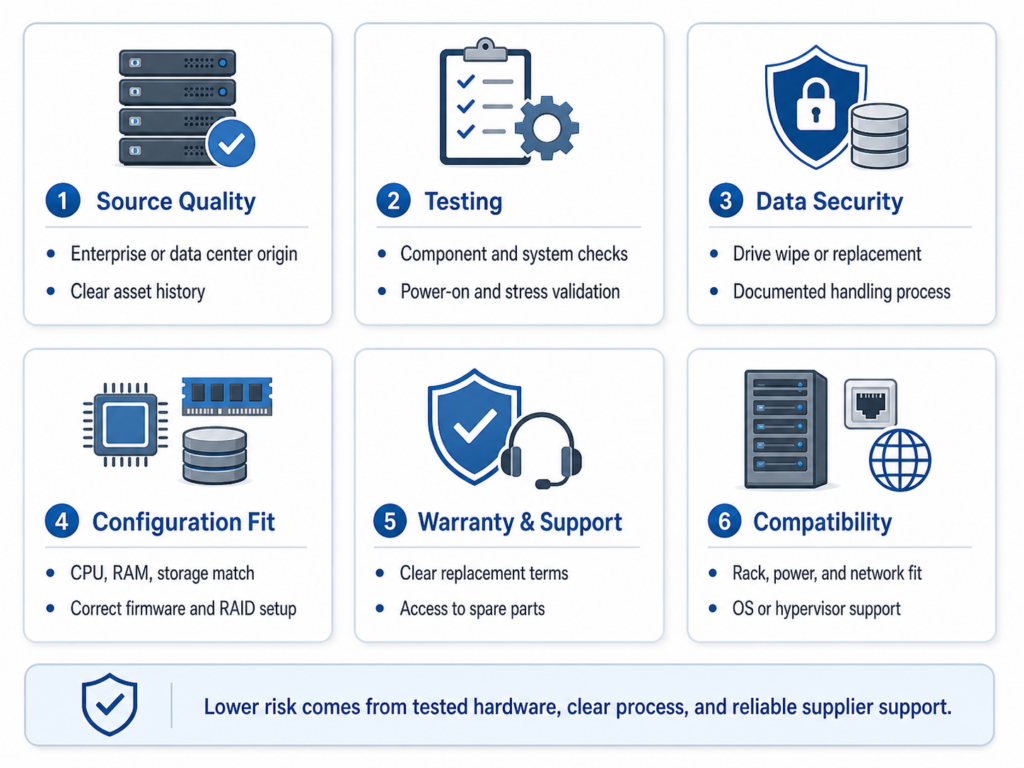
Refurbished servers can be reliable, but quality depends on process. The main risk is not that the server is refurbished. The main risk is buying from a supplier that does not test, document, configure, or support the hardware properly.
Buyers should focus on practical checks. They should review sourcing, testing, data handling, warranty, packaging, and compatibility.
Key Risk Checks Before Purchase
Before buying refurbished servers, procurement and infrastructure teams should review:
- Source of the equipment
- Testing process
- Data handling process
- Warranty terms
- Component condition
- Firmware and BIOS levels
- Configuration accuracy
- Rail and power requirements
- Packaging standards
- Replacement part access
| Risk Area | Buyer Question | Practical Standard |
| Source quality | Where did the server come from? | Prefer enterprise or data center recovery sources |
| Testing | What tests were performed? | Require component and system-level checks |
| Data security | How were drives handled? | Require wiping, removal, replacement, or destruction |
| Configuration | Does it match the workload? | Confirm CPU, RAM, storage, NIC, RAID, and firmware |
| Warranty | What happens if a part fails? | Require clear replacement or support terms |
| Compatibility | Will it fit the environment? | Check OS, hypervisor, rack, power, and network needs |
| Supplier depth | Can the supplier support future needs? | Prefer partners with inventory and channel access |
Buyers should also know when new hardware is a better choice. New servers may be the right fit for long-term production clusters, strict OEM support models, or high-density AI environments.
Refurbished servers may be a strong fit for expansion, backup, development, disaster recovery, lab, edge, and short-term capacity needs.
A practical new vs refurbished review can help teams match each workload to the right sourcing model.
When Should Enterprise Buyers Choose Refurbished Servers Over New?
Enterprise buyers often choose refurbished servers when speed, cost, or compatibility matters more than using the newest generation.
Refurbished servers are often used when:
- New systems have long lead times
- The project has a fixed budget
- Existing infrastructure uses older platforms
- Workloads do not need the latest CPU generation
- Teams need fast expansion capacity
- Backup or disaster recovery hardware is needed
- Lab and test environments need reliable systems
- Replacement hardware must match existing equipment
Refurbished servers can also help buyers avoid unnecessary redesign. If an organization already runs a stable HPE, Dell, Cisco, or Lenovo platform, adding compatible refurbished units may be simpler than moving to a new generation.
Cost is another driver. Refurbished hardware can often reduce upfront costs by 30–70%, depending on age, demand, configuration, and supply. This helps buyers stretch budgets without giving up enterprise-grade hardware.
The key is fit. Buyers should compare workload needs, support needs, lifecycle plans, and risk before choosing.
How Can Procurement Teams Build a Better Refurbished Server Buying Strategy?

A better refurbished server buying strategy starts with clear workload needs. Procurement teams should work with IT teams to define what the server will support, how long it must stay in use, and what performance level is required.
Refurbished servers work best when they are planned sourcing options, not last-minute backups. This gives teams time to compare new, refurbished, and alternative configurations with less risk.
Start With the Workload
The workload should guide the purchase. A server for virtualization, backup, AI testing, storage, or disaster recovery may need different CPU, memory, storage, and networking specs.
Teams should confirm:
- Whether the workload is production, secondary, or temporary
- Required performance level
- Expected lifecycle
- Compatibility with existing infrastructure
Align Technical and Buying Requirements
Procurement should review more than model and price. Small details can affect deployment and support.
Key items to confirm include:
- CPU generation and core count
- Memory capacity
- Storage layout and RAID needs
- Network card requirements
- Power, rails, and rack fit
- Firmware and hypervisor support
- Warranty, quantity, and delivery timing
A strong hardware buying plan should also include approved alternatives in case a preferred model is unavailable.
Check Supplier Capability
The supplier matters as much as the server. Buyers should ask how equipment is sourced, tested, configured, packaged, and supported after delivery.
A reliable supplier should also support matching multi-unit orders, replacement parts, and clear warranty terms.
When procurement and IT teams use this framework, refurbished servers become a controlled sourcing strategy. The result is faster deployment, better cost control, and stronger lifecycle planning.
What Should Buyers Know About Refurbished Server Pricing?
Refurbished server pricing changes based on supply, demand, generation, and configuration. It does not always work like a fixed catalog price.
Prices may rise when buyers need a specific generation, GPU, memory type, or storage layout. Prices may fall when many companies refresh the same platform and more systems enter the market.
Common pricing factors include:
- Server generation
- CPU family
- RAM capacity
- Drive type and size
- GPU availability
- RAID card or HBA needs
- Network adapter type
- Warranty terms
- Quantity required
- Speed of delivery
- Market demand
AI demand can also affect pricing. When newer GPUs are limited, buyers may look at previous-generation GPU systems. That can increase demand for older but still useful platforms.
This is why buyers should not judge value by price alone. A low-cost server with weak testing, no warranty, or poor configuration support may cost more later.
The better question is: does the server meet the workload, timeline, and risk profile at a lower total cost?
Understanding refurbished pricing trends helps teams set realistic budgets before requesting quotes.
How Do Refurbished Servers Support Circular IT and Sustainability Goals?
Refurbished servers support circular IT by extending the useful life of enterprise hardware. Instead of sending working systems directly to recycling, companies can reuse, resell, or redeploy them.
This can reduce e-waste and help organizations connect procurement with sustainability goals. It can also improve asset recovery for companies that are refreshing infrastructure.
Circular IT is not only about environmental goals. It is also about asset value and better lifecycle planning.
A simple circular server lifecycle looks like this:
- Buy or deploy hardware
- Use it in production
- Refresh when business needs change
- Recover value through ITAD or resale
- Refurbish and test usable systems
- Redeploy hardware into new environments
- Recycle non-usable parts responsibly
This lifecycle view connects procurement, operations, finance, and sustainability. It also helps buyers make better choices about when to buy new, when to buy refurbished, and when to retire equipment.
Refurbished servers work best when they are part of a planned lifecycle strategy, not treated as a one-time discount purchase.
What Is the Best Procurement Framework for Enterprise Buyers?
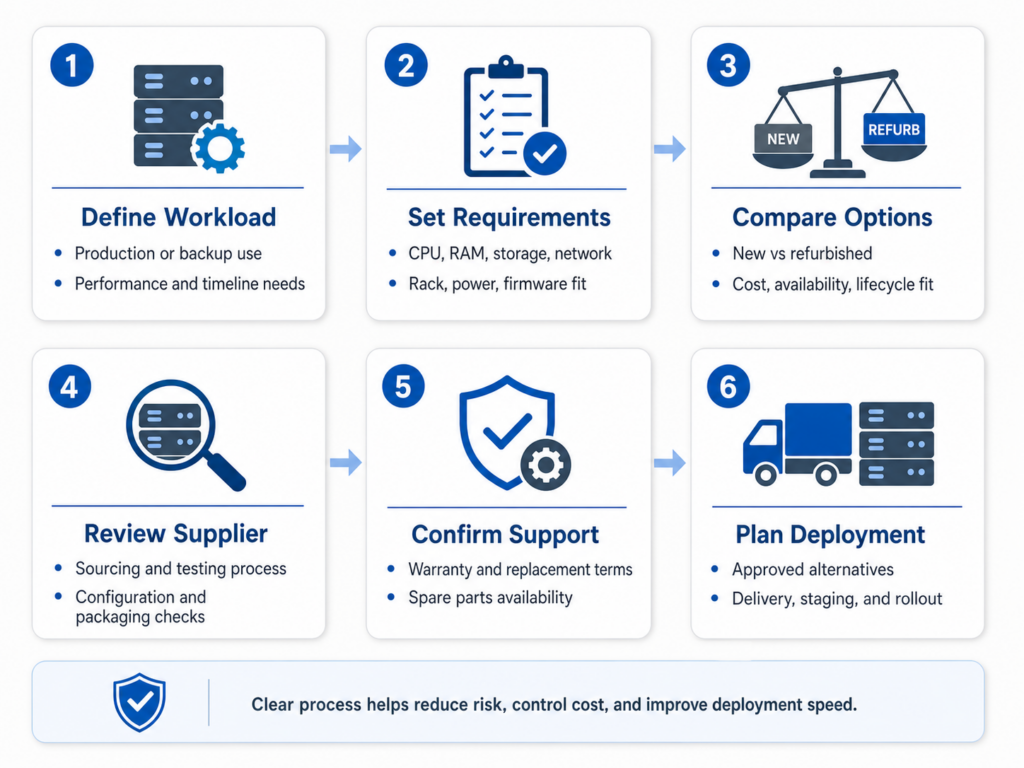
Enterprise buyers should use a clear framework before purchasing refurbished servers. This reduces risk and improves confidence across procurement, IT, finance, and security teams.
Use this practical process:
- Define the workload
Identify whether the server will support production, backup, testing, virtualization, AI, storage, or disaster recovery. - Set technical requirements
Confirm CPU, memory, storage, networking, power, rack, and firmware needs. - Compare new and refurbished options
Review cost, availability, lifecycle fit, support, and deployment speed. - Review supplier process
Ask how equipment is sourced, tested, configured, and shipped. - Check warranty and support
Confirm replacement terms and response expectations before ordering. - Plan for spares
Include extra drives, power supplies, NICs, rails, or memory if fast repair matters. - Document the decision
Record why refurbished was chosen and where it fits in the lifecycle plan.
This framework helps buyers avoid common mistakes. It also makes the business case clearer.
When teams follow this process, refurbished servers can support faster deployment, lower cost, and better lifecycle control.
What Is the Future of the Refurbished Devices Supply Chain?

The refurbished devices supply chain will likely become more important as infrastructure demand grows. AI, cloud repatriation, hybrid cloud, edge computing, and data center expansion are all changing how companies buy servers.
New hardware will remain important. But many enterprise buyers will continue to use a mixed model because not every workload needs the newest system.
Future demand will likely focus on:
- Better testing standards
- More interest in previous-generation GPU systems
- Stronger circular IT programs
- More structured ITAD and resale processes
- Higher need for supply chain visibility
- More hybrid sourcing across new and refurbished hardware
Buyers that build flexible sourcing plans will be in a better position. They can respond faster when new hardware is delayed, prices rise, or project needs change.
The main lesson is clear: refurbished servers should not be treated only as a backup plan. They should be part of a broader infrastructure lifecycle strategy.
Need Better Server Sourcing Options During Tight Timelines?
Catalyst Data Solutions works closely with leading OEMs like Cisco, Arista, HPE, and NVIDIA to help organizations source the right infrastructure for their needs. As a vendor-agnostic partner, Catalyst focuses on what works best for each environment, whether that involves new deployments, refurbished servers, or sourcing equipment during supply constraints.
For teams planning server refreshes, expansion, or mixed infrastructure projects, server sourcing support can help compare performance, budget, availability, and lifecycle fit. The goal is to support better decisions, reduced cost, faster deployment, and a stronger infrastructure strategy.
FAQs:
Q: Why are enterprise IT hardware lead times so long?
This directly supports the market overview and global supply chain discussion.
Q: How do companies get hardware faster during shortages?
This connects strongly to secondary markets, refurbished sourcing, and procurement strategy.
Q: How does Catalyst Data Solutions source hard-to-find hardware?
This supports Catalyst positioning and the refurbished server supply chain breakdown.
Q: Why is there strong demand for refurbished hardware today?
This directly matches the article’s focus on market demand, cost pressure, shortages, and faster deployment needs.
Q: Can Catalyst source hard-to-find or backordered IT hardware?
This fits the topic best because the article focuses on refurbished server supply chains, market availability, backordered hardware, and alternative sourcing.
Q: How does Catalyst support organizations during hardware shortages?
This is also highly relevant because it connects directly to supply chain disruptions, secondary markets, refurbished options, and procurement risk reduction.