


Cyber threats are evolving faster than most organizations can adapt. Attack surfaces are expanding, threat actors are more sophisticated, and response times are under constant pressure.
At the same time, enterprises face a shortage of skilled cybersecurity professionals. Building and maintaining effective security operations has become both complex and resource-intensive.
This makes choosing the right operational model critical. This guide compares in-house SOC and Managed SOC approaches to help organizations make informed, strategic decisions.
Key Takeaways:
- In-house SOC offers full control but requires high cost, skilled talent, and long deployment timelines.
- Managed SOC delivers 24/7 monitoring, faster deployment, and scalable security through outsourced expertise.
- Talent shortages and operational complexity make Managed SOC a practical choice for many enterprises.
- Hybrid SOC models combine internal control with external scalability for balanced, modern security operations.
What is a Security Operations Center (SOC)?

Definition
A Security Operations Center (SOC) is a centralized function responsible for continuously monitoring, detecting, and responding to cybersecurity threats within an organization.
Core Functions
A SOC typically performs three essential functions:
- Monitoring: Continuous tracking of network, endpoint, and system activity
- Detection: Identifying suspicious behavior and potential threats
- Incident Response: Investigating and mitigating security incidents
These functions are often aligned with a broader enterprise security strategy to ensure consistency across the organization.
Key Technologies
Modern SOCs rely on a combination of integrated technologies:
- SIEM (Security Information and Event Management): Aggregates and analyzes logs
- SOAR (Security Orchestration, Automation, and Response): Automates workflows
- XDR (Extended Detection and Response): Provides cross-layer visibility
- Vulnerability Management: Identifies and prioritizes exposure risks
Platforms from providers such as Palo Alto Networks often integrate these capabilities into unified security operations ecosystems.
SOC Team Structure
SOC teams are typically structured in tiers:
- Tier 1 (Analysts): Initial triage and alert monitoring
- Tier 2 (Investigators): Deep analysis and incident validation
- Tier 3 (Experts): Threat hunting and advanced response
What is a Managed SOC?
Definition
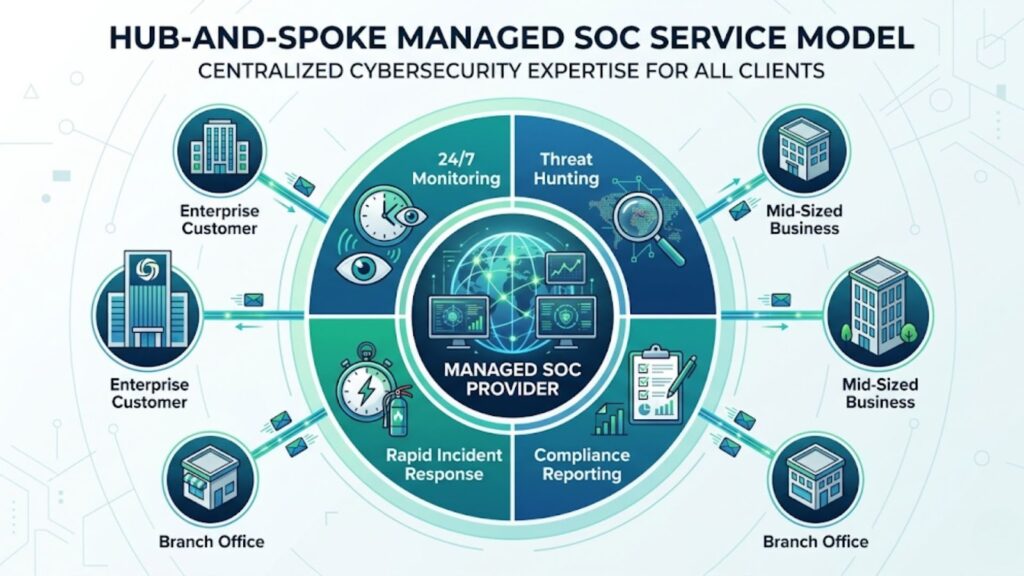
A Managed SOC is an outsourced security operations service delivered by a third-party provider. It offers continuous monitoring, detection, and response capabilities without requiring in-house infrastructure.
Core Services
Managed SOC providers typically deliver:
- 24/7 monitoring and alerting
- Proactive threat hunting
- Incident detection and response
- Compliance and reporting support
These services often align with broader managed IT capabilities to streamline operational overhead.
Managed SOC vs MSSP
While both Managed SOC and MSSP (Managed Security Service Provider) models offer outsourced security:
- MSSPs focus on managing tools (firewalls, antivirus, etc.)
- Managed SOCs focus on threat detection, analysis, and response
The Managed SOC model is more aligned with modern threat-centric security operations.
Service Delivery Model
Managed SOC services are typically delivered through:
- Remote monitoring centers
- Cloud-based platforms
- Subscription-based pricing models
Detection and response capabilities are increasingly embedded within integrated security platforms, where vendors such as Fortinet combine network security with centralized monitoring to improve operational visibility and scalability.
SOC vs Managed SOC: Key Differences
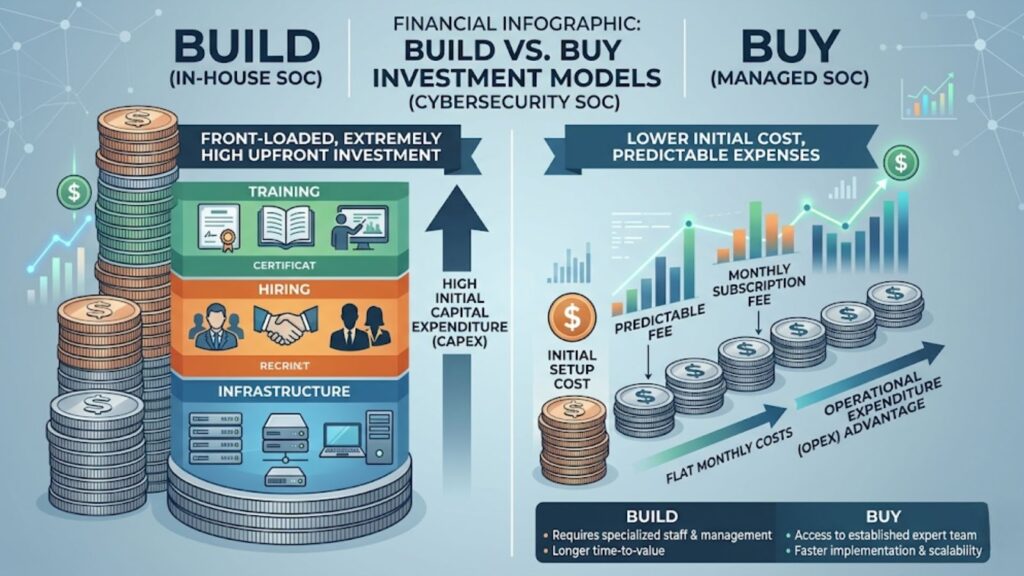
Table 1: Comparison
| Feature | In-House SOC | Managed SOC |
| Control | Full internal control | Shared or outsourced control |
| Cost Structure | High upfront investment | Predictable subscription model |
| Scalability | Limited by internal resources | Highly scalable |
| Talent Requirement | High | Low (provider-managed) |
| Deployment Time | Long (6–18 months) | Fast (weeks) |
| Coverage | Depends on staffing | 24/7 coverage |
Cost Analysis: Build vs Buy
In-House SOC Costs
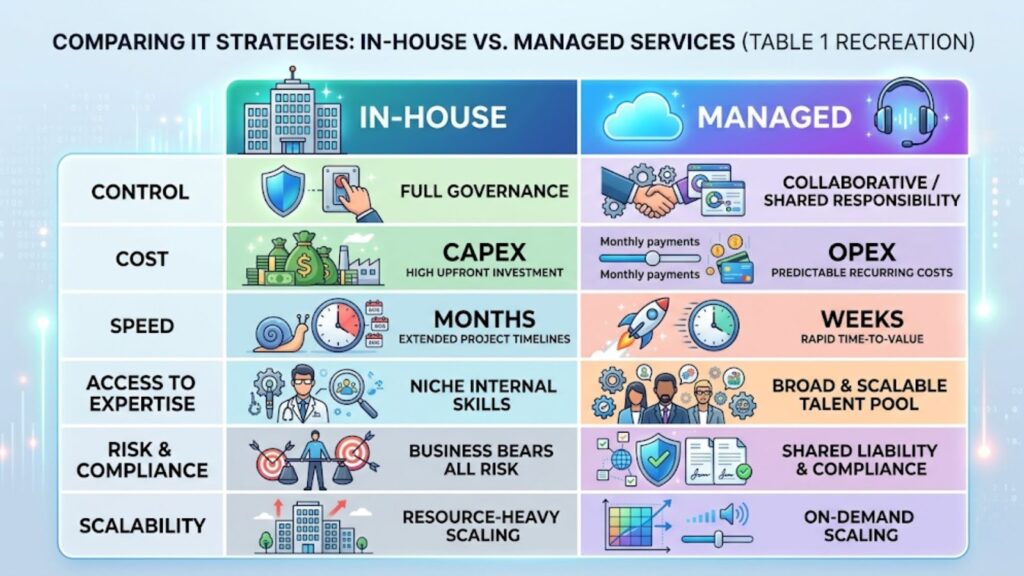
Building a SOC involves significant investment:
- Infrastructure (tools, hardware)
- Licensing (SIEM, SOAR, XDR)
- Staffing (analysts, engineers)
- Ongoing maintenance
Costs can easily exceed millions annually for mid-to-large enterprises.
Managed SOC Pricing
Managed SOC services typically follow a subscription model based on:
- Number of assets or endpoints
- Log volume
- Service scope
This allows organizations to align spending with actual usage.
Total Cost of Ownership
When evaluating long-term costs:
- In-house SOCs offer control but require continuous reinvestment
- Managed SOCs reduce overhead but introduce dependency on vendors
Organizations often compare these models alongside broader infrastructure cost models to assess financial impact.
Talent and Skill Challenges
Workforce Shortage
The cybersecurity talent gap continues to widen globally. Skilled SOC analysts are difficult to hire and retain.
Impact on SOC Efficiency
Limited staffing can lead to:
- Alert fatigue
- Delayed incident response
- Increased risk exposure
Managed SOC Advantage
Managed SOC providers mitigate this challenge by:
- Offering experienced security teams
- Providing continuous coverage
- Reducing internal hiring pressure
When to Choose an In-House SOC
Ideal Use Cases
An in-house SOC is suitable for organizations that:
- Require full control over security operations
- Operate in highly regulated environments
- Have mature security programs
Readiness Checklist
Before building a SOC, organizations should assess:
- Budget availability
- Access to skilled talent
- Defined security processes
- Integration with existing systems
When to Choose a Managed SOC

Ideal Use Cases
Managed SOC is ideal for organizations that:
- Lack internal security expertise
- Need rapid deployment
- Require 24/7 monitoring
Key Benefits
- Faster time to value
- Reduced operational burden
- Access to advanced tools and expertise
- Scalable security operations
Hybrid SOC Model
Definition
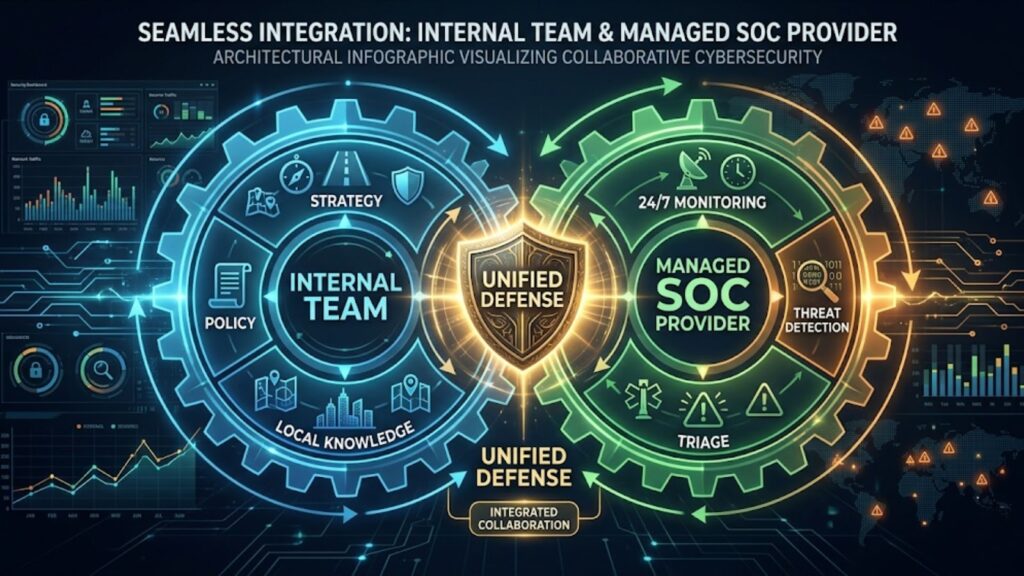
A Hybrid SOC combines internal security teams with external Managed SOC services.
Benefits
- Balances control and scalability
- Enhances threat visibility
- Reduces operational gaps
Implementation Approach
Organizations can:
- Retain strategic functions internally
- Outsource monitoring and response
- Integrate with frameworks like zero trust implementation for stronger security posture
Decision Framework
Decision Matrix
| Criteria | In-House SOC | Managed SOC | Hybrid SOC |
| Budget | High | Medium | Medium |
| Control | High | Low | Balanced |
| Speed of Deployment | Slow | Fast | Moderate |
| Talent Availability | Required | Not required | Partial |
| Scalability | Limited | High | High |
Key Risks and Challenges

In-House Risks
- High operational costs
- Talent shortages
- Slow scalability
Managed SOC Risks
- Reduced visibility into operations
- Vendor dependency
- Data privacy concerns
Mitigation Strategies
- Define clear SLAs and governance
- Implement strong access controls
- Align with internal security policies
Future Trends
AI and Automation
AI-driven detection and automated response are reshaping SOC operations, improving speed and accuracy.
Rise of MDR
Managed Detection and Response (MDR) services are expanding, offering deeper threat intelligence and proactive defense.
Platform-Based Security
Integrated platforms combining SIEM, XDR, and automation are becoming the standard, reducing tool sprawl and complexity. Solutions incorporating exposure management, such as those from Tenable, are increasingly embedded into these ecosystems.
Need Help Choosing Between SOC and Managed SOC?
Choosing the right SOC model requires balancing security, cost, and scalability. Many organizations work with partners like Catalyst Data Solutions Inc to design and implement solutions that align with their infrastructure and risk needs.
If you’re planning to build or optimize your security operations, expert guidance can help you move faster and avoid costly mistakes.
FAQs
What is SOC vs Managed SOC?
A SOC is an internal security operations function, while a Managed SOC is an outsourced service that provides similar capabilities.
Is Managed SOC same as MDR?
No. MDR focuses specifically on threat detection and response, while Managed SOC provides broader security operations support.
Which is more cost-effective?
Managed SOC is generally more cost-effective for organizations without existing infrastructure or talent.
Can both models be combined?
Yes. A hybrid SOC model combines internal teams with external services for flexibility and scalability.
How long to build a SOC?
Building a SOC typically takes 6 to 18 months, depending on complexity and resources.
Which industries need SOC most?
Industries handling sensitive data such as finance, healthcare, and government require robust SOC capabilities.