



Choosing an infrastructure partner is not a choice between “small and attentive” and “large and impersonal.” Those labels are too simple to support a high-stakes decision.
A national or global value-added reseller, or VAR, is often the stronger fit for globally standardized procurement, very large rollouts, broad contract coverage, and programs that depend on major integration facilities.
A specialist VAR may be the better fit when the program requires fast senior-level decisions, a tailored multi-OEM architecture, mixed-generation infrastructure, or lifecycle planning that connects procurement, support, reuse, and asset recovery.
When evaluating delivery models, the Specialist VAR vs National VAR decision should be guided by the program’s scope, complexity, risk, and operating requirements not by the provider’s size alone.
What Is the Difference Between a Specialist VAR and a National VAR?
Both models can source technology, coordinate services, and support complex infrastructure. The practical difference is usually how each provider organizes its scale, expertise, delivery resources, and customer engagement.
| Partner model | Typical operating strengths | Common best-fit situation |
| National or global VAR | Broad geographic reach, extensive vendor relationships, large procurement capacity, contract coverage, standardized deployment, and major integration resources | Large, repeatable programs across many regions, countries, business units, or technology areas |
| Specialist VAR | Focused expertise, direct access to decision-makers, adaptable sourcing, smaller project teams, and tightly defined outcomes | Complex or time-sensitive programs where fit, flexibility, lifecycle choices, or mixed environments matter more than global breadth |
“Specialist” does not always mean small. “National” does not mean slow or inflexible.
Some large providers offer highly personalized teams. Some regional firms operate mainly as transactional resellers.
The better question is:
Which operating model matches the work your organization must complete?
Where National and Global VARs Are Structurally Strong

Large providers have advantages that are difficult to reproduce through messaging alone.
CDW describes itself as a multi-brand technology provider serving business, government, education, and healthcare customers in the United States, United Kingdom, and Canada. Its official profile reports approximately 250,000 customers, 2025 net sales of $22.4 billion, and the ability to provide solutions in more than 150 countries.
SHI positions itself as a global solutions integrator that combines global scale with local-VAR-style service. Its official profile reports more than 17,000 customer organizations, 7,000 employees, 30-plus offices, more than 1,000 technical resources, and integration centers across the United States, United Kingdom, Europe, and Asia.
World Wide Technology’s Advanced Technology Center shows another large-provider advantage: major testing infrastructure. WWT reports more than 20,000 virtual machines, 500-plus racks, 600-plus prebuilt capabilities, more than 200 OEMs, and a $1 billion infrastructure investment in the environment.
A national or global model is often well suited to programs that require:
- Consistent procurement across several countries or business units
- Large contract vehicles and broad manufacturer coverage
- High-volume staging, configuration, warehousing, and distribution
- Formal global governance and reporting
- Extensive test labs and integration centers
- A broad portfolio covering infrastructure, software, cloud, security, and managed services
- Standardized rollouts at significant scale
These strengths matter when consistency, reach, and repeatability are more important than adapting every decision to a local or mixed-generation environment.
Where a Specialist VAR Can Create Value
A specialist model becomes relevant when the buyer needs a focused team to solve a defined infrastructure problem, not simply access a broad catalog.
The value should be visible in the provider’s process. It may include direct access to senior technical decision-makers, fewer handoffs, or greater flexibility across new, prior-generation, refurbished, and supported legacy equipment.
These are not automatic benefits. Buyers should ask the provider to prove how its engagement model delivers them.
A trusted provider like Cartalyst Data Solution Inc offering vendor-agnostic infrastructure services should explain the criteria used to compare architecture options.
The evaluation should account for:
- Workload fit
- Compatibility
- Deployment risk
- Lead time
- Support coverage
- Useful life
- Power and operating requirements
- Recovery or exit value
A specialist model may be a strong fit when:
- The installed environment includes several OEMs or hardware generations
- A full replacement would be wasteful, disruptive, or unnecessary
- The buyer needs options for constrained or end-of-life equipment
- Architecture and sourcing decisions must be made quickly
- The internal IT team is lean
- The project has a clear outcome but does not require a global transformation program
- Procurement, maintenance, redeployment, and disposition must be planned together
A specialist may also help evaluate multi-OEM technology partners through one decision framework.
The value is not the number of available brands. It is the quality and transparency of the comparison.
Decision Matrix: Which Partner Model Fits the Program?
Use this matrix as a starting point. It does not replace technical validation, reference checks, contract review, or due diligence.
| Decision factor | National or global VAR may fit better when… | Specialist VAR may fit better when… |
| Geography | The program spans many countries and needs local entities, international logistics, or globally standardized contracts | The work is concentrated in defined regions or can be delivered through a documented partner network |
| Program scope | The initiative covers many technology domains, business units, and service areas | The initiative has a focused outcome, such as a network refresh, constrained sourcing project, or lifecycle program |
| Standardization | Uniform configurations and processes must be repeated at high volume | The design must account for site differences, installed assets, legacy dependencies, or phased modernization |
| Integration resources | The buyer requires major labs, integration centers, and extensive preproduction testing | Testing can be completed through a focused engineering process, OEM resources, or a defined partner facility |
| Decision speed | The program can follow a formal enterprise governance and approval model | The buyer needs a compact decision team, rapid option review, and direct escalation |
| Lifecycle needs | Procurement scale and standard warranty structures are the main priorities | Purchase, support, spares, useful life, redeployment, recovery value, and disposition must be evaluated together |
| Internal capacity | The customer has mature architecture, sourcing, program, and vendor-management teams | A lean team needs a partner to connect technical, sourcing, deployment, and lifecycle decisions |
| Risk profile | Broad geographic coverage and standardized delivery reduce the main risks | Compatibility, lead time, legacy support, budget limits, or disruption are the main risks |
| Commercial model | Enterprise agreements and consolidated global spending are central | Flexible sourcing and a defined project outcome matter more than global purchasing consolidation |
Do not decide from one row. Evaluate the full pattern of requirements and risks.
Examples of Projects That May Favor a Specialist
A specialist model may be worth evaluating for the following projects.
1. A phased data-center refresh
The organization wants to modernize compute, storage, and networking without replacing every usable asset at once.
A specialist can help identify which systems should remain, which should be upgraded, and which should be replaced.
2. A mixed-generation network
Several sites use different platforms or hardware generations. The buyer needs a practical migration path rather than one forced standard.
The project may require new equipment, retained assets, compatible prior-generation hardware, and a staged deployment plan.
3. Constrained or hard-to-find sourcing
A project needs compatible equipment to avoid an early refresh, a long delay, or an extended outage.
For asset-heavy projects, IT hardware procurement services should be assessed alongside architecture and lifecycle requirements not treated as a separate purchasing transaction.
4. A lifecycle-led infrastructure refresh
The next purchase must be planned with warranty coverage, spare parts, resale, redeployment, and final disposition in mind.
Purchase price is only one part of the financial decision.
5. A regulated or public-sector program
The buyer needs clear documentation, responsibility boundaries, chain-of-custody records, and budget-aware project phases.
The provider must show who owns each task and what evidence will be produced.
6. A bounded AI infrastructure pilot
The team needs to validate data, storage, networking, compute, power, cooling, security, and operational limits before scaling.
The goal is to prove a defined workload not to purchase hardware before the requirements are clear.
When a National or Global VAR Is the Better Fit
A balanced decision guide must state where the specialist model may not be the right answer.
A national or global VAR is likely to be the better fit when the program requires:
- Direct operations and support in many countries
- A single global procurement structure
- Very large device or infrastructure rollouts
- Extensive integration-center capacity
- Broad application, cloud, cybersecurity, and consulting services
- Standard configurations across thousands of locations
- Contract vehicles or manufacturer tiers unavailable through the specialist
- A delivery footprint that the specialist cannot document or govern
The provider should be selected for demonstrated capabilities not for a general preference toward large or small firms.
When Using Both Partner Models Makes Sense
The decision does not always need to be exclusive.
A national VAR may hold the main global agreement, manage standardized procurement, or coordinate broad deployments. A specialist may support a specific region, solve a constrained sourcing problem, extend the life of installed equipment, or lead a lifecycle workstream.
A blended model can work when responsibilities are explicit.
The customer should document:
- Which provider owns architecture decisions
- Which provider holds the contract for each product or service
- Who validates compatibility and configuration
- Who manages deployment, escalation, and warranty claims
- Who maintains records and reports outcomes
- Who is accountable when responsibilities overlap
For environments with older but still useful assets, third-party hardware maintenance may be one part of a blended strategy.
Buyers should verify coverage, response times, subcontractors, parts logistics, exclusions, and escalation paths in writing.
Ten Questions to Ask Any Infrastructure VAR
Use the same questions for every provider. Comparable answers are more useful than polished presentations.
- Which program conditions are your strongest fit and when should we choose another provider?
- Who will make architecture decisions, and how directly can our team reach those people?
- How do you compare OEMs, configurations, and sourcing paths?
- Which services do you deliver directly, and which depend on partners or subcontractors?
- How do you validate compatibility with our installed environment?
- What geographic coverage, support hours, escalation paths, and service levels are contractually available?
- How do you manage refurbished, prior-generation, constrained, or end-of-life equipment?
- How do you include support, power, spares, useful life, recovery value, and disposition in the recommendation?
- What customer evidence can you provide for a similar project, with its scope and outcomes clearly defined?
- What will the first engagement produce: an assessment, architecture, bill of materials, roadmap, risk register, or lifecycle model?
Organizations in healthcare, education, government, manufacturing, and other complex sectors should also review the provider’s industry-specific IT solutions for real delivery details not just industry labels.
How to Decide: A Five-Step Partner-Fit Assessment
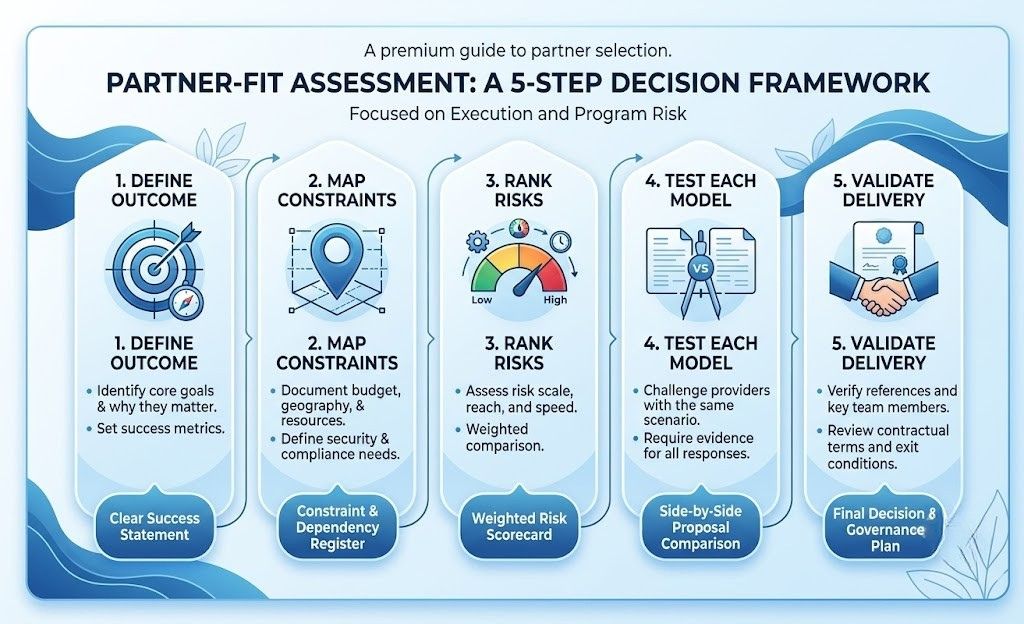
A structured assessment keeps the decision focused on execution and program risk.
| Step | Action | Expected output |
| 1. Define the outcome | State what must change, why it matters, and how success will be measured | One-page outcome and success statement |
| 2. Map the constraints | Document geography, installed assets, standards, budget, schedule, staffing, security, and compliance needs | Constraint and dependency register |
| 3. Rank the risks | Identify whether the main risks involve scale, reach, compatibility, speed, lifecycle, governance, or internal capacity | Weighted risk scorecard |
| 4. Test each model | Ask national and specialist providers to respond to the same scenario, assumptions, and evidence requirements | Comparable proposals and responsibility maps |
| 5. Validate delivery | Check references, named team members, partner dependencies, escalation paths, contractual commitments, and non-fit conditions | Final partner-fit decision and governance plan |
This process may show that one provider should own the full program.
It may also show that a primary provider and a specialist workstream partner create the lowest-risk model.
How Catalyst Fits and Where It May Not
Catalyst Data Solutions publicly positions its team around enterprise hardware sourcing, multi-OEM infrastructure, lifecycle planning, ITAD, asset recovery, public-sector procurement, and support for new, refurbished, constrained, and legacy equipment.
That model may fit an organization that needs:
- A focused infrastructure outcome
- Practical sourcing options
- A phased modernization plan
- Support for a mixed-generation environment
- Lifecycle planning tied to the next purchase
- Clear direct-versus-partner responsibilities
For example, a buyer planning a refresh may need to compare new equipment with retained assets. The team may also need to decide which systems require support extensions and which retired assets can be redeployed or recovered.
ITAD and asset recovery services can then be evaluated as part of the program economics rather than as an end-of-project disposal task.
Catalyst may not be the right fit when a program requires:
- A provider-owned global operating footprint
- Very large international integration facilities
- One universal procurement contract
- Direct operations in a large number of countries
- A broad transformation covering applications, cloud operating models, and business-process redesign
Before selection, Catalyst should provide a current coverage and escalation model, named delivery roles, direct-versus-partner responsibilities, relevant customer evidence, and contract-specific service commitments.
Buyers should require the same proof from every provider under consideration.
Choose the Model That Reduces Your Actual Program Risk
The best infrastructure partner is not the largest available company or the smallest team promising personal service.
It is the provider whose operating model matches the program’s geography, complexity, risk, speed, lifecycle, and internal capacity.
Use national and global VARs where their reach, scale, standardization, and integration resources create clear value.
Evaluate a specialist where focused expertise, multi-OEM flexibility, mixed-generation support, direct decisions, and lifecycle economics are central to the outcome.
Continue evaluating these choices through enterprise IT infrastructure insights that explain methods, tradeoffs, and practical modernization decisions not just product features.
Talk to an Architect or Request a Partner-Fit Assessment

Bring your current environment, program goals, geographic requirements, timeline, and risk constraints.
Catalyst Data Solution Inc can help map the requirements and determine whether a specialist model, national provider, or blended approach is the most credible fit.
To begin the discussion, request an infrastructure quote and include your project scope, locations, installed platforms, target outcome, and decision timeline.
Frequently Asked Questions
1. Can we change infrastructure VARs without disrupting current support?
Yes, but the transition should be planned carefully. Review active warranties, maintenance agreements, licensing terms, open orders, service tickets, and renewal dates before moving work. The new provider should document what it can take over immediately, what must remain with the current provider, and where OEM approval may be required.
2. What should we prepare before meeting a potential VAR?
Prepare a basic overview of your environment, business goals, locations, current vendors, major pain points, budget range, and target timeline. Include known dependencies, upcoming renewals, unsupported equipment, and security or compliance requirements. Clear inputs help the provider give useful recommendations instead of a generic sales presentation.
3. How long should it take to select an infrastructure partner?
The timeline depends on project risk and complexity. A focused sourcing or maintenance need may take a few weeks, while a multi-site modernization program may require several months of technical review, reference checks, contract negotiation, and stakeholder approval. Do not shorten due diligence when the provider will influence long-term architecture or operations.
4. Can a VAR support equipment purchased from another provider?
Often, yes. A VAR may support, maintain, upgrade, or integrate equipment purchased elsewhere, but coverage depends on the manufacturer, warranty status, licensing rules, product condition, and available technical expertise. Ask the provider to confirm responsibilities and exclusions in writing before the engagement begins.
5. What happens if our project scope changes after the VAR is selected?
The provider should have a clear change-control process. It should explain how new requirements affect architecture, cost, delivery dates, staffing, support, and risk. Before approving a change, request an updated scope, responsibility map, assumptions, pricing, and implementation schedule.