

IT teams face rising hardware costs, longer lead times, tighter budgets, and growing pressure to reduce e-waste. At the same time, businesses still need reliable servers, storage, networking, and end-user devices to support daily operations and new projects.
The circular economy in IT offers a practical way to manage this pressure. It helps companies extend the life of technology assets, reuse equipment, recover value, and reduce waste while keeping infrastructure aligned with performance, budget, and sustainability goals.
What Does Circular Economy Mean for IT Hardware?
Circular economy in IT is a lifecycle approach that keeps technology assets in use for as long as they deliver value. Instead of following a “buy, use, discard” model, companies reuse, repair, refurbish, resell, or recycle hardware through a planned process.
This strategy applies to servers, storage, switches, routers, laptops, desktops, GPUs, and other enterprise hardware. A strong circular IT strategy helps teams decide when to buy new, when to reuse, when to choose refurbished, and when to retire assets securely.
The goal is simple: reduce waste, lower cost, and make better use of every asset across its full lifecycle.
Circular economy in IT usually includes:
- Smarter procurement
- Asset tracking
- Hardware reuse
- Refurbished equipment
- Secure ITAD
- Responsible recycling
- Resale and value recovery
- ESG-aligned reporting
For enterprise buyers, this is not just a sustainability topic. It is also a procurement, finance, security, and infrastructure planning issue.
Linear vs Circular IT Lifecycle
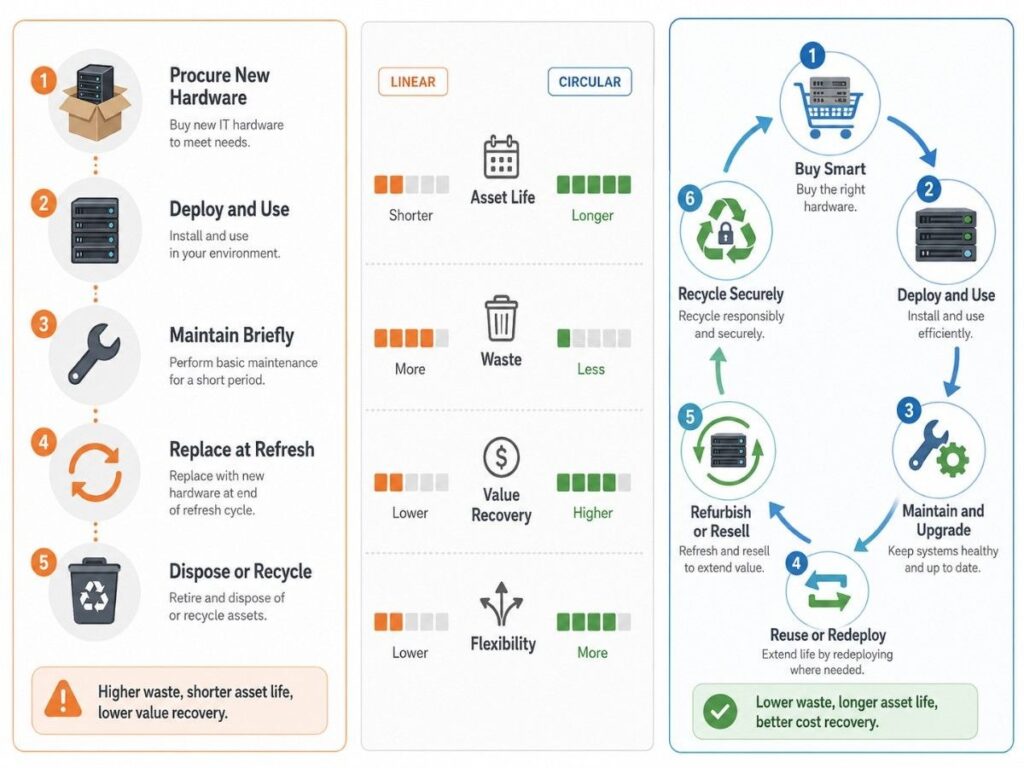
A linear IT lifecycle is the traditional model. A company buys hardware, uses it for a set period, replaces it, and then disposes of the old equipment.
A circular IT lifecycle takes a more flexible approach. It looks for ways to keep assets useful before they become waste. This can include redeploying equipment, buying refurbished hardware, reselling retired devices, or using ITAD to manage end-of-life assets.
| Lifecycle Area | Linear IT Model | Circular IT Model |
| Procurement | Mostly new hardware | New, refurbished, or mixed sourcing |
| Usage | Use until refresh date | Maintain, optimize, and extend use |
| Refresh | Replace and remove | Reuse, redeploy, or resell first |
| End of life | Store, scrap, or dispose | ITAD, resale, recycling, or reuse |
| Business impact | Higher waste and missed value | Lower waste and better lifecycle value |
The circular model gives companies more choices. It helps avoid early replacement, reduces storage waste, and supports better recovery from old hardware.
This matters because many IT assets still have useful life after a standard refresh cycle. A server may no longer fit a high-performance workload, but it may still support testing, backup, internal tools, or lower-demand applications.
Why Does Circular Economy in IT Matter for Enterprises?
Circular economy in IT matters because enterprise hardware decisions affect cost, uptime, risk, and sustainability. Companies cannot treat IT assets as short-term purchases only. Each asset has a financial, operational, and environmental impact.
Many businesses are dealing with:
- Higher infrastructure costs
- Hardware shortages
- Long OEM lead times
- More demand for compute and storage
- E-waste concerns
- ESG reporting pressure
- Limited refresh budgets
A circular model helps IT and procurement teams respond with more flexibility. Instead of using one path for every purchase, companies can match hardware decisions to workload needs.
For example, new hardware may be the right fit for mission-critical production systems. Refurbished or reused hardware may be a better fit for backup, testing, development, or short-term capacity.
This approach also helps reduce data center waste by giving older assets a second useful life before recycling or disposal.
How Does Circular IT Help Lower IT Costs?
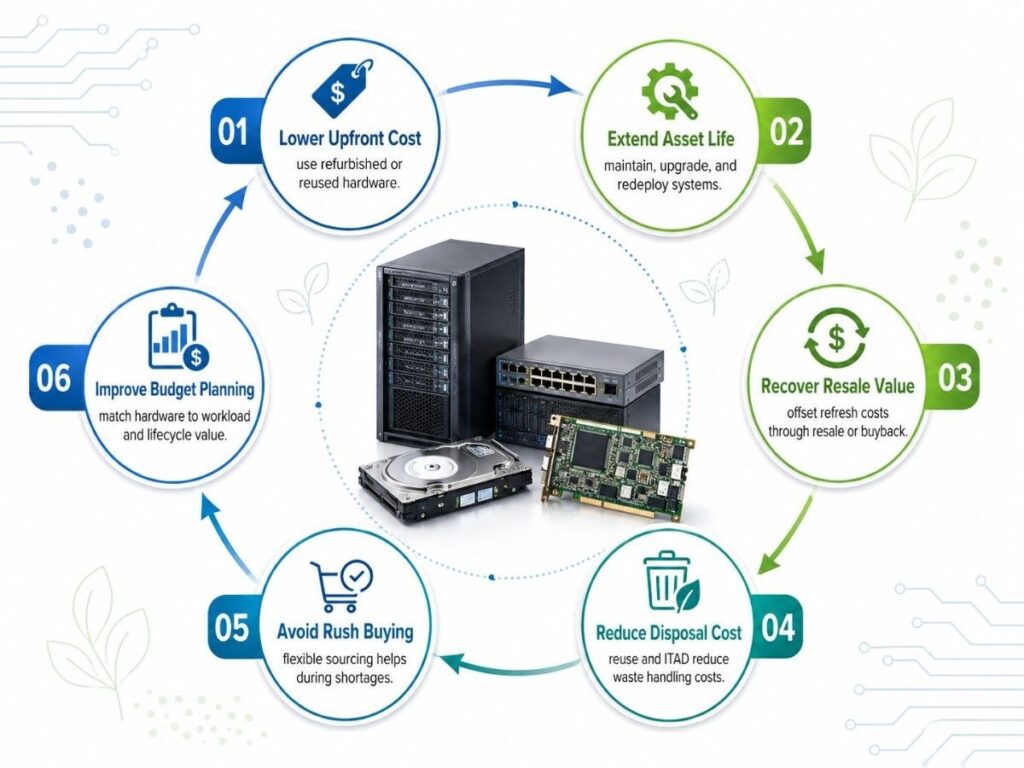
Circular IT lowers costs by helping companies get more value from hardware they already own. It also gives procurement teams more sourcing options when new equipment is too expensive, delayed, or not required for the workload.
Cost savings can come from extending hardware life, buying refurbished equipment, reselling retired assets, and avoiding rushed purchases.
| Cost Area | Circular IT Action | Budget Benefit |
| New purchases | Reuse or redeploy current assets | Delays capital spending |
| Expansion projects | Use refurbished hardware | Reduces upfront cost |
| Refresh cycles | Resell retired equipment | Recovers value |
| Emergency needs | Source from secondary markets | Reduces rush spending |
| End-of-life handling | Use structured ITAD | Lowers risk and disposal cost |
Circular IT also supports better total cost of ownership. The cheapest purchase is not always the best decision. Companies should review performance, support, energy use, deployment speed, resale value, and end-of-life cost.
A practical plan for hardware cost control helps finance and IT teams make decisions based on long-term value, not just the first invoice.
What Is the Role of Refurbished IT Hardware in Circular Economy?
Refurbished IT hardware plays a key role in the circular economy because it keeps working equipment in use longer. Instead of sending usable hardware into waste streams, the equipment is tested, repaired, cleaned, configured, and returned to productive use.
Refurbished hardware can support many enterprise needs, including:
- Backup systems
- Testing environments
- Development labs
- Branch office infrastructure
- Short-term capacity
- Legacy system support
- Cost-sensitive deployments
For many companies, refurbished supply options also help reduce lead-time risk. When new hardware is delayed, refurbished servers, switches, storage, or GPUs may help keep projects moving.
Refurbished does not mean “lower standard.” The quality depends on sourcing, testing, warranty terms, and supplier expertise. Enterprise buyers should look for clear testing processes, accurate grading, replacement part checks, and support options.
When used correctly, refurbished hardware can support both budget goals and sustainability goals. It gives companies a way to reduce waste without forcing every workload onto new equipment.
How Can Businesses Extend the Life of IT Assets?
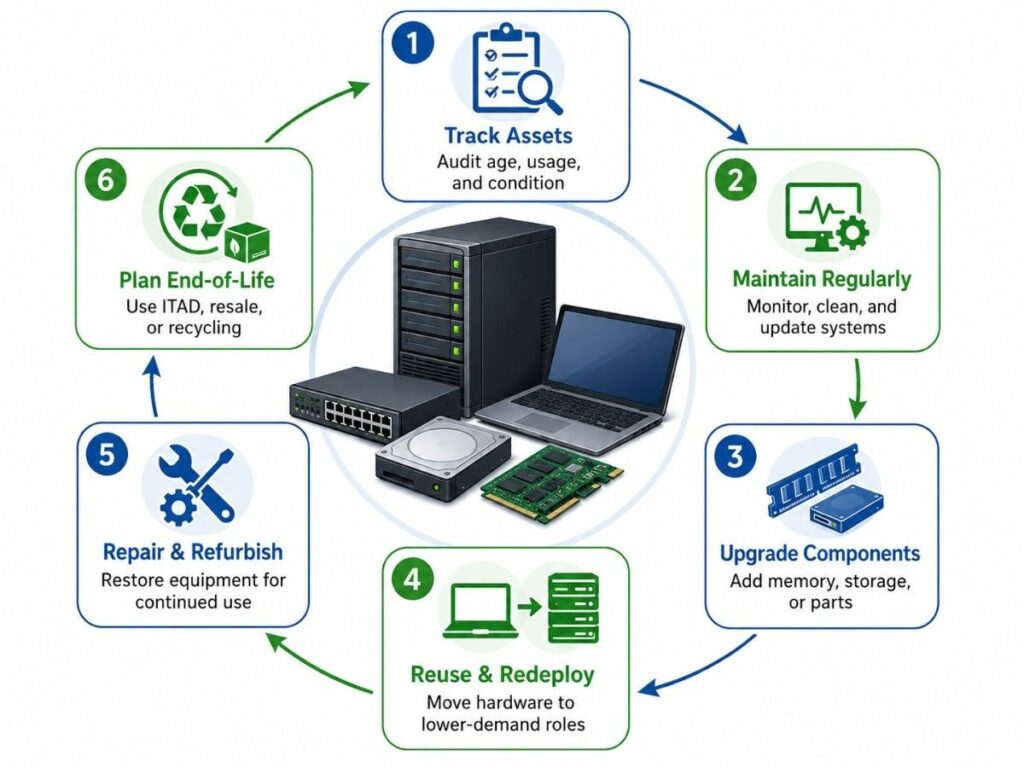
Businesses can extend the life of IT assets by planning for reuse before equipment reaches the end of its first role. This requires good tracking, regular maintenance, and clear refresh decisions.
Extending asset life does not mean keeping outdated hardware in critical systems. It means using each asset where it still makes sense.
Track Assets Across the Full Lifecycle
Companies need a clear view of what they own. Without asset visibility, equipment can be overbought, underused, lost, or stored too long after refresh.
A strong asset record should include:
- Model and serial number
- Age and warranty status
- Location and owner
- Current workload
- Configuration
- Data-bearing components
- Reuse or resale potential
This helps IT teams decide whether equipment should stay in service, move to another role, be sold, or go through ITAD.
Match Hardware to the Right Workload
Not every workload needs the latest generation hardware. Some systems need top performance, while others need reliability, capacity, or short-term availability.
Common reuse paths include:
- Servers for testing or backup
- Switches for labs or branch locations
- Storage for archive or non-critical data
- GPUs for lower-demand workloads
- Laptops for redeployment after secure wiping
This approach helps companies get more value from old enterprise servers and other retired assets before choosing resale or recycling.
Maintain, Upgrade, and Repair First
Small upgrades can extend hardware life. Memory, drives, power supplies, network cards, and firmware updates can keep systems useful for longer.
Before replacing equipment, teams should ask:
- Can this asset be upgraded?
- Can it move to a lower-demand workload?
- Is repair more cost-effective than replacement?
- Does it still have resale value?
- Does it need secure data removal before reuse?
These questions help prevent waste and reduce avoidable spending.
How Can Companies Start a Circular IT Strategy?
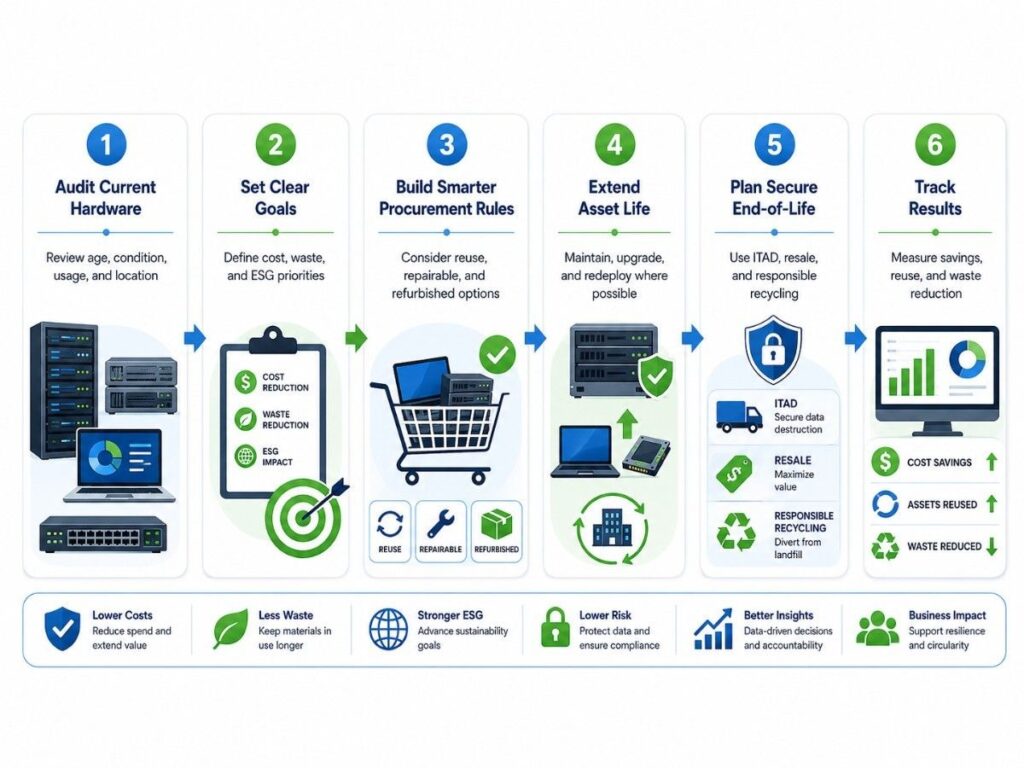
Companies can start a circular IT strategy by building simple rules for procurement, reuse, refresh, and disposal. The process does not need to be complex at first. It needs to be clear, repeatable, and tied to business goals.
| Step | Action | Business Outcome |
| 1 | Audit current hardware | Finds unused and aging assets |
| 2 | Classify workload needs | Matches hardware to purpose |
| 3 | Review reuse options | Extends asset value |
| 4 | Add refurbished sourcing | Improves cost and availability |
| 5 | Use secure ITAD | Reduces data and disposal risk |
| 6 | Track results | Supports ESG and budget reporting |
Start with an asset inventory. Then identify which systems are active, underused, near refresh, or ready for retirement.
Next, create a decision path. Some assets may be redeployed internally. Others may be resold, refurbished, recycled, or destroyed through a secure process.
A reliable secure ITAD process is important because retired equipment may contain sensitive data. Chain of custody, data destruction, and asset reporting help reduce risk.
Companies should also add refurbished equipment to their procurement options. A mixed sourcing model gives teams more flexibility when budgets are tight or when new hardware is not available quickly.
Is Circular Economy in IT the Future of Sustainable Technology?
Circular economy in IT is becoming a core part of sustainable technology because it connects cost control, waste reduction, and smarter procurement. It gives companies a way to support growth without treating every hardware need as a new purchase.
As infrastructure demand increases, businesses will need more flexible lifecycle models. AI, cloud, edge computing, remote work, and data center growth all place pressure on hardware supply and budgets.
Circular IT helps companies respond by making better use of existing assets. It also supports ESG goals through reuse, resale, recycling, and responsible end-of-life handling.
This does not mean new hardware will disappear. New systems will still be important for high-performance workloads, security needs, warranty coverage, and major infrastructure upgrades.
The future is more likely to be a blended model:
- New hardware where performance matters most
- Refurbished hardware where value and speed matter
- Redeployed assets where existing equipment still fits
- ITAD where secure retirement is required
- Recycling where equipment has no further use
This model gives enterprises more control over cost, supply risk, and sustainability impact.
What Should Enterprises Remember About Circular Economy in IT?
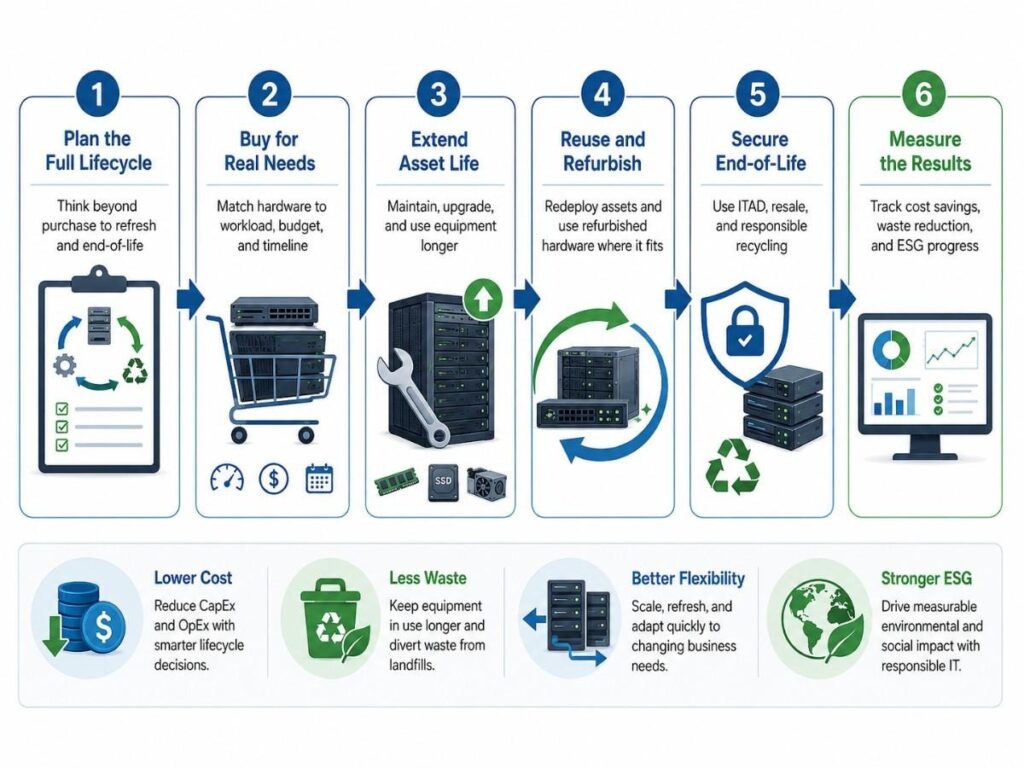
Circular economy in IT helps companies reduce waste, lower costs, and improve hardware planning. It turns IT asset management from a simple replacement cycle into a full lifecycle strategy.
For enterprises, the best results come from planning early. Procurement, IT, finance, security, and sustainability teams should work together before assets reach the end of life.
A strong circular IT approach can help companies:
- Make better buying decisions
- Reduce unnecessary hardware waste
- Lower infrastructure costs
- Recover value from retired equipment
- Improve refresh planning
- Support ESG goals
- Reduce supply chain risk
- Build a more flexible infrastructure strategy
Circular IT is not only about being more sustainable. It is about making smarter technology decisions from purchase to retirement.
Need a Practical Partner for Circular IT Planning?
Catalyst Data Solutions helps organizations make practical infrastructure decisions across new, refurbished, and hard-to-find hardware markets. As a vendor-agnostic partner, Catalyst works with leading OEMs such as Cisco, Arista, HPE, and NVIDIA while focusing on what fits each customer’s performance, budget, timeline, and availability needs.
Catalyst supports procurement, refresh planning, hardware reuse, and ITAD decisions so teams can reduce waste, recover value, and keep projects moving. Whether a company needs new infrastructure, tested refurbished equipment, or support during supply constraints, Catalyst helps create flexible options that align with real business needs.
FAQs
How does circular IT reduce e-waste?
Circular IT reduces e-waste by keeping usable equipment in service before disposal. Companies can redeploy hardware, buy refurbished equipment, resell retired assets, and recycle only when reuse is no longer practical.
Can circular IT lower infrastructure costs?
Yes, circular IT can lower infrastructure costs by reducing new purchases, extending asset life, and recovering value from retired hardware. It also gives teams more sourcing options when new equipment is delayed or over budget.
Is refurbished IT hardware reliable for business use?
Refurbished IT hardware can be reliable when it is properly tested, sourced, and configured. It is often used for backup, development, expansion, and cost-sensitive workloads.
How can a company start circular IT planning?
A company can start by auditing current assets, identifying reuse opportunities, adding refurbished sourcing options, and creating a secure ITAD process. Clear asset tracking is the first step.