


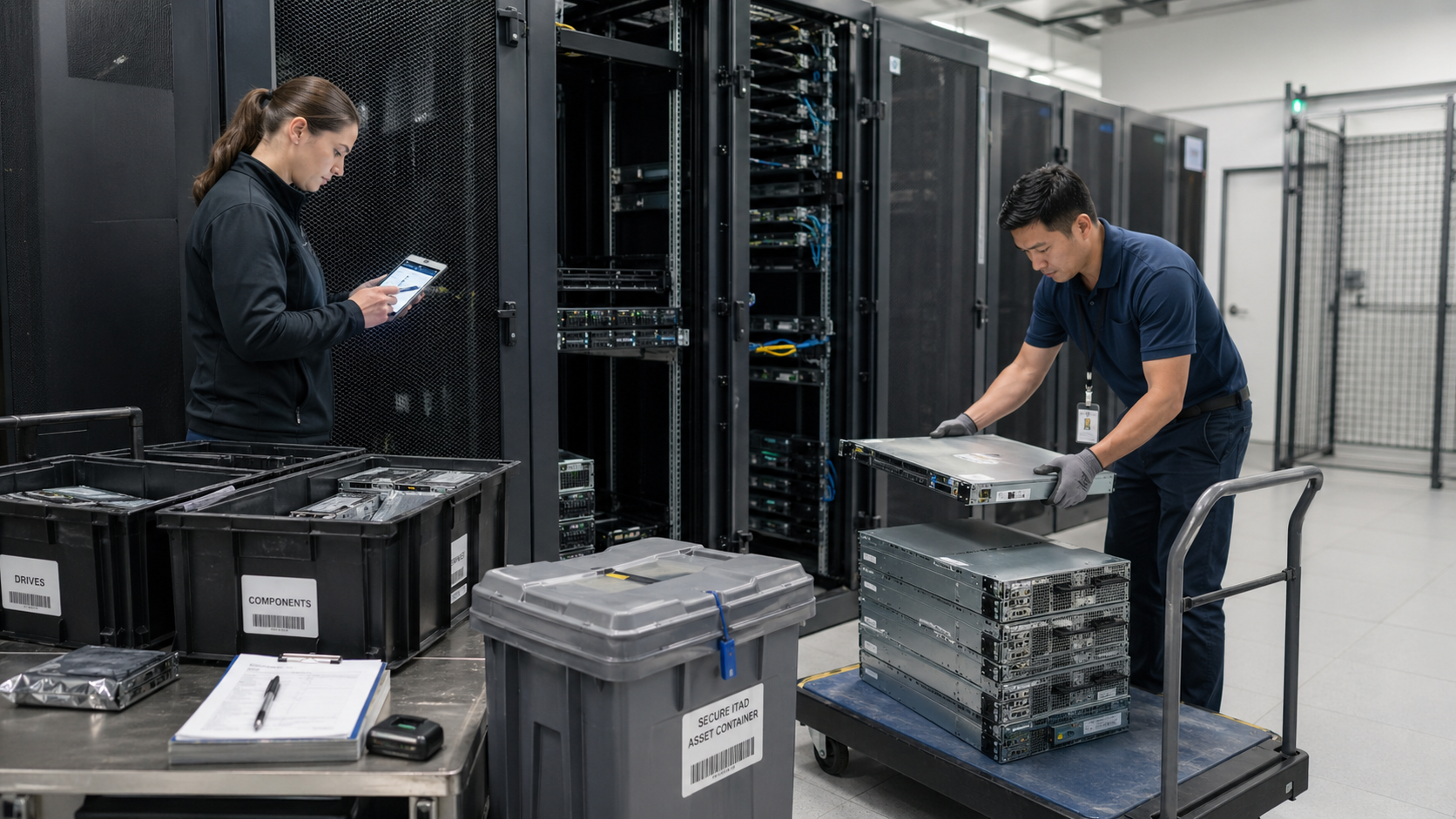
Enterprise IT teams are under pressure from both sides. New infrastructure is expensive, lead times can be unpredictable, and refresh cycles are happening faster in data centers, edge environments, and AI-driven deployments. At the same time, retired hardware still carries risk, value, and compliance obligations.
That is where IT Asset Disposition, or ITAD, becomes important.ITAD is the structured process of retiring IT equipment in a secure, documented, and financially responsible way. It covers what happens after servers, storage, networking gear, laptops, and other devices leave production.
That includes inventory review, data destruction, deinstallation, logistics, remarketing, recycling, and reporting.For many organizations, ITAD is no longer a side task. It is part of infrastructure planning. A mature program helps reduce risk, recover value, support sustainability goals, and make room for the next refresh. It also works best when connected to broader lifecycle decisions such as hardware sourcing strategy and long-term deployment planning.
Key Takeaways:
- ITAD securely retires IT equipment through data destruction, resale, recycling, and documented chain of custody.
- Strong ITAD programs reduce breach risk, support compliance, and recover value from retired enterprise hardware.
- Data center growth and faster refresh cycles are increasing demand for structured, lifecycle-focused ITAD programs.
- The best ITAD partners combine secure disposition, asset reporting, value recovery, and alignment with future infrastructure planning.
Why ITAD matters now
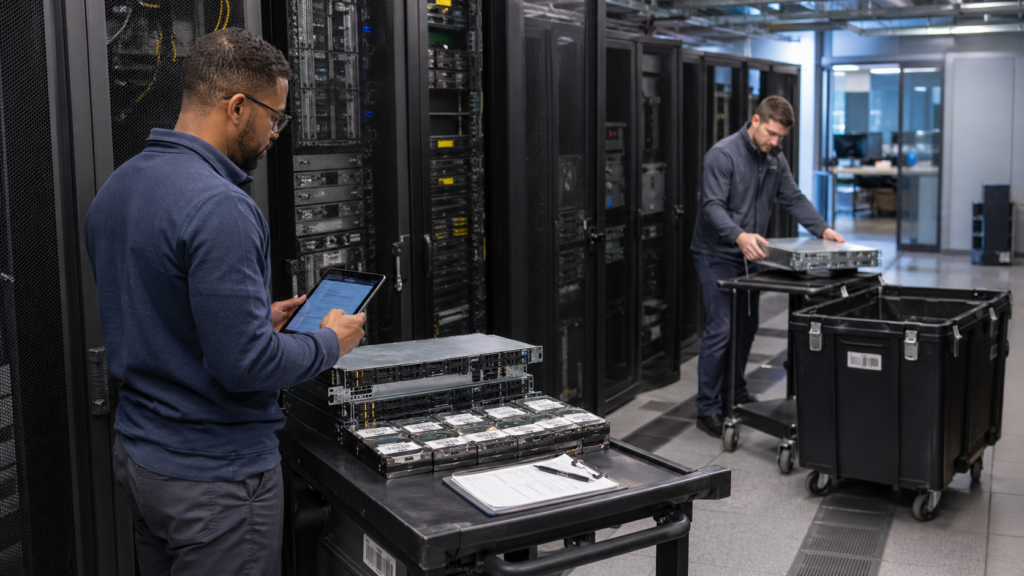
The demand for data center infrastructure keeps rising. More organizations are expanding compute, storage, and networking capacity to support virtualization, analytics, cloud connectivity, and GPU-heavy workloads.
As that expansion continues, older platforms are being replaced more often, which increases the volume of equipment that must be retired securely and efficiently. For many organizations, IT asset disposition is no longer a one-time cleanup task. It is an ongoing part of infrastructure lifecycle planning that affects security, compliance, cost recovery, and operational efficiency.
The demand for ITAD is also growing because the stakes are higher.
When retired equipment is mishandled, the consequences can be serious:
- Sensitive data may remain on drives, arrays, or backup media
- Asset records can become incomplete or inaccurate
- Compliance evidence may be missing
- Usable equipment may be scrapped too early
- Refresh budgets lose potential recovery value
Globally, e-waste reached 62 billion kilograms in 2022, and only 22.3% was formally collected and recycled. That makes structured end-of-life handling a business issue, not just an environmental one.
Security is another major driver. IBM reported that the global average cost of a data breach reached USD 4.88 million in 2024. Not every breach starts with retired hardware, but weak disposition practices create avoidable exposure, especially when storage devices leave controlled environments without documented sanitization. Teams aligning ITAD with a broader security compliance checklist usually reduce operational gaps between infrastructure, governance, and audit readiness.
Common reasons companies invest in ITAD
| Driver | Why it matters | Typical outcome |
| Security | Retired devices can still hold recoverable data | Lower breach and compliance risk |
| Cost control | Idle hardware ties up space and budget | Better value recovery and cleaner refresh planning |
| Sustainability | E-waste and reuse goals are under more scrutiny | More reuse, refurbishment, and responsible recycling |
| Operations | Large refreshes create logistical complexity | Faster site clearing and smoother upgrades |
Growing demand for data center infrastructure and for ITAD
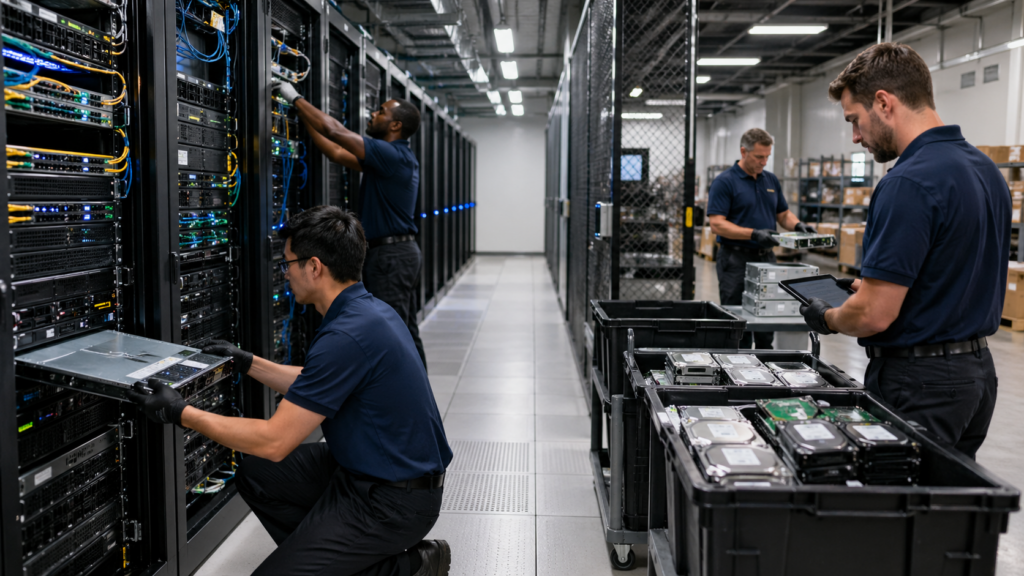
Data center growth creates a chain reaction. More servers, storage platforms, switches, and power systems eventually lead to more decommissions, migrations, and hardware swaps. That means ITAD demand rises alongside procurement demand.
In practice, several trends are driving that increase:
- Shorter refresh cycles for performance-sensitive environments
- Expansion of AI and GPU infrastructure
- Consolidation of legacy systems after modernization
- Mergers, relocations, and data center exits
- Pressure to reduce waste and document ESG activity
- Need to balance new purchases with refurbished or secondary-market options
This is why ITAD should be viewed as part of infrastructure lifecycle management, not just disposal. Enterprises that plan decommissioning early often make better decisions about resale, redeployment, and replacement timing. In supply-constrained markets, that same lifecycle view also supports more flexible use of new and refurbished assets through practical procurement support and post-installation maintenance coverage.
What usually enters the ITAD pipeline
| Asset type | Common ITAD concern | Value potential |
| Servers | Data on drives, de-racking, resale timing | Often high if within normal refresh window |
| Storage arrays | Sanitization and chain of custody | Moderate to high depending on model and age |
| Network gear | Configuration cleanup and compatibility | Often strong in secondary markets |
| Laptops/endpoints | Volume handling and user data | Varies by age and condition |
| GPUs/accelerators | Demand volatility and testing | Can retain meaningful value |
How to handle the ITAD process
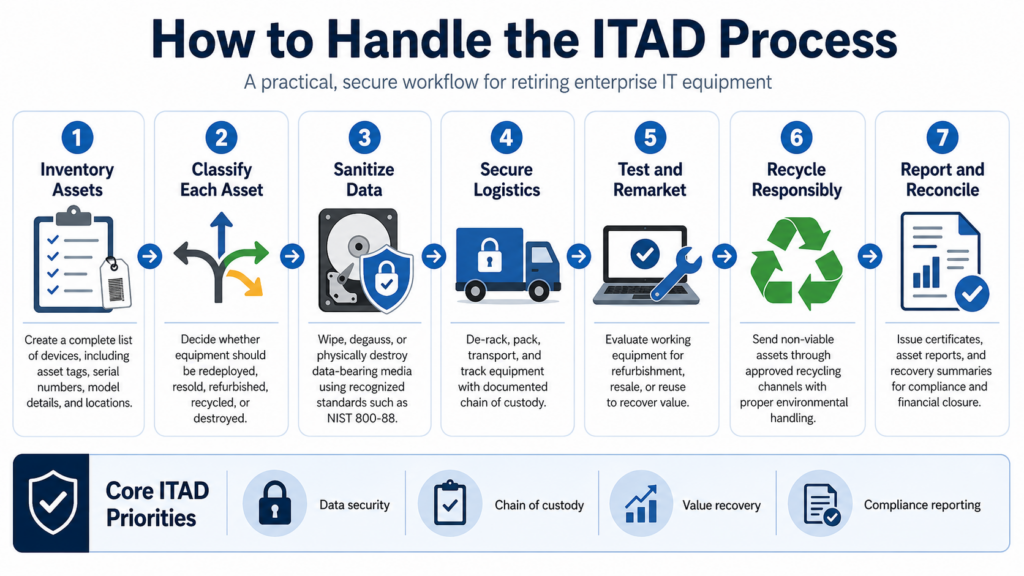
A strong ITAD process is repeatable, documented, and aligned with procurement, security, and finance teams. It should not begin the day equipment is removed. The best results come when organizations plan ITAD before the refresh starts.
A practical ITAD process
1. Build a full asset inventory
Start with a detailed list of devices being retired. Include asset tags, serial numbers, model details, location, configuration, and whether the unit contains storage media. This inventory becomes the foundation for valuation, chain of custody, and reporting.
2. Classify assets by next path
Not every device should be treated the same way. Separate assets into categories such as:
- Redeploy internally
- Resell or remarket
- Return under lease or contract
- Recycle
- Destroy
This step helps avoid two common mistakes: destroying equipment that still has value and holding obsolete equipment that adds no return.
3. Define data destruction requirements
Data-bearing assets need a clear sanitization method. That may include wiping, degaussing, or physical destruction, depending on policy and device type.
4. Secure logistics and chain of custody
Once devices leave racks, offices, or storage rooms, tracking matters. Serialized handling, tamper-evident packaging, and documented transfer points reduce risk and make audit reviews easier.
5. Test, grade, and remarket viable equipment
Assets that still hold value should be evaluated for refurbishment or resale. This is especially relevant for servers, network equipment, and selected accelerators. In many environments, resale proceeds can help offset future purchases or migration costs.
6. Recycle responsibly when resale is not viable
Some assets have no useful secondary-market value. Those should go through approved downstream recycling channels, with documentation that supports environmental and compliance needs.
7. Close with reporting and financial reconciliation
The final stage should include certificates of destruction, serialized asset reports, disposition summaries, and recovery-value reporting. That creates a clean end point for finance, operations, and compliance teams.
ITAD process at a glance
| Step | What happens | Why it matters |
| Inventory | Identify and document retired assets | Prevents loss and supports valuation |
| Data handling | Wipe, destroy, or sanitize media | Protects sensitive information |
| Logistics | Pack, track, and transport assets | Maintains control and auditability |
| Resale/recycling | Recover value or recycle responsibly | Balances budget and sustainability |
| Reporting | Issue certificates and summaries | Supports compliance and decision-making |
5 benefits of implementing ITAD
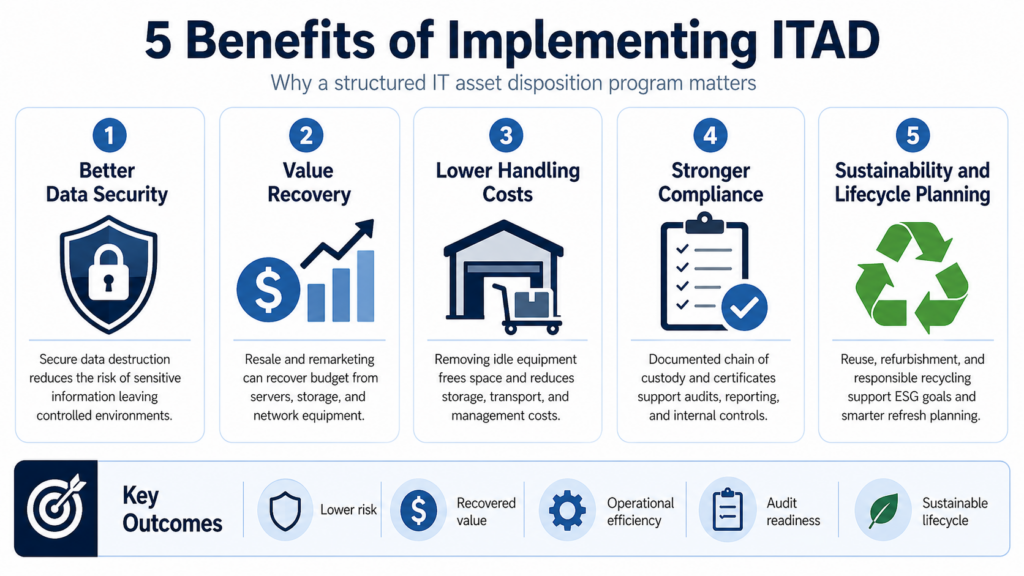
A structured ITAD program delivers more than clean-up. It supports operational, financial, and risk goals.
1. Better data security
Secure sanitization reduces the chance that retired equipment becomes a security gap. It also supports stronger control alignment with broader cybersecurity planning and segmented access models such as zero trust rollout.
2. Value recovery
Many organizations can recover budget from decommissioned servers, networking gear, and other enterprise assets when they are evaluated and remarketed at the right time.
3. Lower storage and handling costs
Unused hardware often sits in cages, closets, or warehouses. ITAD clears that backlog and reduces hidden carrying costs.
4. Stronger compliance posture
Documented chain of custody, certificates, and asset-level reporting support internal controls and external audit needs.
5. Improved sustainability and lifecycle planning
Reuse, refurbishment, and responsible recycling support circular-economy goals while giving procurement teams more options for future refreshes.
How to choose an ITAD partner

Not all ITAD providers offer the same level of control, reporting, or infrastructure understanding. A good partner should fit your operating model, not force a generic process.
Look for these capabilities:
- Documented data sanitization methods aligned with recognized standards
- Clear chain of custody from pickup through final disposition
- Asset-level reporting with serial tracking and certificates
- Remarketing expertise to recover fair value where possible
- Recycling transparency for non-resellable assets
- Operational reach for data center, branch, and multi-site projects
- Lifecycle perspective that connects ITAD with procurement and refresh planning
Need a more practical approach to IT refresh and retirement?
Catalyst Data Solutions works closely with leading OEMs such as Cisco, Arista, HPE, and NVIDIA to help organizations manage infrastructure decisions across the full hardware lifecycle.
As a vendor-agnostic partner, Catalyst focuses on what fits each environment best, whether that means supporting a new deployment, identifying reliable refurbished options, or handling secure IT asset disposition during a refresh.
Our role is to provide practical guidance and flexible sourcing strategies that align with performance goals, budget requirements, and real-world timelines.
FAQ
1. What makes Catalyst Data Solutions different from traditional IT resellers?
This fits well because the article is not only about disposal. It also frames ITAD as part of a broader infrastructure lifecycle. This FAQ reinforces Catalyst’s vendor-agnostic and advisory position in a natural way.
2. Can Catalyst source hard-to-find or backordered IT hardware?
This is relevant because your article includes:
- Growing demand for data center infrastructure
- Supply pressure
- Lifecycle planning tied to refresh and replacement decisions
It helps connect ITAD with the reality that retired hardware decisions often happen alongside replacement planning.
3. What role does Catalyst play in IT hardware lifecycle management?
This is the strongest fit overall. Your article is built around lifecycle thinking, not just disposal. This FAQ supports the main article theme and strengthens Catalyst’s positioning as a practical partner.
4. What is the safest way to dispose of enterprise IT hardware?
This matches closely with:
- How to handle the ITAD process
- How to choose an ITAD partner
It also reinforces the practical side of the article by covering secure data destruction, chain of custody, and proper recycling or resale channels.
5. How often should companies review their IT assets for disposal or resale?
Most organizations review IT assets during major refresh cycles, which often happen every 3 to 5 years in data center environments. Waiting too long can reduce resale value, increase storage costs, and create tracking issues. A regular review helps teams identify what should be reused, sold, or retired before assets become obsolete
6. Is it better to resell old IT equipment or recycle it?
It depends on the age, condition, and market demand for the equipment. Hardware that is still functional may recover 10% to 40% of original value, especially servers, storage, and networking gear within normal lifecycle windows. Recycling is usually the better option when equipment has little resale value, fails testing, or no longer meets reuse standards.
7.Can ITAD help reduce the cost of infrastructure upgrades?
Yes, ITAD can help reduce upgrade costs by recovering value from equipment that is no longer needed. In many cases, proceeds from resale or buyback can offset part of the cost of replacement hardware. This becomes more important when organizations are balancing capital budgets and considering refurbished equipment that may lower upfront costs by 30% to 70
8. What should companies prepare before contacting an ITAD provider?
The best starting point is a clear asset list. That usually includes model numbers, quantities, asset tags, condition, location, and whether the equipment contains storage media. Having this information ready makes it easier to estimate resale value, identify data destruction needs, and move the process forward faster with fewer delays.