



Choosing an E-Rate vendor is one of the most important decisions in a school or library network project. The lowest price may look attractive, but it may not always include the right hardware, support, licenses, accessories, or delivery timeline. A weak bid can create delays, budget gaps, and compatibility issues after the project begins.
A strong vendor selection process gives IT and procurement teams a better way to compare bids. It helps buyers look at eligible price, OEM fit, lead times, warranty coverage, service capability, and lifecycle value in one structured process. That structure matters when public funds, local budgets, and network uptime are all involved.
This article breaks down E-Rate vendor selection in a practical way. You will learn how Form 470 and RFP alignment work, why price must be the primary factor, how to build a bid evaluation matrix, and how schools compare OEMs, resellers, and channel partners before choosing a solution.
What Is E-Rate Vendor Selection?
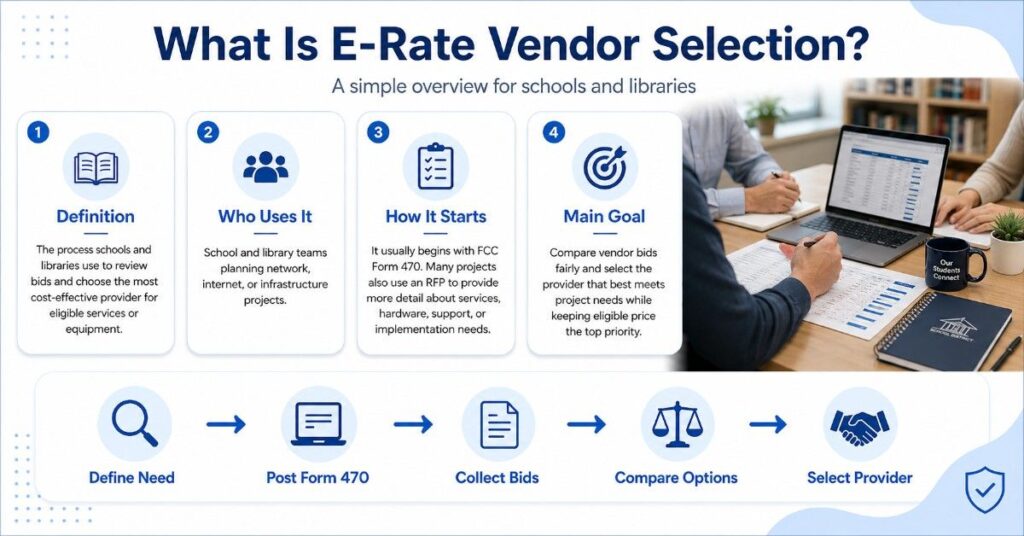
E-Rate vendor selection is the process schools and libraries use to review bids and choose the most cost-effective provider for eligible services or equipment.
The process usually starts with FCC Form 470. In many projects, the applicant also uses an RFP to give vendors more detail about the requested network services, hardware, support, or implementation needs.
For buyers still building the foundation, a clear E-Rate planning guide can help separate eligible infrastructure from broader IT budget items before the bid language is created.
| E-Rate Question | Simple Answer |
| What is vendor selection? | The process of comparing bids and choosing the most cost-effective provider |
| Who uses it? | Schools, libraries, districts, library systems, and consortia |
| What starts the process? | FCC Form 470 and, when used, an RFP |
| What matters most? | Price of eligible products and services |
| What else matters? | Compatibility, support, lead time, lifecycle fit, and service capability |
How Does the E-Rate Competitive Bidding Process Work?
The E-Rate competitive bidding process gives service providers a fair chance to respond to a school or library’s request. The goal is to help applicants receive fair pricing, clear options, and supportable project proposals.
Applicants describe what they need through Form 470 and any related bid documents. Vendors then respond with pricing, product details, service terms, and project assumptions.
A practical E-Rate bidding process usually includes:
- Defining the network or connectivity need
- Posting Form 470
- Attaching an RFP when more detail is needed
- Waiting through the required bidding window
- Receiving and organizing vendor responses
- Scoring bids with a documented method
- Selecting the most cost-effective provider
- Keeping records for future review
E-Rate discounts generally range from 20% to 90% for eligible services. That discount can reduce the eligible cost, but schools still need to plan for the local share and non-eligible items through a broader E-Rate funding plan.
Pre-Bidding: How Form 470 and RFP Alignment Prevents Weak Bids
Pre-bidding is where many vendor selection problems begin. Form 470 and the RFP should describe the same project need, equipment scope, service expectations, and response requirements.
If these documents do not align, vendors may price different assumptions. One vendor may include optics and support, while another may price only switches or access points. That makes bid comparison harder and less reliable.
A stronger pre-bid scope should define:
- Project locations
- Current network environment
- Category One or Category Two need
- Required hardware or approved equivalents
- Port counts and PoE requirements
- Wireless coverage goals
- Cabling or fiber needs
- Firewall throughput needs
- Licensing and support expectations
- Delivery and installation timing
- Bid response format
A district planning a switching refresh may compare Cisco Catalyst, HPE Aruba, Extreme Networks, Juniper switching, or equivalent options. A library upgrading public Wi-Fi may compare Meraki, HPE Aruba, Juniper Mist, or other campus wireless platforms.
When E-Rate planning overlaps with broader public-sector purchasing, SLED buying options can help teams think through contracts, local rules, and hardware fulfillment paths.
Why Price Must Be the Primary Factor in E-Rate Vendor Selection
Price is the golden rule in E-Rate vendor selection. The price of eligible products and services must receive the highest weight in the bid evaluation.
This does not mean the cheapest bid must always win. It means eligible price must count more than any other single evaluation factor. Schools can still consider compatibility, support, lead times, warranty, and lifecycle fit.
What price-first evaluation means:
- Price must receive the highest score weight
- Eligible costs should be separated clearly
- The same scoring method should apply to all valid bids
- Non-price factors can still matter
- The final decision should be documented
What it does not mean:
- Schools must ignore support quality
- Schools must accept incomplete quotes
- Schools must choose missing or incompatible hardware
- Schools must accept unrealistic delivery dates
- Schools must treat all OEM options as equal
A low bid can become expensive if it excludes required optics, licenses, power supplies, stacking cables, or support. A complete bid may cost more but reduce project risk.
How to Structure a Bid Evaluation Matrix
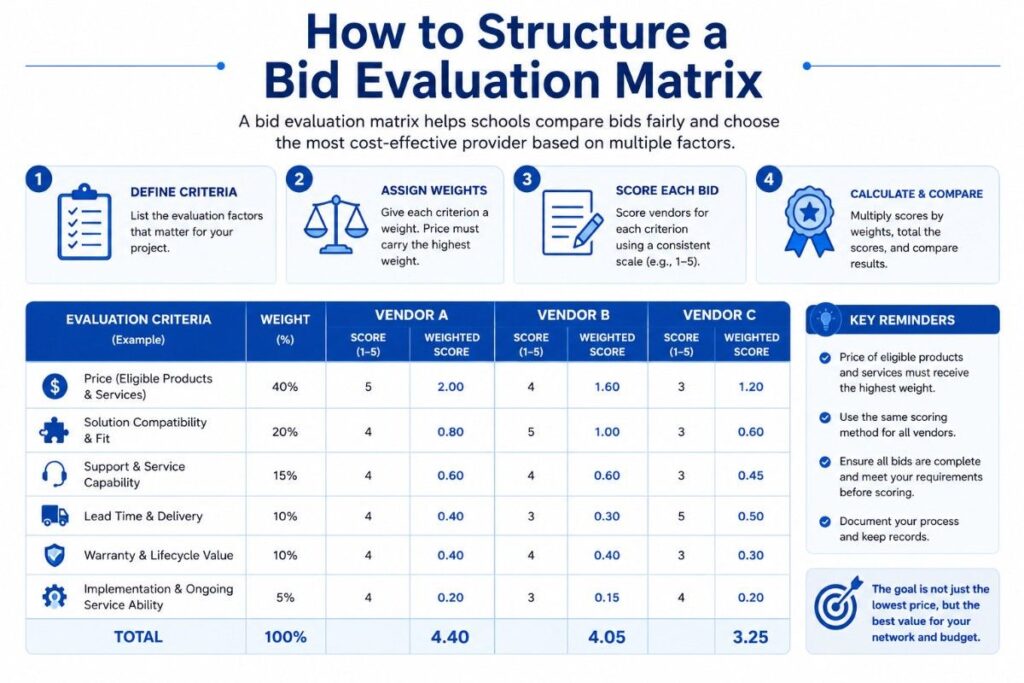
A bid evaluation matrix helps schools and libraries compare vendors in a clear and consistent way. It turns the selection process into a documented scoring model instead of a loose discussion.
The matrix should match the project. A simple internet service bid may need fewer factors. A full network refresh needs more structure because hardware, support, availability, and compatibility can all affect success.
| Sample Evaluation Factor | Suggested Weight | Buyer Question |
| Eligible price | 35% | Is this the strongest eligible price? |
| Compatibility | 20% | Does it fit the current network? |
| Lead time | 15% | Can the vendor deliver on schedule? |
| Warranty/support | 15% | Are support terms clear and practical? |
| Service capability | 10% | Can the vendor quote, source, and fulfill the project? |
| Lifecycle fit | 5% | Does it support long-term standards? |
This is only a sample. Applicants should build their own matrix based on program rules, project needs, and local procurement policy.
For hardware-heavy projects, the matrix should test more than the purchase price. A network refresh plan may include switches, APs, optics, cabling, licensing, and support that must work together.
How to Calculate the Price Score Scientifically
A price score should be easy to explain. The goal is to compare vendors using the same formula, not personal preference.
One common method gives the lowest eligible price the full price score. Higher-priced bids receive a proportional score based on how close they are to the lowest eligible bid.
Formula:
Lowest eligible bid ÷ vendor eligible bid × maximum price points = vendor price score
| Vendor | Eligible Price | Formula | Price Score |
| Vendor A | $80,000 | $80,000 ÷ $80,000 × 35 | 35.0 |
| Vendor B | $92,000 | $80,000 ÷ $92,000 × 35 | 30.4 |
| Vendor C | $100,000 | $80,000 ÷ $100,000 × 35 | 28.0 |
This method keeps price objective while leaving room for secondary factors. It also helps procurement teams explain why the selected vendor scored highest overall.
The price score should focus on eligible services and equipment when evaluating E-Rate-funded items. Non-eligible items should be tracked separately so the full project budget remains clear.
How Schools Evaluate Price, Compatibility, Lead Times, and Lifecycle Fit
A strong E-Rate vendor selection process looks beyond the first number on the quote. Schools and libraries need bids that support the actual network, the funding plan, and the installation timeline.
The best evaluation process connects IT, procurement, and budget needs. It helps the team select hardware that works now and remains supportable over time.
Price and Eligible Cost
Buyers should compare eligible price, local share, and total project cost. A bid may appear cheaper because it leaves out important parts.
Common missing items include:
- Optics and transceivers
- Stacking cables
- Power supplies
- Mounting kits
- Licenses
- Support contracts
- Warranty coverage
- Delivery or staging costs
A Wi-Fi project may include eligible access points and PoE switches, while endpoint software, cloud tools, or staff devices may need other funds. Buyers should keep those costs separated.
Compatibility and OEM Fit
Compatibility matters because most schools and libraries already have standards. A district may use Cisco Catalyst switching, HPE Aruba wireless, Fortinet firewalls, or Juniper Mist management in key environments.
Vendor-neutral evaluation does not mean every OEM is equal for every site. It means the buyer compares Cisco Catalyst, Meraki, HPE Aruba, Fortinet, Juniper, Arista, and Extreme Networks based on project fit.
Compatibility checks should include:
- Current switch and AP environment
- Controller or cloud management model
- Firewall and routing needs
- PoE and bandwidth requirements
- Optics and module compatibility
- Support and licensing model
- Internal team skill set
A campus wireless project should define AP count, PoE capacity, coverage needs, and licensing before vendors price school Wi-Fi upgrades.
Lead Times, Support, and Lifecycle Risk
Lead time can change the value of a bid. A low price may not help if equipment arrives after the summer installation window or after a grant timeline.
Support also affects lifecycle cost. Buyers should review warranty terms, licensing renewals, end-of-sale timelines, replacement options, and future expansion needs before choosing a vendor.
Key lifecycle questions include:
- Is the product current or near end-of-sale?
- Is support available for the planned lifecycle?
- Are licenses included for the right term?
- Can the vendor source replacements later?
- Will the platform support future growth?
- Are compatible alternatives available if inventory changes?
How Buyers Compare OEMs and Channel Providers
Many E-Rate infrastructure projects involve both OEMs and channel providers. The OEM makes the equipment. The channel partner helps source, quote, configure, and fulfill the solution.
This matters because schools do not only buy model numbers. They buy a working project outcome. That outcome may depend on availability, compatible accessories, bundle accuracy, warranty terms, and delivery timing.
| OEM / Provider Area | What Buyers Compare | Common Project Use |
| Cisco Catalyst / Meraki | Switching, wireless, cloud-managed options | District networks and campus Wi-Fi |
| HPE Aruba | Campus switching and wireless | Schools and libraries with Aruba standards |
| Fortinet | Firewalls and edge security | Network security and internet edge projects |
| Juniper Mist / Juniper | AI-driven wireless and switching | Modern campus and network refreshes |
| Arista | High-performance switching | Data center or advanced network environments |
| Extreme Networks | Campus networking | K-12 and public-sector networks |
| Channel providers | Sourcing, quoting, fulfillment | Complete hardware and support packages |
A channel provider can help buyers compare real options across OEMs, distributors, and inventory channels. That support does not replace the applicant’s evaluation process. It helps create cleaner, more complete quotes.
For multi-category projects, hardware sourcing support can help translate a rough bill of materials into a quote-ready hardware package.
How Product Availability Changes Real Project Planning
Product availability affects budget, timing, and vendor selection. Schools and libraries often work around board approvals, school breaks, public access schedules, funding windows, and installation timelines.
A bid with strong pricing may still create risk if switches, APs, firewalls, or optics are backordered. Buyers should ask whether the delivery date is firm, estimated, or dependent on uncertain inventory.
Availability questions to ask vendors:
- Is the quoted hardware available now?
- Are all accessories included?
- Are delivery dates confirmed?
- Are approved equivalents available?
- Can the vendor source through distribution?
- Are licenses and support available on the same timeline?
- Can delivery be staged by site?
- Are refurbished options only for non-E-Rate scope?
A school may prefer new standardized hardware for an eligible refresh while using refurbished inventory for local-funded spares or legacy replacements. Buyers should verify funding eligibility and procurement rules before mixing sourcing paths.
For budget-sensitive planning, network cost control can help teams compare new, available, and refurbished options without weakening performance goals.
Why Documentation Matters After Vendor Selection
Documentation explains how the applicant moved from bid request to vendor decision. It also helps future reviewers understand why one vendor scored higher than another.
Good documentation should show what was requested, who responded, how bids were scored, and why the selected vendor was the most cost-effective option under the evaluation method.
A practical documentation file may include:
- Form 470
- RFP or bid document
- Vendor questions and answers
- Addenda
- All received bids
- Evaluation matrix
- Price score calculation
- Selection notes
- Contract or purchase records
- Board approval records
- Final quote
- Delivery and inventory records
Documentation also helps internal teams. A future IT director may need to know why the district chose one switching platform. A procurement officer may need to explain why a higher-priced bid won after full scoring.
How to Prepare for Audit-Ready Records Without Treating Vendors as Compliance Advisors
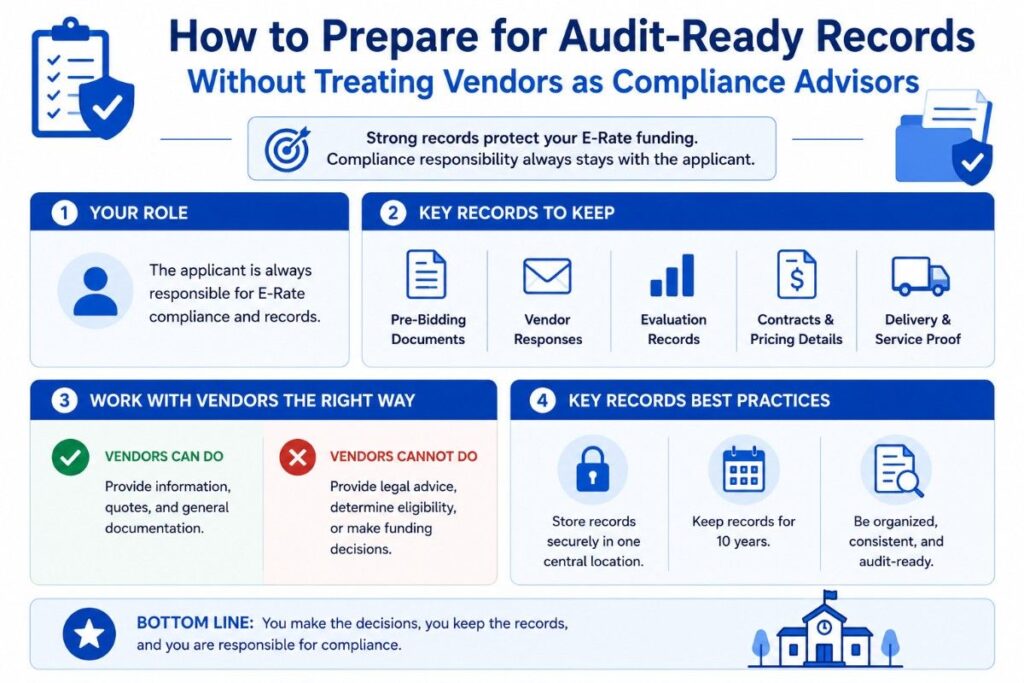
Audit-ready records should stay under the control of the applicant, consultant, or authorized program support team. A hardware vendor should not be treated as an E-Rate legal, filing, or compliance advisor.
A sourcing partner can still support the record package by providing itemized quotes, part numbers, fulfillment details, warranty terms, support details, delivery records, and hardware documentation.
Applicant-owned records should make the process easy to trace:
- What was requested
- Which vendors responded
- How bids were scored
- Why the winner was selected
- What was purchased
- What was delivered
- Where the equipment was installed
- Which records support the project
USAC guidance states that E-Rate participants must retain documentation for 10 years after the relevant funding year or service delivery deadline. That makes organized records useful long after the equipment is installed.
Practical Example: Comparing Three Network Refresh Bids
A mid-size school district plans a Category Two network refresh. The project includes access switches, PoE capacity, core switching, optics, stacking accessories, licensing, support, and delivery before summer installation.
The district receives three bids. The lowest price does not automatically win because the team must score price, compatibility, lead time, support, service capability, and lifecycle fit.
| Vendor | Strength | Risk | Likely Review Point |
| Vendor A | Lowest eligible price | Missing optics and unclear lead time | Strong price, weaker completeness |
| Vendor B | Complete scope and confirmed delivery | Higher eligible price | Better support and lower project risk |
| Vendor C | Alternate OEM with good pricing | More retraining and migration work | Needs deeper compatibility review |
In this example, Vendor B may win if the total score is highest. The decision should be supported by the published evaluation matrix and clear documentation.
This is why structured E-Rate vendor selection matters. It helps schools compare complete project value, not only the first price on the quote.
Common Hardware Buyers Compare During E-Rate Vendor Selection
E-Rate bidding often connects directly to infrastructure planning. Buyers may start with a funding need, but the final decision depends on real equipment, accessories, licenses, support, and delivery.
Common school and library purchases include:
- Access switches
- Core switches
- Wireless access points
- Routers
- Firewalls for edge planning
- Cabling and fiber
- Optics and transceivers
- Stacking cables
- Power supplies
- Mounting kits
- Support and maintenance
- Network controllers
- Cloud management tools
A public library may compare APs, switches, cabling, and public Wi-Fi management tools. A district may compare Cisco Catalyst switching, Meraki wireless, HPE Aruba APs, Fortinet firewalls, Juniper switching, or Extreme campus networking.
Some SLED buyers also compare servers, storage, and backup hardware during broader infrastructure planning. These items may not all fall inside E-Rate, so teams should separate funding paths before quoting.
For K-12 projects that include network and broader infrastructure needs, education IT planning can help organize hardware categories before procurement starts.
E-Rate Vendor Selection Checklist for Schools and Libraries
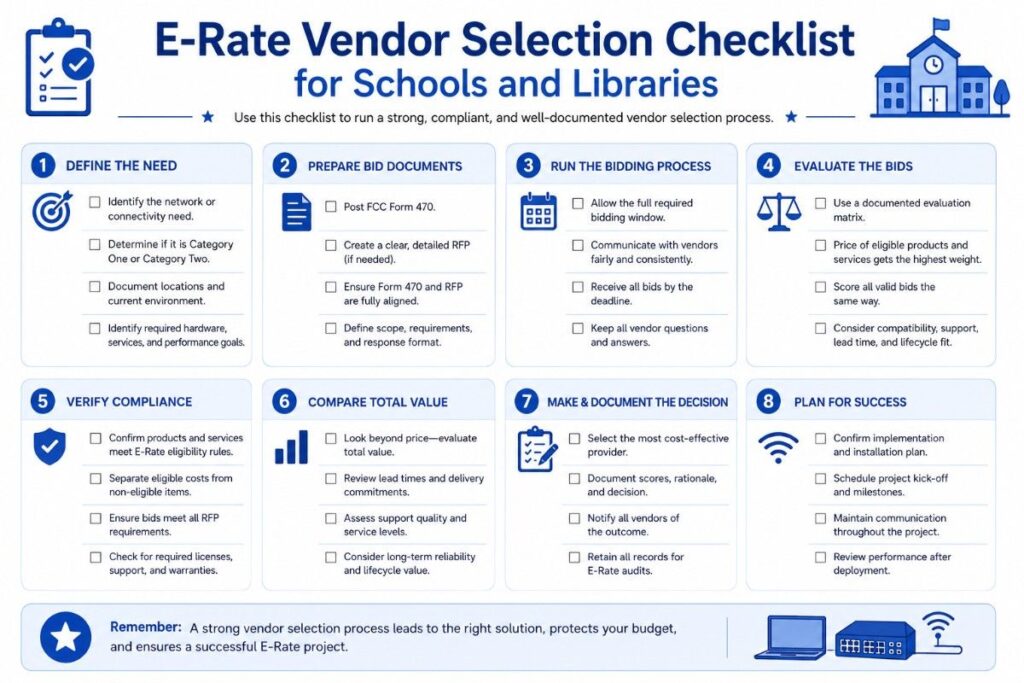
A clear checklist keeps IT, procurement, finance, and leadership teams aligned. It also helps buyers avoid rushed decisions when project timelines become tight.
Before posting, define the project. During bidding, treat vendors fairly. During evaluation, use the same scoring method. After selection, confirm the final quote and keep records organized.
| Checklist Area | What to Confirm |
| Project scope | Sites, goals, hardware categories, and service needs |
| Form 470/RFP | Aligned language and clear response requirements |
| Bid review | Same criteria used for every valid bid |
| Price scoring | Eligible price receives the highest weight |
| Technical fit | Compatibility, support, lifecycle, and availability reviewed |
| Vendor capability | Sourcing, quoting, delivery, and fulfillment checked |
| Final records | Bids, matrix, notes, quote, and delivery records retained |
A good process is practical, consistent, and easy to explain. It helps schools and libraries choose a vendor without turning the sourcing partner into a compliance advisor.
Need Help Comparing New, Refurbished, and Hard-to-Find Hardware?
A strong E-Rate project starts with a clear hardware plan. Catalyst Data Solutions helps schools and libraries compare practical options for switches, access points, routers, optics, cabling, support, and related infrastructure across major OEMs, new inventory, refurbished options, and hard-to-find equipment.
Catalyst data solution inc supports the hardware sourcing and fulfillment side, helping buyers move from network scope to quote-ready solutions through OEM, channel, distribution, and refurbished market access where appropriate.
FAQs
Does E-Rate require schools to choose the lowest bid?
No. Price of eligible products and services must receive the highest weight, but the lowest bid does not always win. Schools and libraries may also score compatibility, support, lead time, service capability, and lifecycle fit.
Can Catalyst help if our preferred equipment has long lead times?
Yes. Catalyst can help check channel, distribution, refurbished, and hard-to-find inventory options where appropriate. This can be useful when a school or library has a tight installation window, a phased refresh plan, or an urgent replacement need.
Does Catalyst handle E-Rate filing or compliance work?
No. Catalyst does not act as an E-Rate legal, filing, or compliance advisor. Catalyst supports the hardware sourcing and fulfillment side by helping buyers build quote-ready equipment plans, compare OEM/channel options, and source infrastructure based on budget, timeline, and compatibility needs.
Can a school name a preferred OEM in an E-Rate bid?
Schools may have existing standards, but bid language should be handled carefully. Many applicants allow equivalent products where appropriate. Buyers should use official FCC and USAC guidance before writing restrictive specifications.
What should a vendor include in an E-Rate hardware bid?
A strong bid should include part numbers, quantities, eligible and non-eligible costs, licensing, warranty terms, support details, delivery timing, assumptions, and required accessories.
How should schools compare resellers and channel partners?
Schools should compare price, product availability, channel access, support capability, bill-of-material accuracy, fulfillment timing, and ability to source compatible components.
Why does product availability matter in E-Rate projects?
Availability affects whether hardware arrives before installation windows, school breaks, testing periods, or funding deadlines. A low-price quote can still create risk if equipment is backordered.
Can refurbished hardware be used in an E-Rate-funded project?
Do not assume refurbished hardware is eligible. Schools and libraries should verify eligibility for the exact product, request, and funding source. Refurbished hardware may still help with local-funded spares or legacy replacements.
How long should E-Rate bidding records be kept?
E-Rate participants should retain documentation under official program rules. Records may include Form 470, RFPs, bids, evaluation notes, scoring matrices, contracts, invoices, delivery records, and inventory documentation.