



Regulated organizations cannot evaluate an infrastructure partner on technical capability alone.A server refresh, network change, maintenance visit, cloud connection, hardware shipment, or asset retirement can affect security controls, audit records, data handling, and operational risk.
A decision that appears routine to an IT team may later need to be explained to security leaders, compliance teams, auditors, procurement, or regulators.
The real risk often appears after the contract is signed. Responsibilities may be unclear. A subcontractor may enter the delivery chain without enough oversight. Hardware may move without a complete custody record. A change may be technically successful but poorly documented. During an audit or incident, the organization may then struggle to prove who did what and why.
A strong infrastructure partner reduces that uncertainty. It should help you define responsibilities, verify relevant controls, document changes, manage third-party dependencies, protect the hardware lifecycle, and produce evidence your team can use later.
What Should You Look for in an IT Infrastructure Partner?
For a regulated industry, a good infrastructure partner should be able to answer six questions clearly:
- What parts of the environment and project are you responsible for?
- What security controls apply to the work you perform?
- What evidence supports your compliance and certification claims?
- How will changes, maintenance, and privileged access be controlled?
- How will hardware and data-bearing assets be tracked throughout their lifecycle?
- What documentation will our organization receive for security reviews and audits?
The answers should be specific to your project. They should also identify where responsibility remains with your organization, an OEM, a cloud provider, an MSSP, or another specialist.
Organizations with sector-specific infrastructure needs can align these requirements with their broader regulated industry infrastructure solutions strategy rather than treating compliance as a final check after the architecture has already been chosen.
1. Define Regulatory Scope and Responsibility Before Evaluating Products
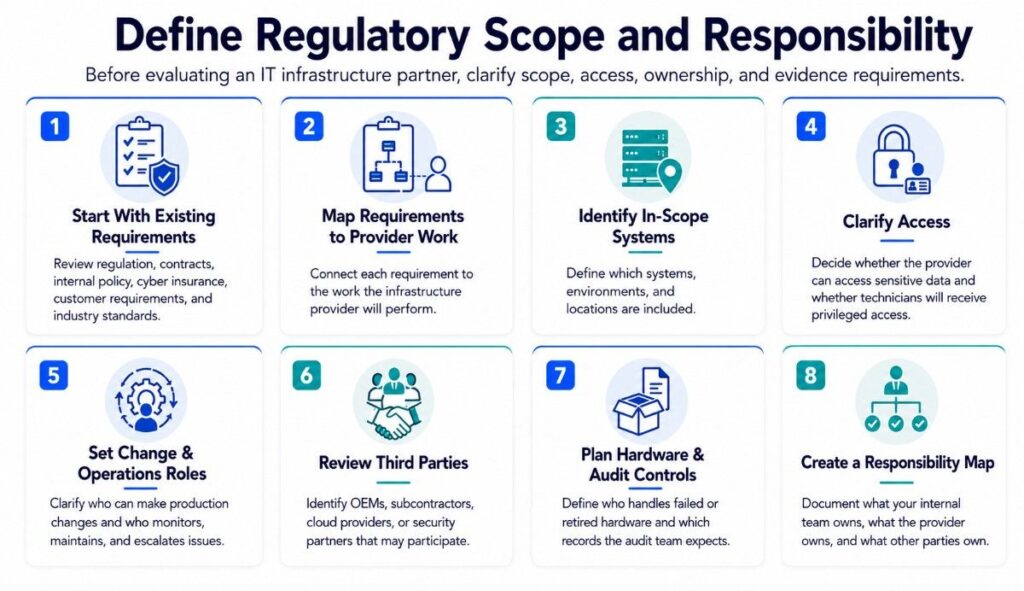
The first step in choosing an IT infrastructure partner is not comparing hardware brands.
It is defining the environment the partner will enter.
Start with the requirements that already apply to your organization. These may come from regulation, contracts, internal policy, cyber insurance, customer requirements, or industry standards.
Then map those requirements to the work the infrastructure provider will perform.
For example, determine:
- which systems and locations are in scope;
- whether the provider can access sensitive data;
- whether technicians will receive privileged access;
- who can make production changes;
- whether third parties will participate;
- who handles failed or retired hardware; and
- which records your audit team expects.
A written responsibility map is useful here. It should show what your internal team owns, what the provider owns, and what other parties own.
| Area | What You Should Clarify | Evidence to Request |
| Architecture | Who designs, reviews, and approves the environment? | Architecture records and approval process |
| Security | Who owns identity, segmentation, logging, backup, and hardening? | Responsibility matrix and control documentation |
| Operations | Who monitors, maintains, changes, and escalates issues? | Support and escalation procedures |
| Hardware | Who sources, receives, services, transports, and retires assets? | Asset and custody records |
| Third parties | Which OEMs, subcontractors, cloud providers, or security partners participate? | Partner and subcontractor disclosures |
At Catalyst Data Solutions, we work across infrastructure architecture, sourcing, deployment, support, maintenance, and asset lifecycle requirements.
When our work involves multi-OEM technology partners, we believe the responsibility model should remain clear even when several technology providers are involved.
2. Verify Compliance Requirements and Certifications in Context
A common vendor-evaluation question is:
What compliance requirements should technology vendors meet?
There is no single answer for every provider.
The requirements should match the service being delivered, the information the provider can access, the systems involved, and the regulatory obligations of your organization.
The same principle applies to certifications.
What certifications should an IT infrastructure provider have?
Do not build a checklist of certifications simply because the names are familiar.
Instead, ask whether each certification, assessment, or authorization supports the specific service you are evaluating.
For example, depending on the engagement, a buyer may review:
- information security certifications;
- independent control reports;
- OEM technical certifications;
- sector-specific credentials;
- data destruction or ITAD qualifications;
- government authorizations; or
- documented security and operational procedures.
Then verify the details.
Ask five questions about every important certification or compliance claim:
- What organization or service does it cover?
- What locations or systems are included?
- Is it current?
- Who issued or assessed it?
- Does it apply to the service we are buying?
This is also how to verify an IT vendor’s compliance claims.
A provider should be able to move from a statement to supporting evidence.
If a vendor says a service supports a regulatory requirement, ask what part of that requirement it supports and what responsibility stays with your team.
Our cloud security compliance controls approach reflects the same principle: a secure infrastructure decision requires clear control ownership rather than assuming a provider’s certification covers every part of the customer’s environment.
3. Evaluate Security Controls and Third-Party Cyber Risk
A cybersecurity review should examine both the provider’s own practices and the access it may receive inside your environment.
Start with the controls that could directly affect your systems.
Security questions to ask an IT infrastructure vendor
Ask how the provider handles:
- multifactor authentication;
- privileged access;
- role-based permissions;
- remote administration;
- network segmentation;
- patching and vulnerability remediation;
- logging and monitoring;
- backup and recovery;
- encryption;
- incident escalation; and
- removal of access when work ends.
Do not stop at “Do you have MFA?” or “Do you patch systems?”
Ask how the control works.
For example:
How is administrative access approved? Who reviews it? Is it temporary or persistent? What record remains after the access ends?
Those questions tell you more about operational maturity than a yes-or-no security questionnaire.
Our enterprise cybersecurity strategy treats cybersecurity as part of the wider infrastructure architecture, where identity, networks, resilience, data protection, operations, and recovery need to work together.
How to assess third-party IT security risk
The infrastructure partner may not be the only outside organization involved.
A project can include:
- OEMs;
- distributors;
- field technicians;
- maintenance firms;
- cloud providers;
- logistics companies;
- managed security partners; and
- ITAD providers.
Ask who can access your facilities, systems, credentials, hardware, or data.
Then determine how those parties are approved, monitored, and removed from the engagement.
At Catalyst Data Solutions, our enterprise hardware procurement services allow us to evaluate infrastructure sourcing within the wider technical and lifecycle plan. In regulated environments, we also recommend defining the required sourcing, support, warranty, hardware-handling, and documentation standards before equipment is selected.
4. Require Evidence Your Audit Team Can Actually Use
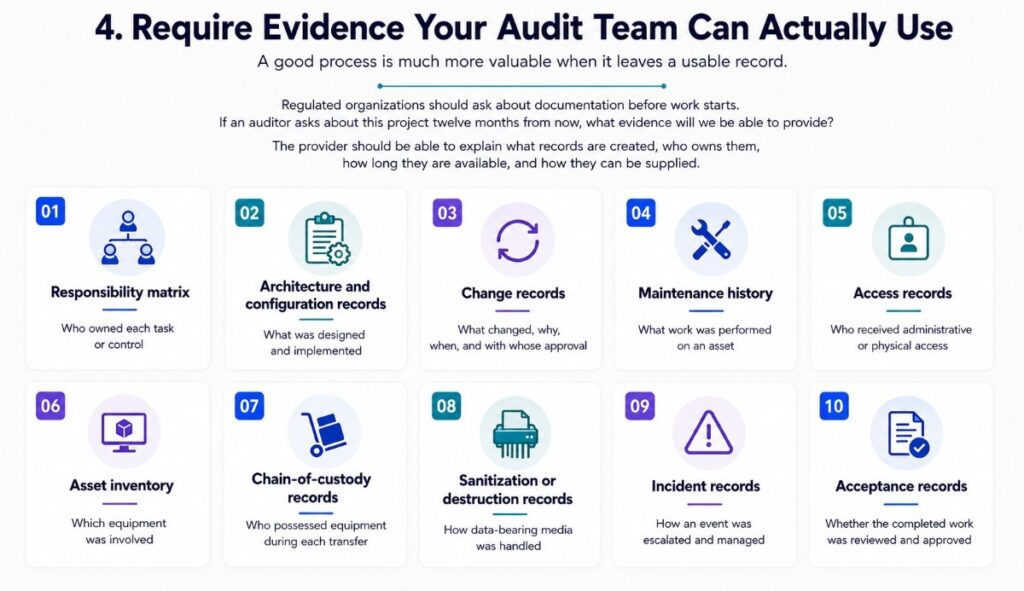
A good process is much more valuable when it leaves a usable record.
That is why regulated organizations should ask about documentation before work starts.
A useful question is:
If an auditor asks about this project twelve months from now, what evidence will we be able to provide?
The provider should be able to explain what records are created, who owns them, how long they are available, and how they can be supplied.
| Documentation | What It Helps Prove |
| Responsibility matrix | Who owned each task or control |
| Architecture and configuration records | What was designed and implemented |
| Change records | What changed, why, when, and with whose approval |
| Maintenance history | What work was performed on an asset |
| Access records | Who received administrative or physical access |
| Asset inventory | Which equipment was involved |
| Chain-of-custody records | Who possessed equipment during each transfer |
| Sanitization or destruction records | How data-bearing media was handled |
| Incident records | How an event was escalated and managed |
| Acceptance records | Whether the completed work was reviewed and approved |
This directly addresses a common buyer question: What documentation should an IT vendor provide for an audit?
The exact documentation will vary by project, but the standard should remain the same: another qualified person should be able to reconstruct what happened without relying on the memory of the engineer who performed the work.
5. Examine Chain of Custody Across the Hardware Lifecycle

Chain of custody becomes critical when equipment leaves a controlled environment.
Chain of custody for IT equipment is the documented record of who had possession of an asset, where it moved, when control changed, and what happened to it.
This applies to more than final disposal.
It may matter when:
- drives are replaced;
- equipment is shipped between sites;
- servers are returned;
- devices are sent for repair;
- a data center is consolidated;
- assets are redeployed; or
- hardware enters an ITAD program.
A reliable hardware chain-of-custody process should connect the physical device to an identifiable record.
That record may include the serial number, location, pickup information, responsible party, custody transfers, transport, receiving location, sanitization action, and final disposition.
At Catalyst Data Solutions, we connect asset tracking and lifecycle reporting through our secure ITAD asset recovery work. We believe asset retirement should be planned as part of the infrastructure lifecycle, especially when security, documentation, recovery value, and disposition requirements intersect.
Our ITAD Security and Compliance guidance also addresses the need to connect asset handling, data protection, documentation, and disposition rather than treating ITAD as a simple removal service.
6. Review Change Control and Maintenance Procedures
Infrastructure risk does not end after deployment.
Routine maintenance and infrastructure changes can introduce new configuration, security, availability, or audit issues.
That makes change management an important part of vendor due diligence.
What change control should an infrastructure provider follow?
A controlled change process should normally document:
- the requested change;
- the reason for it;
- systems affected;
- security and operational risk;
- required approval;
- implementation plan;
- maintenance window;
- test procedure;
- rollback plan;
- validation results; and
- final closure.
The exact workflow may differ by organization, but the outcome should be consistent:
A production change should be authorized, traceable, tested, and documented.
At Catalyst Data Solutions, our managed infrastructure support services can support ongoing infrastructure operations based on the agreed service scope. We define support and escalation responsibilities so our customers know how issues and changes move through the service process.
How should vendor maintenance be documented?
Maintenance records should be detailed enough to show what happened to the affected asset.
Useful information includes:
- asset or serial number;
- reported problem;
- technician or provider;
- date and time;
- diagnostic activity;
- parts replaced;
- configuration or firmware changes;
- testing performed;
- final status; and
- handling of any removed data-bearing component.
Through our multi-Vendor hardware maintenance work, we support infrastructure across multiple technology platforms while keeping service activity and escalation tied to the agreed support model.
For regulated environments, the required maintenance evidence should be defined before an emergency repair makes documentation an afterthought.
Specialist Infrastructure Partner vs. National or Global Provider
A larger provider is not automatically safer for a regulated project, and a specialist is not automatically more flexible.
The better choice depends on the program.
| Buyer Need | Specialist Infrastructure Partner | Large National/Global Provider |
| Focused infrastructure modernization | Often well suited to a defined program | Also capable, often within a broader delivery model |
| Direct technical collaboration | Can be easier in a focused engagement | Depends on account and project structure |
| Mixed OEM or mixed-generation environment | Can be a strong fit | Broad OEM access is also common |
| Global standardized procurement | May require partner coverage | Often a core strength |
| Very large international rollout | May not be the strongest primary model | Often better aligned |
| Procurement plus lifecycle planning | Strong when integrated into the engagement | Depends on service structure |
| Highly standardized global transformation | Usually not the primary specialist use case | Often a stronger fit |
The useful comparison is not small versus large.
It is:
Which provider has the operating model that best fits our scope, risk, internal resources, geography, and lifecycle requirements?
Where Catalyst Data Solutions Can Be a Better Fit
We can be a strong fit when a regulated organization needs more than a hardware transaction but does not need to turn every infrastructure project into a broad global transformation program.
At Catalyst Data Solutions, we connect infrastructure decisions across architecture, multi-OEM sourcing, deployment, support, maintenance, and asset recovery.
That allows us to consider what happens before the purchase, during operation, and when the asset eventually needs to be extended, replaced, redeployed, or retired.
Our approach can be especially useful when your project involves:
- a complex hybrid or on-prem environment;
- multiple OEM options;
- existing infrastructure that cannot simply be replaced;
- phased modernization;
- constrained or hard-to-find equipment;
- lifecycle and ITAD requirements;
- lean internal IT teams; or
- a need for clear responsibility across several providers.
We do not believe every project belongs with us.
A national or global provider may be the better fit when your priority is worldwide procurement coverage, very large standardized rollouts, major global integration facilities, or a broad transformation program.
That distinction matters because regulated buyers need credible boundaries as much as they need technical capability.
Six Checks Before Selecting an Infrastructure Partner
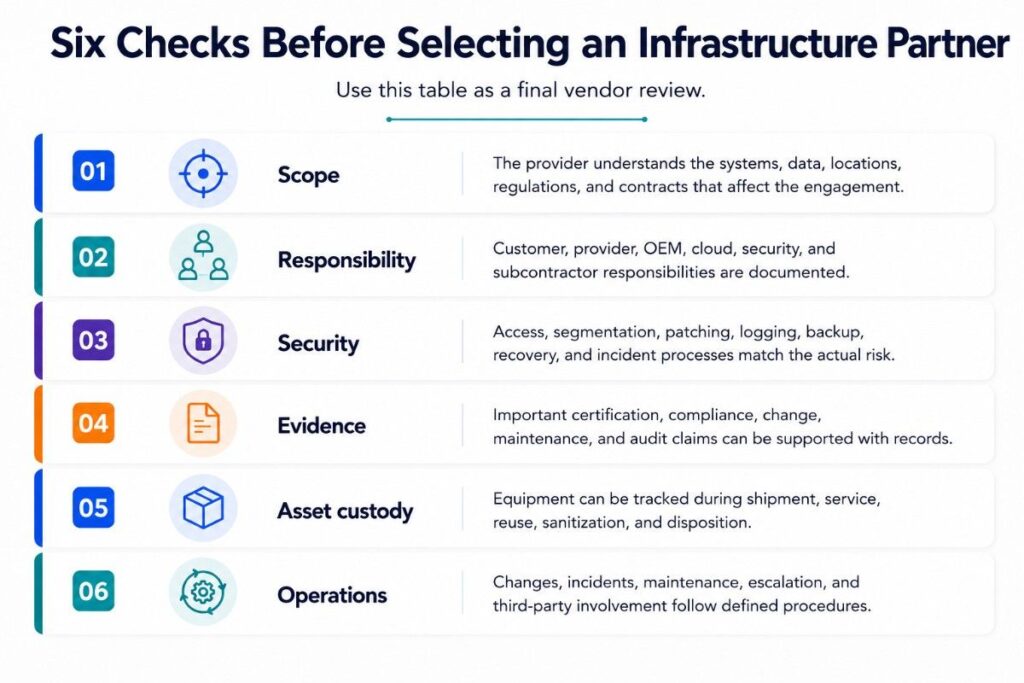
Use this table as a final vendor review.
| Check | What Good Looks Like |
| Scope | The provider understands the systems, data, locations, regulations, and contracts that affect the engagement. |
| Responsibility | Customer, provider, OEM, cloud, security, and subcontractor responsibilities are documented. |
| Security | Access, segmentation, patching, logging, backup, recovery, and incident processes match the actual risk. |
| Evidence | Important certification, compliance, change, maintenance, and audit claims can be supported with records. |
| Asset custody | Equipment can be tracked during shipment, service, reuse, sanitization, and disposition. |
| Operations | Changes, incidents, maintenance, escalation, and third-party involvement follow defined procedures. |
A provider that cannot answer these areas clearly during selection is unlikely to make them easier during an incident or audit.
Frequently Asked Questions
How do I choose an IT infrastructure partner?
Choose based on your actual operating conditions. Review technical fit, security controls, regulatory scope, support coverage, responsibility boundaries, third-party dependencies, audit evidence, change management, and lifecycle requirements.
The strongest provider is the one that can show how its delivery model fits those needs.
What compliance requirements should technology vendors meet?
A vendor should meet the requirements that apply to the work it performs.
First define which systems, data, locations, and processes the vendor will touch. Then map your regulatory, contractual, and internal requirements to that scope.
Avoid asking whether a provider is simply “compliant” without defining the requirement.
What certifications should an IT infrastructure provider have?
There is no universal list.
Relevant certifications may include information security, technical, OEM, government, ITAD, or sector-specific credentials. What matters most is whether the certification is current and whether its scope covers the service you plan to use.
How can I verify an IT vendor’s compliance claims?
Ask for supporting evidence and verify the scope.
Check which entity, system, service, and location the claim covers. Confirm dates, exclusions, assessment details, and any responsibilities that remain with your organization.
A broad claim without a defined scope should not be treated as complete evidence.
What security controls should an IT infrastructure provider have?
Relevant controls often include multifactor authentication, privileged-access management, network segmentation, secure configuration, vulnerability management, patching, logging, backup, recovery, encryption, and incident escalation.
The required controls should match the level of access and risk involved in the engagement.
How do I evaluate an IT vendor’s cybersecurity?
Do not evaluate only whether controls exist. Ask how they operate.
Find out who receives privileged access, how access is approved, how incidents are escalated, how vulnerabilities are handled, what third parties participate, and what evidence remains afterward.
What evidence should we request from an infrastructure provider?
Useful evidence can include responsibility maps, architecture diagrams, configuration records, change records, maintenance reports, access records, asset inventories, chain-of-custody documents, sanitization evidence, incident records, and project acceptance documentation.
Request the evidence that matches your actual audit and risk requirements.
What is the chain of custody for enterprise hardware?
Chain of custody documents who controlled an asset, where it moved, when possession changed, and what happened to it.
It is particularly important when data-bearing equipment leaves your facility for maintenance, relocation, resale, recycling, sanitization, or destruction.
How should IT vendors manage infrastructure changes?
Changes should follow a documented process covering risk, approval, testing, implementation, rollback, validation, and final records.
Your team should be able to determine who approved the change, who performed it, what was affected, and whether the result was validated.