


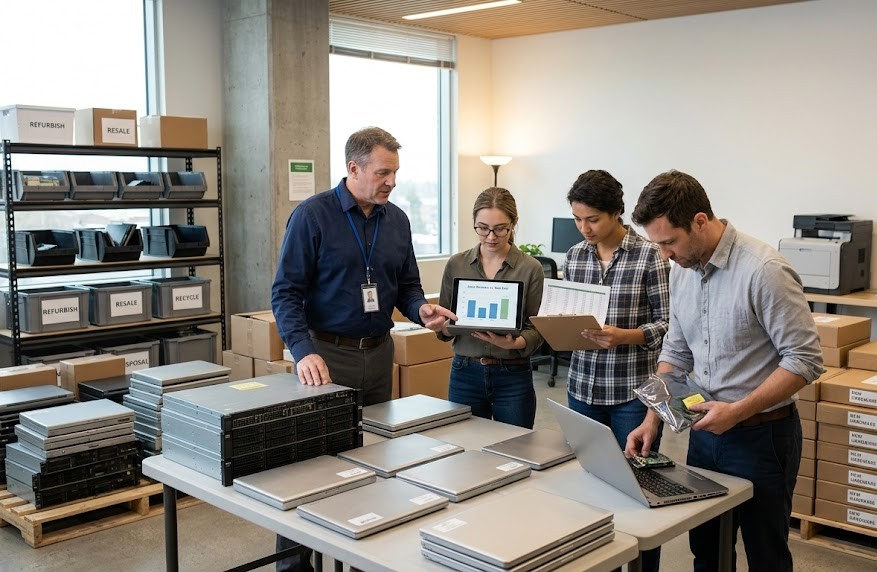
Hardware refresh planning often starts with the cost of replacement servers, storage, networking equipment, or endpoints.
That view is incomplete. Retired equipment may still support internal workloads, provide spare components, qualify for refurbishment, or retain secondary-market value.
IT asset disposition, or ITAD, creates a controlled process for evaluating those options while protecting data and documenting each asset’s final outcome.
When ITAD is included early, acquisition cost, support, useful life, retirement timing, and residual value become part of one lifecycle decision.
This approach does not guarantee a financial return. It helps organizations understand the full cost of a refresh and avoid losing value through rushed or poorly documented disposal.
How Does ITAD Lower Hardware Refresh Costs?
ITAD can reduce the net cost of a refresh through value recovery, internal reuse, avoided storage costs, and better retirement timing.
The financial result depends on the equipment’s age, configuration, condition, demand, data-handling requirements, location, and processing costs.
A structured program may create value through five paths:
- Redeploying suitable assets inside the organization
- Reselling or remarketing equipment with market demand
- Refurbishing hardware for continued use
- Recovering compatible parts or maintaining a spare pool
- Recycling equipment that has no safe or economic reuse path
Catalyst Data Solution Inc ITAD and asset recovery services include inventory review, serialized tracking, data sanitization, testing, remarketing, recycling, payout, and final reporting.
The important distinction is that ITAD does not make every asset valuable. It creates a process for identifying which assets have value and which should be securely retired.
The Hardware Refresh Cost Equation
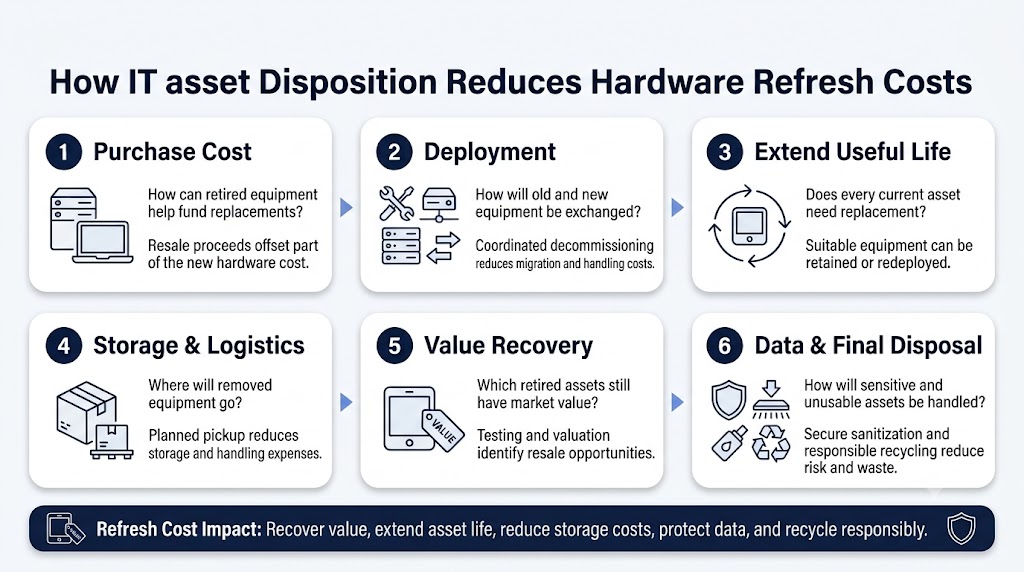
A conventional refresh budget may include only the new equipment, installation, migration, and support.
A lifecycle-aware budget also includes the financial effect of the equipment leaving service.
| Refresh measure | Cost-focused question | ITAD contribution |
| New equipment cost | What will replacement hardware cost? | Recovery proceeds may offset part of the purchase |
| Deployment cost | What will installation and migration require? | Coordinated decommissioning may reduce duplicate handling |
| Useful life | Must every current asset be replaced? | Suitable equipment may be retained or redeployed |
| Storage cost | Where will removed equipment remain? | Planned pickup reduces long-term storage and handling |
| Retirement value | Does current equipment have market demand? | Testing and valuation identify resale opportunities |
| Data risk | How will data-bearing assets be handled? | Sanitization, destruction, custody records, and certificates support control |
| Final disposal | What happens to unusable equipment? | Responsible recycling provides a documented final path |
ITAD should therefore be measured as part of the complete refresh program, not as an isolated recycling transaction.
Include ITAD Before the Buying Decision
ITAD is most effective when planning begins before replacement equipment is ordered.
Early planning allows teams to understand the installed environment, determine what truly requires replacement, and identify equipment that may remain useful.
Catalyst’s lifecycle guidance recommends connecting disposition with sourcing and long-term deployment planning rather than treating retirement as a one-time end-of-life task.
A lifecycle-aware provider should consider:
- The current asset’s workload and support requirements
- Its remaining useful life and compatibility
- The cost and risk of keeping it in service
- Its possible reuse, refurbishment, or resale path
- Its eventual sanitization, reporting, and recycling requirements
These factors can influence the replacement architecture.
For example, a modular platform with available parts and strong secondary demand may create different lifecycle economics from a lower-cost system with limited support or reuse options.
Residual value should not control the technical design. Performance, security, availability, and workload fit remain primary.
It should be one documented input in the buying decision.
When Should ITAD Be Included in a Refresh Project?
ITAD should be introduced during discovery and inventory, not after the new environment is running.
Waiting until equipment has been disconnected can reduce valuation accuracy, complicate data handling, and create pressure to remove assets quickly.
Catalyst’s enterprise ITAD guidance uses a six-stage process covering inventory, classification, collection, sanitization, disposition review, and final reporting.
| Project stage | ITAD action | Cost-control benefit |
| Initial assessment | Record asset type, model, serial number, location, and condition | Creates a reliable basis for valuation |
| Solution design | Identify assets that can remain, move, or become spares | May reduce unnecessary replacement |
| Budget development | Estimate recovery, fees, logistics, and recycling costs | Produces a more complete net budget |
| Deployment planning | Coordinate removal with installation and migration | Reduces delays and duplicate handling |
| Decommissioning | Track, sanitize, test, and classify equipment | Protects value while controlling risk |
| Project close | Reconcile assets, fees, proceeds, and certificates | Supports finance, audit, and governance |
This sequence helps prevent ITAD from becoming an unplanned cost at the end of the project.
Example: Calculating the Net Refresh Impact
The following example is illustrative. It does not represent a Catalyst customer result or guarantee a recovery amount.
Assume an organization plans to retire 120 servers and network devices during a data center refresh.
After inventory review, the assets are divided into several disposition paths.
| Disposition category | Units | Illustrative gross value or avoided cost |
| Equipment selected for resale | 45 | $33,750 |
| Equipment redeployed internally | 20 | $18,000 |
| Components retained as approved spares | 15 | $6,000 |
| Equipment sent for recycling | 40 | $0 |
| Total | 120 | $57,750 |
The program also has costs.
| Program expense | Illustrative amount |
| Pickup, packing, and transportation | $6,500 |
| Data sanitization and destruction | $5,800 |
| Testing, grading, and processing | $7,200 |
| Recycling and reporting | $2,250 |
| Total program cost | $21,750 |
The estimated net benefit would be:
$57,750 in recovery and avoided cost − $21,750 in program cost = $36,000
This figure combines cash recovery and estimated avoided purchases. Those categories should remain separate in financial reporting.
Actual results require verified asset data, current market pricing, documented costs, and approved accounting assumptions.
Measure ITAD ROI With Verified Project Data
ITAD return on investment should be based on project records, not a broad industry percentage.
The calculation should separate money received from estimated costs avoided.
Recommended ITAD ROI measures
| Measure | Calculation | Evidence required |
| Gross recovery | Total resale, buyback, or revenue-share proceeds | Settlement statement and asset-level sales report |
| Net recovery | Gross recovery minus processing and logistics costs | Invoices, fees, and settlement documentation |
| Redeployment value | Approved replacement purchase avoided | Procurement estimate and redeployment approval |
| Storage cost avoided | Prior monthly storage cost multiplied by avoided period | Facility or warehouse records |
| Recycling cost | Processing and downstream recycling charges | Vendor invoice and recycling report |
| Net program impact | Recovery plus verified avoided cost minus total program expense | Finance-approved project summary |
A simple financial formula is:
Net ITAD impact = verified proceeds + approved avoided costs − program costs
An ROI percentage may then be calculated as:
ITAD ROI = net ITAD impact ÷ total ITAD program cost × 100
This calculation is useful only when each input has a defined owner, source, period, and approval status.
The Catalyst editorial playbook also requires quantitative claims to include a source, baseline, time period, and approval before publication.
How Organizations Can Maximize Retired Hardware Value
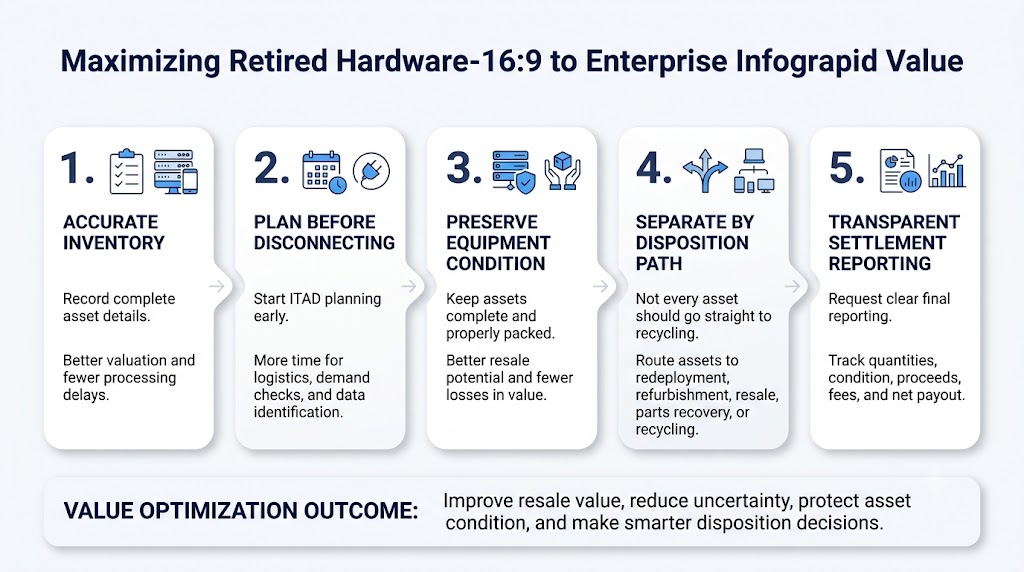
Organizations cannot control secondary-market demand, but they can improve the quality of the disposition process.
1. Build an accurate inventory
Record manufacturer, model, serial number, processor, memory, storage, accessories, support status, location, condition, and configuration.
A complete inventory improves valuation and reduces uncertainty during pickup and processing.
2. Begin before equipment is disconnected
Early planning gives the organization time to identify demand, preserve configurations, arrange logistics, and confirm which devices contain data.
Catalyst warns that late ITAD planning can lead to rushed handling and missed opportunities to identify resale value or destruction requirements.
3. Preserve equipment condition
Missing power supplies, rails, adapters, drives, licenses, or components may reduce marketability.
Equipment should be removed, packed, labeled, and transported through a controlled process.
4. Separate assets by disposition path
Do not send every asset directly to recycling.
Assets should be evaluated for redeployment, refurbishment, resale, parts recovery, return obligations, or recycling.
5. Request transparent settlement reporting
The final report should show asset quantities, serial numbers, condition, disposition path, gross proceeds, fees, and net payout.
Organizations developing an enterprise IT asset disposition strategy should define these reporting requirements before collection.
Asset Recovery Is More Than Resale
Resale is only one form of asset recovery.
In many environments, internal redeployment may provide more value than a secondary-market sale.
A production server may still support testing, development, backup, lab, or lower-demand workloads. A switch may serve a branch, training environment, or approved spare pool.
Catalyst’s circular IT guidance identifies potential reuse paths for servers, switches, storage, GPUs, laptops, and desktops.
| Asset type | Possible recovery path | Potential budget effect |
| Servers | Testing, backup, internal tools, resale | Avoids some purchases or creates proceeds |
| Network switches | Branch, lab, spare pool, remarketing | Reduces replacement or emergency sourcing costs |
| Storage systems | Archive, test environment, component recovery | Extends use where risk is acceptable |
| GPUs and accelerators | Lower-demand workloads, testing, resale | Preserves use of a high-value asset |
| Endpoints | Redeployment, resale, donation after sanitization | Reduces new endpoint demand or creates recovery |
Every redeployment decision requires technical and security review.
Compatibility, performance, warranty, firmware, licensing, power, support, and risk should be evaluated before the asset returns to service.
Readers can also review what happens to retired servers after an upgrade when comparing reuse, resale, refurbishment, parts recovery, and recycling.
Refurbishment Can Extend Useful Life
Refurbishment may preserve value when equipment is technically suitable but requires inspection, testing, repair, configuration, or component replacement.
A credible refurbishment process should be more rigorous than confirming that equipment powers on.
It may include:
- Visual inspection and serial-number verification
- Component, port, memory, storage, and power testing
- Firmware and configuration review
- Secure data removal
- Final grading, packaging, warranty, and documentation
The financial decision should compare the refurbishment cost with the asset’s expected internal value or resale potential.
The enterprise hardware refurbishment process provides additional context for evaluating tested hardware.
Secure Data Disposition Protects the Financial Outcome
Data security is not separate from refresh economics.
A low-cost disposal method can become expensive if assets are lost, data remains recoverable, or the organization cannot prove what happened after pickup.
Catalyst Data Solution Ics identifies residual data, improper wiping, broken custody, unauthorized access, poor documentation, and unvetted vendors as common ITAD risks.
| Security control | Required evidence | Financial exposure it helps control |
| Serialized inventory | Asset list with serial numbers | Lost or disputed equipment |
| Chain of custody | Pickup and transfer records | Untracked movement and liability |
| Approved sanitization | Method, date, device, and result | Data exposure and remediation costs |
| Physical destruction | Destruction certificate and asset reference | Failure to prove media destruction |
| Secure transport | Packaging, tracking, and custody handoffs | Theft, loss, or damage |
| Final reporting | Resale, recycling, and destruction records | Incomplete audit and financial reconciliation |
Basic deletion or a factory reset does not prove secure data removal.
The appropriate method may include clearing, purging, cryptographic erase, degaussing, or physical destruction, depending on the media, policy, and data sensitivity.
Organizations should define ITAD data security and compliance requirements before assets leave their control.
Compliance claims must remain scoped. No provider should imply that one process guarantees compliance with every law, contract, or industry requirement.
Serialized Chain of Custody Supports Cost Control
Serialized chain of custody is often viewed only as a security measure.
It also provides the records needed to verify financial outcomes.
Consider a project involving 500 devices. Without serial-level tracking, finance may know that 20 pallets were collected but not which devices were sold, destroyed, recycled, or returned.
That gap makes it difficult to validate charges or settlement amounts.
A strong final report should reconcile:
| Reconciliation field | Example record |
| Asset identity | Manufacturer, model, and serial number |
| Original location | Data center, office, branch, or warehouse |
| Collection status | Date, quantity, and custody handoff |
| Data outcome | Wiped, destroyed, or non-data-bearing |
| Condition grade | Reusable, repairable, parts-only, or nonviable |
| Final path | Redeployed, resold, recycled, or returned |
| Financial result | Gross value, fee allocation, and net recovery |
This structure allows security, finance, procurement, and operations to review the same project record.
ITAD and Recycling Are Not the Same
ITAD is the complete governance process for retiring equipment.
Recycling is one possible final outcome.
| Term | Main purpose | Possible financial result |
| Redeployment | Continue internal use | Avoided purchase |
| Refurbishment | Restore equipment for reuse or resale | Extended life or improved marketability |
| Resale | Sell usable equipment | Cash recovery |
| Parts recovery | Retain or sell compatible components | Avoided support cost or cash recovery |
| Recycling | Recover materials from nonviable equipment | Usually limited or no asset recovery |
| ITAD | Govern all retirement decisions | Combined risk control and value optimization |
Sending useful equipment directly to recycling may destroy potential reuse or resale value.
However, recycling is appropriate when assets are damaged, obsolete, unsafe, unsupported, or uneconomic to process.
The article on the difference between ITAD and recycling explains why recycling should normally follow an evaluation of higher-value paths.
Keep Financial and Sustainability Benefits Separate
ITAD may support both cost control and environmental goals, but the two should not be treated as the same result.
A financial benefit requires evidence such as resale proceeds, avoided purchases, reduced storage costs, or lower handling expenses.
A sustainability benefit may include longer asset life, reduced waste, increased reuse, or documented recycling.
| Benefit category | Example measure |
| Financial | Net resale proceeds |
| Financial | Approved purchase avoided through redeployment |
| Financial | Storage and handling cost avoided |
| Operational | Assets reconciled by serial number |
| Security | Percentage of data-bearing assets with verified sanitization |
| Sustainability | Equipment reused, refurbished, or recycled by weight or unit |
An organization may achieve strong environmental results without receiving meaningful resale proceeds.
It may also recover financial value from equipment without proving a broader sustainability outcome.
A circular IT strategy for reducing lifecycle costs should therefore report financial and environmental measures separately.
What to Ask an ITAD Provider

A buyer should look beyond a promised resale percentage.
The provider should explain its process, controls, commercial model, reporting, and responsibilities.
Ask the following questions:
- How are assets inventoried and tracked by serial number?
- Which data sanitization and destruction methods are available?
- How are resale values, processing fees, and revenue sharing calculated?
- What documentation is provided after final disposition?
- Which activities are performed directly and which use downstream partners?
The agreement should also define transportation costs, inspection conditions, payment timing, unsold assets, recycling charges, liability, and reporting requirements.
Recovery values should be presented as estimates unless the provider offers a fixed purchase price for specifically identified equipment.
Plan the Next Purchase With the Exit in Mind
The financial impact of ITAD begins when equipment is purchased.
Procurement and architecture teams should consider useful life, repairability, support options, parts availability, upgrade paths, energy requirements, and possible residual value.
Catalyst’s circular economy guidance recommends considering repairability, warranty, parts availability, resale value, and upgrade options before buying.
A lifecycle-aware comparison may look like this:
| Buying factor | Option A | Option B |
| Acquisition cost | Lower | Higher |
| Support period | Shorter | Longer |
| Upgrade flexibility | Limited | Modular |
| Parts availability | Uncertain | Established |
| Expected useful life | Three years | Five years |
| Redeployment potential | Low | Moderate |
| Residual value | Unknown | Market evidence available |
This does not mean Option B is automatically better.
The final decision must consider workload requirements, risk, support, budget, and the assumptions behind each estimate.
Should ITAD Be Included in Hardware Refresh Planning?
Yes. ITAD should be part of refresh planning when the organization begins inventory, architecture, budgeting, sourcing, security, and migration discussions.
Early inclusion can help teams:
- Identify assets that do not require immediate replacement
- Estimate proceeds and program costs before finalizing the budget
- Preserve equipment condition and marketability
- Coordinate secure removal with deployment
- Produce complete financial and custody records
The value is not a guaranteed payout.
The value is a more complete decision process that connects what the organization buys, how long it uses the equipment, how it supports it, and what happens when the equipment leaves service.
Catalyst Data Solutions positions ITAD, asset recovery, infrastructure sourcing, and lifecycle planning as connected activities rather than unrelated transactions.
Request an Infrastructure Consultation With Catalyst Data Solutions Inc.
A refresh budget should account for the equipment entering the environment and the assets leaving it.
We can help assess inventory, data requirements, disposition paths, reuse opportunities, logistics, and potential recovery as part of a broader infrastructure plan.
Organizations with an upcoming data center refresh, decommissioning project, or hardware retirement initiative can request an infrastructure consultation with Catalyst Data Solutions Inc.
Frequently Asked Questions
1. How does IT asset disposition help reduce hardware refresh costs?
ITAD can reduce net refresh costs by identifying equipment suitable for resale, redeployment, refurbishment, parts recovery, or recycling. The financial result depends on asset condition, demand, configuration, logistics, and processing costs. Recovery values should be estimated from verified inventory rather than treated as guaranteed savings.
2. When should ITAD be included in a hardware refresh project?
ITAD should begin during inventory, budgeting, and solution planning—not after new equipment is installed. Early planning helps preserve asset value, coordinate secure removal, identify reuse opportunities, and estimate disposition costs before the refresh budget is finalized.
3. How can an organization maximize the value of retired IT equipment?
Start with a detailed asset inventory, preserve equipment condition, include accessories and configuration details, and separate assets by potential disposition path. Organizations should also request transparent reporting that shows serial numbers, final outcomes, fees, gross proceeds, and net recovery.
4. How does Catalyst Data Solutions approach ITAD differently from a basic recycling provider?
Catalyst connects ITAD with the broader infrastructure lifecycle. Instead of treating retired hardware as waste, Catalyst evaluates secure disposition, serialized chain of custody, reuse, refurbishment, value recovery, and responsible recycling. This lifecycle-aware approach helps customers consider the next purchase and the current asset exit within one plan.
5. Why include Catalyst Data Solutions in hardware refresh planning?
Catalyst combines infrastructure sourcing, multi-OEM planning, asset recovery, and ITAD services. This allows customers to evaluate acquisition cost, support options, useful life, transition requirements, and potential residual value before equipment is purchased or retired. The advantage is a more coordinated decision process—not an unsupported promise of guaranteed savings.