



AI training and AI inference use many of the same GPUs, but they place very different demands on infrastructure. Training builds or updates a model. Inference uses that trained model to answer requests, generate content, classify data, or support applications in production.
Training often focuses on finishing a large compute job as fast as possible. Production inference has a different goal: deliver predictable response times, handle changing request volume, keep services available, control cost per request or token, and protect production data.
That changes how teams should think about GPUs, memory, networking, storage, cloud capacity, power, and support. A high-performance training cluster is not automatically the best inference platform.
The right strategy starts with the workload and then compares hyperscaler cloud, AI-focused neoclouds, owned infrastructure, and secondary hardware as different capacity options. A complete design also has to account for the infrastructure layers beyond the GPU, including data, networking, storage, facilities, security, software, and operations.
Key Takeaways
- Training and inference optimize for different outcomes. Training favors time-to-train and large-scale parallel compute. Production inference must balance latency, throughput, concurrency, uptime, and cost per useful output.
- Cloud is not one category anymore. Hyperscalers, neoclouds, owned systems, and secondary hardware offer different combinations of flexibility, availability, cost, control, and operational work.
- GPU-hour price alone does not show the real cost. Utilization, storage, networking, egress, power, cooling, software, staff, support, and residual hardware value can change the result.
- High utilization can strengthen the case for ownership. Variable or short-lived demand usually favors rented capacity, while stable 24/7 inference can move the break-even point toward owned infrastructure.
- Previous-generation or secondary hardware can work well for some inference workloads, but only after validating performance, memory, condition, provenance, warranty, firmware, compatibility, and support.
What Is the Difference Between AI Training and AI Inference?
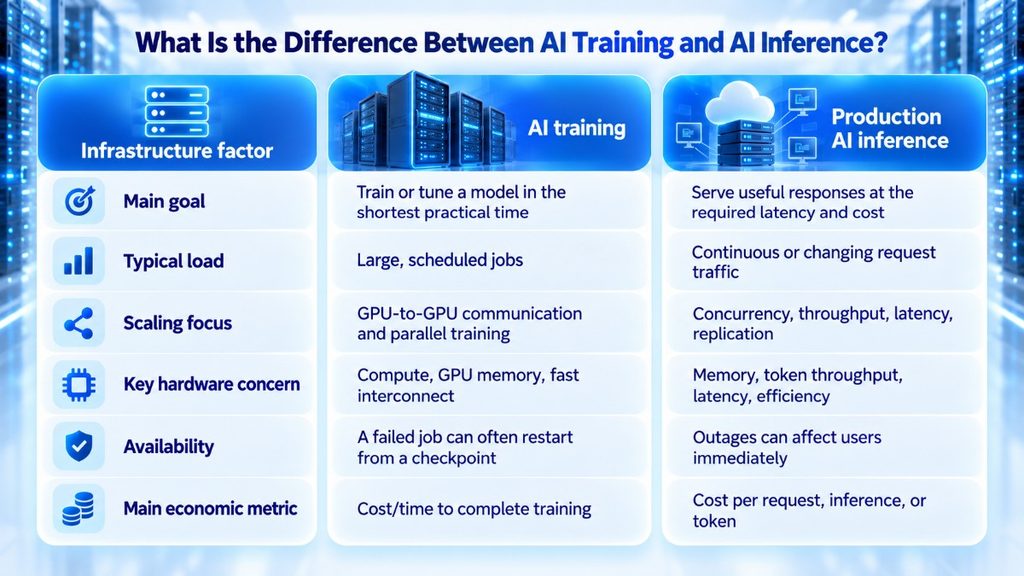
Training is the process of teaching or adapting a model. It can include pretraining, fine-tuning, and other learning jobs that update model weights.
Inference begins after a model is ready to use. The model receives an input and produces an output. For a business application, inference may run thousands or millions of times after one training cycle.
The practical requirements for NVIDIA GPU deployment therefore change depending on whether the system is running large training jobs, steady production inference, or both.
| Infrastructure factor | AI training | Production AI inference |
| Main goal | Train or tune a model in the shortest practical time | Serve useful responses at the required latency and cost |
| Typical load | Large, scheduled jobs | Continuous or changing request traffic |
| Scaling focus | GPU-to-GPU communication and parallel training | Concurrency, throughput, latency, replication |
| Key hardware concern | Compute, GPU memory, fast interconnect | Memory, token throughput, latency, efficiency |
| Availability | A failed job can often restart from a checkpoint | Outages can affect users immediately |
| Main economic metric | Cost/time to complete training | Cost per request, inference, or token |
MLCommons reflects this difference in its benchmark design. MLPerf Training measures how fast a system reaches a target model-quality level, while MLPerf Inference includes real-world serving scenarios and latency-sensitive tests.
Why Does Production Inference Need a Different Infrastructure Strategy?
A training system can run at very high utilization for a fixed period and then become idle. Inference often behaves more like an application service.
Demand may rise during business hours, fall overnight, and spike without warning. A production system may also need spare capacity so maintenance or a failed node does not interrupt service.
That makes several factors more important:
- requests per second and concurrent users;
- time to first response and total response time;
- model and context memory;
- GPU utilization at normal and peak demand;
- availability and failover capacity;
- power efficiency;
- CPU and system-memory capacity;
- storage and retrieval performance;
- monitoring, patching, and support.
For inference, the question is not simply, “How fast is this GPU?” It is closer to, “How much useful output can this whole system deliver within our latency, availability, and cost limits?”
That is why cost per token as an AI infrastructure ROI metric can be more useful than acquisition price alone.
What Do the Main AI Deployment Models Mean?
Modern AI teams have more options than traditional “cloud vs. on-prem.”
One important distinction: secondary or refurbished hardware is not a physical deployment location. It is a sourcing and ownership option. Secondary systems may run in an enterprise data center, colocation facility, or other owned environment.
| Model | What it means | Main strength | Main trade-off |
| Hyperscaler cloud | GPU infrastructure from large general-purpose cloud providers | Broad services, global regions, elasticity | Premium rates and possible egress/network costs |
| Neocloud | AI-focused cloud built around dense GPU capacity and high-speed fabrics | Specialized GPU access and AI-focused clusters | Smaller service ecosystem and provider concentration risk |
| On-prem / owned | Organization owns or leases infrastructure in its own or colocated facility | Control, predictable capacity, data location | CapEx, facilities, staffing, lifecycle responsibility |
| Secondary hardware | Pre-owned, refurbished, recertified, or surplus equipment purchased for owned deployment | Lower entry cost can improve ownership economics | Condition, provenance, warranty and compatibility require more diligence |
Neoclouds can offer both small GPU instances and large dedicated clusters. Current CoreWeave documentation, for example, lists H100 systems connected with NVLink and 400G NDR InfiniBand for training and inference.
How Much Does AI GPU Capacity Cost?
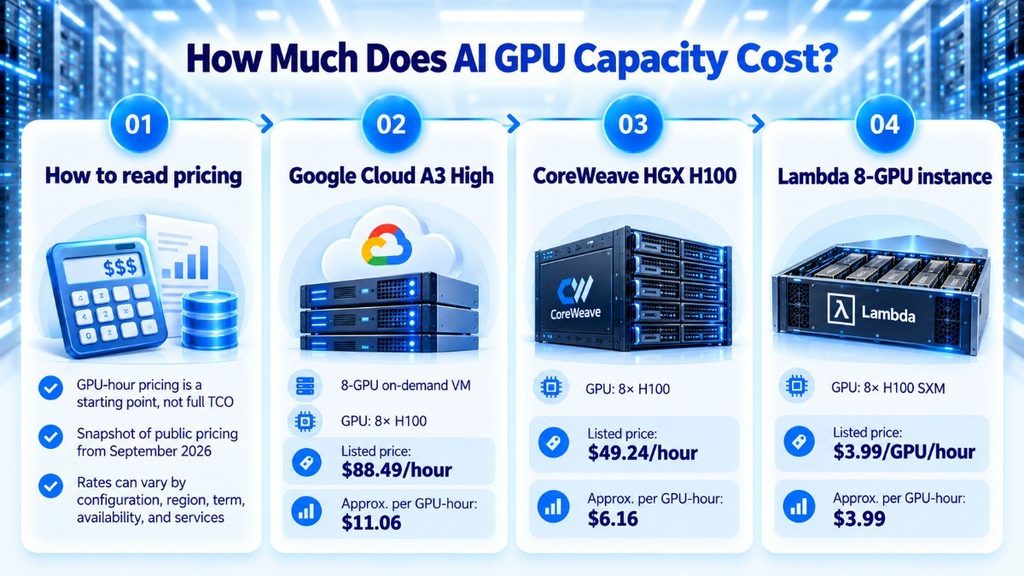
GPU-hour pricing helps compare rental models, but it should be treated as a starting point rather than complete TCO.
The table below provides a snapshot of publicly listed GPU pricing as of September 2026.
These figures are useful for comparing baseline compute costs, but actual rates can vary based on GPU configuration, region, commitment term, capacity availability, and included services.
| Published example | GPU | Listed price | Approx. price per GPU-hour |
| Google Cloud A3 High, 8-GPU on-demand VM | 8× H100 | $88.49/hour | $11.06 |
| CoreWeave HGX H100 | 8× H100 | $49.24/hour | $6.16 |
| Lambda 8-GPU instance | 8× H100 SXM | $3.99/GPU/hour | $3.99 |
These prices are not direct apples-to-apples quotes. CPU capacity, RAM, local storage, network architecture, availability terms, storage fees, egress rules, and support differ.That distinction matters. A cheaper GPU-hour can become a more expensive production platform if the system has weak utilization, slow data access, unnecessary data-transfer charges, or poor operational efficiency.
Cloud and neocloud spending is mainly OpEx. Owned infrastructure shifts more cost toward CapEx, although financing and leasing can change that structure.
Owned TCO should include:
Annual owned cost = annualized hardware cost + power + cooling + networking + facility + software + support + operations − expected residual value
Teams should also model the cost of the network architecture around AI workloads, because GPUs that wait on data or communication still consume money.
When Does Owning AI Hardware Reach Break-Even?
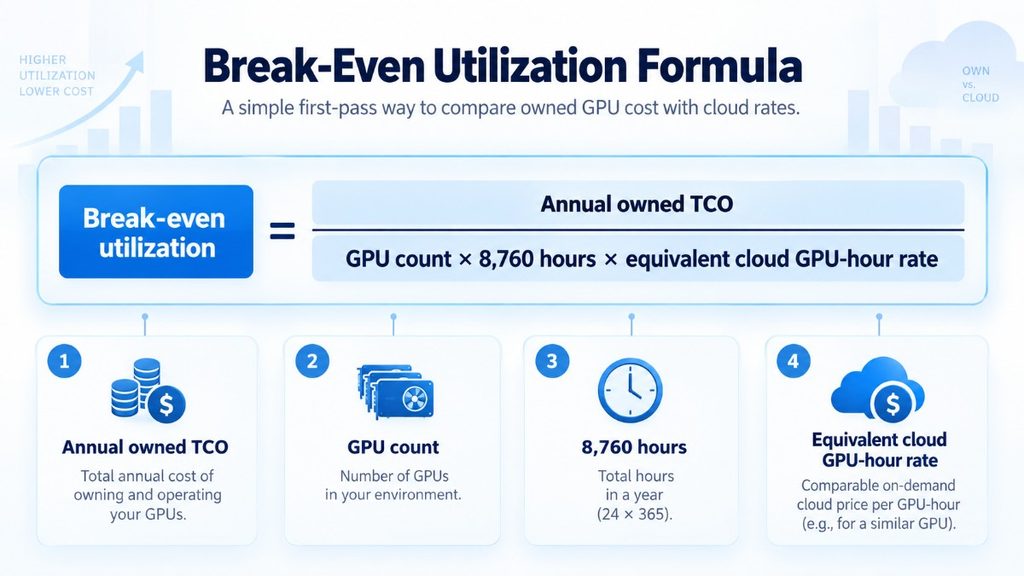
Utilization is one of the strongest variables.
A simple first-pass formula is:
Break-even utilization = Annual owned TCO ÷ (GPU count × 8,760 hours × equivalent cloud GPU-hour rate)
Consider an illustrative model, not a market quote. Assume an eight-GPU system has an annualized total ownership cost of $150,000 after hardware depreciation, expected residual value, power, cooling, networking, support, and facilities.
At an equivalent cloud rate of:
- $4/GPU-hour, break-even is about 54% utilization.
- $6/GPU-hour, break-even is about 36% utilization.
- $11/GPU-hour, break-even is about 19% utilization.
The exact threshold will differ for every organization.
A system running steady inference 24/7 may justify ownership much sooner than a GPU environment used for occasional model experiments. On the other hand, cloud elasticity can remain valuable even when its unit price is higher because the organization does not pay for idle owned capacity.
Which Deployment Model Fits Training and Inference Best?
There is no universal winner.
| Workload | Hyperscaler | Neocloud | Owned new hardware | Owned secondary hardware |
| Short experiments | Strong fit | Strong fit | Often underused | Often underused |
| Large burst training | Strong if capacity is available | Very strong fit | Good at sustained scale | Depends on generation and fabric |
| Continuous inference | Good with autoscaling | Strong | Strong at high utilization | Strong when workload fit is validated |
| Sensitive/local data | Depends on controls and region | Depends on provider | Strong control | Strong control |
| Rapid capacity need | Usually fast | Usually fast when GPU stock exists | Procurement/deployment time required | Can be fast if compatible inventory exists |
| Long, predictable workload | Can become costly | Reserved capacity may work well | Ownership case becomes stronger | Potentially attractive TCO |
Many organizations will use more than one model. Training may burst into cloud or neocloud capacity, while predictable inference runs on owned systems.
Performance, GPU Availability, and Time-to-Capacity
Training tends to reward the newest high-end architectures when faster GPUs and faster interconnects materially reduce a long training run.
MLPerf Training v6.0 shows how current systems are scaling across large AI workloads, including newer mixture-of-experts models.
Inference is more nuanced.
Newer GPUs can deliver major gains when a workload needs very high token throughput, larger memory, or better performance per watt. But a previous-generation GPU can still be economically useful when it meets the model-memory, latency, throughput, and software requirements.
For context, NVIDIA lists the H100 SXM with 80 GB of GPU memory, 3.35 TB/s memory bandwidth, up to 700W TDP, and 900 GB/s NVLink. An 8× H100 server architecture can therefore remain relevant for demanding training or inference even after newer GPU generations enter the market.
Availability can matter as much as benchmark speed. A slightly older system available now may create more business value than a preferred configuration that cannot meet the deployment date.
Why Memory and Networking Matter More in Production
GPU utilization does not exist in isolation.
Inference may depend on model weights, cache, long context windows, retrieval systems, CPU preprocessing, and application services. Higher concurrency can also increase memory demand.
The wider AI memory supply and procurement environment matters because a finished GPU design can still be delayed by server memory or another exact component.
Networking changes too.
Large distributed training places heavy pressure on east-west GPU communication. Inference may use fewer GPUs per job, but production services create their own network demands through APIs, retrieval systems, storage access, model routing, and traffic between application layers.
Those AI data center networking challenges should be tested under real traffic rather than estimated from GPU specifications alone.
How Do Privacy, Security, and Data Location Affect the Choice?
AI workload placement should follow the data.
A cloud or neocloud region may work well when policy allows the data to move there. A regulated, sensitive, or latency-critical workload may need tighter control over where data, prompts, embeddings, models, and logs reside.
Teams should evaluate:
- encryption at rest and in transit;
- identity and role-based access;
- network isolation;
- backup and recovery;
- geographic and regulatory requirements.
Owned infrastructure can provide more direct control, but it also transfers more security and operational responsibility to the organization.
Before bringing dense GPU infrastructure into an existing site, the AI data center readiness requirements should also cover power, cooling, network capacity, rack design, security, and support.
For international high-end accelerator sourcing, buyers must also account for applicable export controls, end-user/end-use screening, and destination restrictions.
New vs. Secondary AI Hardware: Where Do the Economics Change?
Previous-generation equipment should not be treated as obsolete simply because a newer GPU exists.
For production inference, hardware should be judged by workload fit and useful output.
Secondary equipment may lower the capital required to build owned capacity. That can move the ownership break-even point earlier, especially for stable workloads.
But used, pre-owned, refurbished, recertified, and OEM-surplus do not mean the same thing.
Before buying secondary AI hardware, verify:
- exact GPU and server configuration;
- physical condition and testing process;
- equipment provenance;
- memory population;
- NIC and fabric compatibility;
- PSU, rail, cable, and cooling requirements;
- replacement parts and support ownership.
New OEM hardware may still be the better decision when frontier performance, longer warranty coverage, software entitlement, energy efficiency, or a standardized fleet matters more than lower purchase cost.
Secondary hardware becomes attractive when its lower capital cost survives the performance, reliability, support, and compatibility test.
A Practical Production Inference Decision Framework
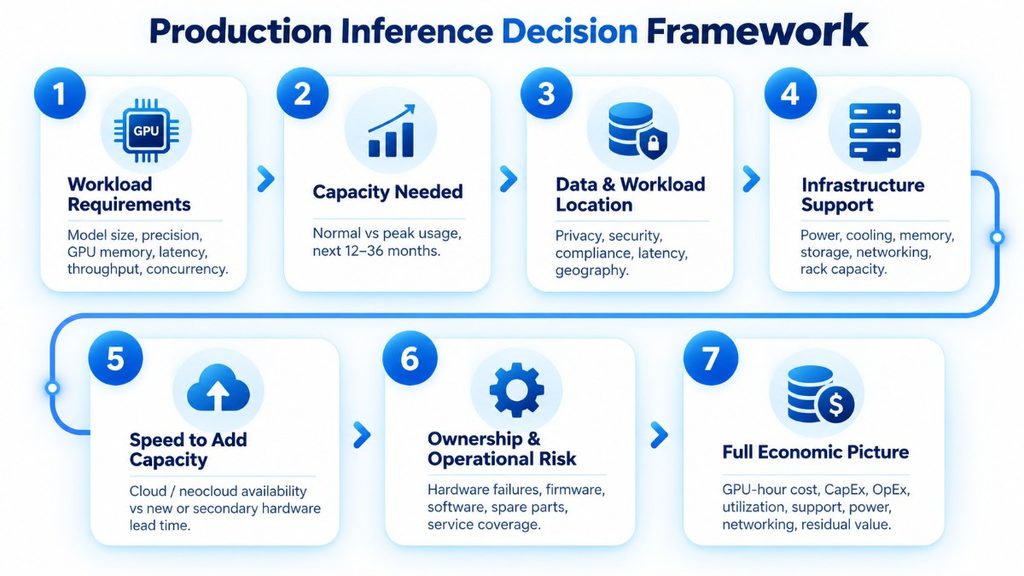
Before choosing cloud, neocloud, new hardware, or secondary hardware, answer these seven questions:
- What does the workload require?
Define the model size, precision, GPU memory, latency, throughput, and concurrency needs. - How much capacity will you actually use?
Estimate normal and peak utilization over the next 12–36 months. - Where must the data and workload run?
Consider data privacy, security, compliance, latency, and geographic requirements. - Can the infrastructure support the workload?
Check power, cooling, memory, storage, networking, and rack capacity. - How quickly do you need capacity?
Compare cloud or neocloud availability with the lead time for owned new or secondary hardware. - Who owns support and operational risk?
Define responsibility for hardware failures, firmware, software, spare parts, and service coverage. - What is the full economic picture?
Compare GPU-hour cost, CapEx, OpEx, utilization, support, power, networking, and expected residual value before choosing a deployment model.
Frequently Asked Questions
Can AI inference run without a GPU?
Yes. Smaller models and low-volume applications can run on CPUs or other accelerators. The right choice depends on model size, response-time targets, request volume, and software support. GPUs become more valuable as parallel compute, throughput, and memory-bandwidth needs rise.
What is the difference between prefill and decode in LLM inference?
Prefill processes the input prompt and can use heavy parallel compute. Decode generates output tokens step by step and is often more sensitive to memory bandwidth and latency. Measuring both phases can reveal why two GPUs with similar headline performance behave differently in production.
Does a RAG vector database need to run on the same GPU server?
Usually not. The retrieval layer can run on separate CPU, memory, storage, or accelerator resources. What matters is whether retrieval can return relevant data fast enough to meet the application’s total response-time target.
How often should an AI inference platform be benchmarked again?
Rebenchmark after major changes to the model, context length, serving software, precision, traffic pattern, GPU generation, or infrastructure. Software optimization alone can change throughput enough to alter capacity and cost assumptions.
What is the best way to keep inference capacity from becoming obsolete?
Design around workloads rather than a single GPU generation. Use modular servers, qualified network and storage paths, clear expansion points, measurable utilization targets, and an asset lifecycle plan.
That makes it easier to add new capacity, reuse older systems, or move workloads between owned and rented infrastructure.