


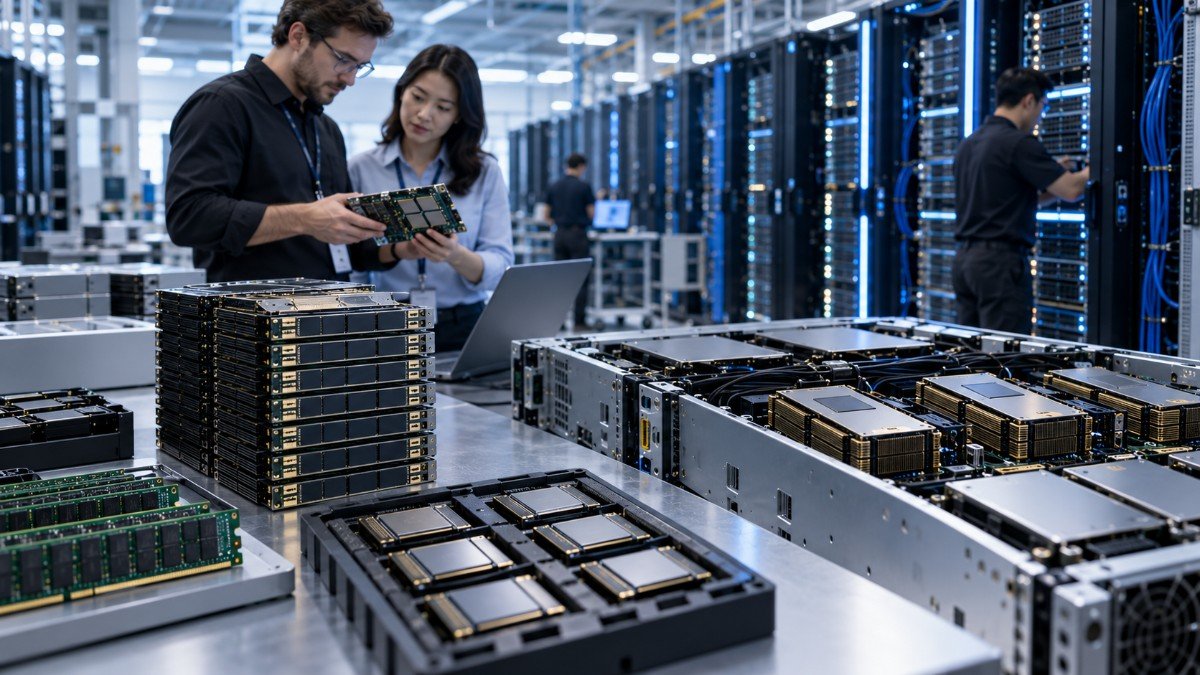
AI demand is creating a broader server memory cycle, not just a shortage of high-bandwidth memory (HBM). As GPU clusters grow, memory suppliers must support more HBM for accelerators while also supplying DDR5 and registered DIMMs (RDIMMs) for CPU-based servers. That pressure is changing how manufacturers allocate DRAM capacity and how enterprise buyers plan memory purchases.
As of Q3 2026, TrendForce expects server DRAM contract prices to rise 13%–18% quarter over quarter. It also expects server DRAM supply to remain tight into 2027 as HBM production consumes more manufacturing capacity and server demand continues to grow.
For infrastructure teams, the practical lesson is clear: memory can no longer be treated as a routine line item ordered after the server design is complete. Capacity, exact part numbers, DIMM population rules, qualified alternatives, availability, and future expansion need to be considered much earlier.
Teams already dealing with the DDR5 memory shortage in 2026 should view it as part of this larger change in server memory economics.
Key Takeaways
- AI is increasing demand for more than HBM. GPU systems still need CPU memory, storage, networking, and large pools of server DRAM.
- HBM growth can tighten conventional DRAM supply. HBM uses advanced DRAM dies, stacking, and complex packaging while competing for manufacturing resources.
- Memory per AI system is rising quickly. NVIDIA’s current HGX platforms show GPU-memory capacity moving from about 1.1 TB per eight-GPU H200 node to 1.44 TB with B200 and 2.30 TB with B300.
- DDR5 and RDIMM pricing remains under pressure. TrendForce forecasts a 13%–18% quarter-over-quarter increase in server DRAM contract prices for Q3 2026.
- Procurement flexibility matters more than chasing the lowest module price. Exact compatibility, available quantities, qualification status, warranty, and project timing can matter as much as cost.
What Is the Server Memory Supercycle?
A server memory supercycle is a sustained period in which demand, supply constraints, higher memory content per server, and changing manufacturing priorities reinforce each other.
It is not simply a temporary DDR5 shortage.
AI infrastructure is changing demand across several memory layers at the same time. Accelerators need HBM. CPU hosts need DDR5 or other system memory. Larger datasets increase storage demand. Inference, retrieval-augmented generation (RAG), databases, vector search, and data preparation can also expand the memory footprint outside the GPU.
That broader relationship is why enterprise AI infrastructure beyond the GPU matters when teams estimate memory demand. A GPU purchase is only one part of the bill of materials.
TrendForce expects AI to remain the main driver of memory demand in 2027. It also projects DRAM demand growth to continue outpacing supply expansion as more manufacturing capacity goes toward HBM and other AI-oriented products.
Why this cycle is different
Three changes are happening together:
- AI accelerators are using more HBM per device.
- AI servers are being deployed in larger numbers and with larger memory pools.
- Memory makers are shifting product mix and manufacturing resources toward AI and server products.
This creates pressure across the memory market instead of within one product category.
Why AI Workloads Are Driving HBM Demand
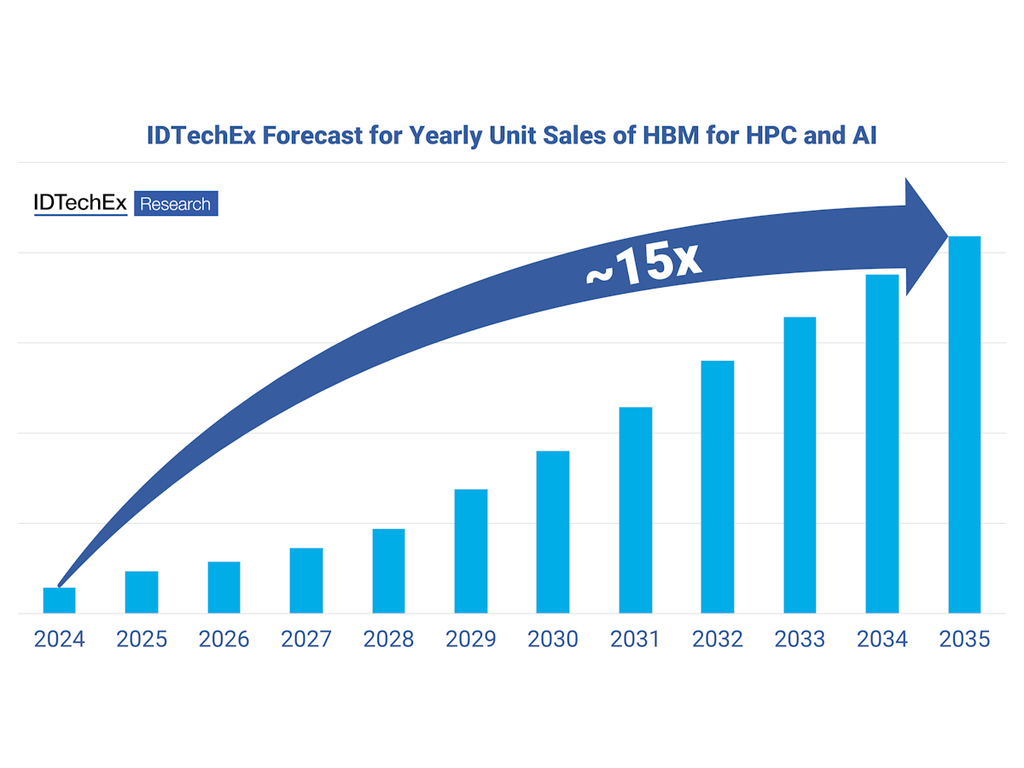
Modern AI accelerators can perform huge numbers of calculations each second. Those compute engines only stay productive when memory can deliver data fast enough.
That is the main purpose of high-bandwidth memory.
HBM stacks DRAM dies vertically and places the memory close to the accelerator. The design creates a very wide connection between the processor and memory, allowing much more data to move each second than conventional server DIMMs can deliver to a CPU.
Micron’s HBM3E products deliver more than 1.2 TB/s of bandwidth per stack, while its HBM4 design increases that figure to more than 2.8 TB/s per stack. Micron also notes that HBM manufacturing requires stacked DRAM dies, through-silicon vias, and high-precision production processes.
AI workloads benefit from this bandwidth because they frequently move large amounts of model data between memory and the accelerator.
HBM becomes especially important for:
- Large-model training
- Fine-tuning
- High-throughput inference
- Large context windows
- AI reasoning workloads
- Scientific and HPC workloads
- Workloads with large active model states
The importance of memory becomes clear in an eight-GPU NVIDIA H100 server configuration, where GPU memory, CPU memory, storage, interconnects, and network bandwidth must work as one system.
HBM vs. DDR5 vs. RDIMM: What Is the Difference?
HBM, DDR5, and RDIMM are related, but they should not be treated as competing versions of the same product.
| Memory term | What it means | Main role | Common location |
| HBM | High-bandwidth stacked DRAM | Feeds GPUs and AI accelerators at very high speed | Packaged close to the accelerator |
| DDR5 | Fifth-generation Double Data Rate SDRAM | Main system memory for modern CPUs | Server memory channels |
| RDIMM | Registered DIMM | Enterprise module format designed for stable, high-capacity server memory | Physical DIMM slots in servers |
| DDR5 RDIMM | DDR5 DRAM built as a registered server module | Standard CPU memory for many modern enterprise servers | HPE, Dell, Lenovo and other server platforms |
The important distinction is that DDR5 describes the memory generation, while RDIMM describes a server module type.
A server can therefore use DDR5 RDIMMs.
Intel server documentation, for example, lists ECC DDR5 RDIMMs with specific supported capacities, ranks, speeds, and population rules. That matters because two modules with the same capacity are not automatically interchangeable.
The same principle applies when planning DDR5 versus DDR4 server upgrades. Memory generation, module type, CPU support, firmware, speed, rank, capacity, and slot population all need to match the platform.
Why HBM Growth Can Affect Conventional Server Memory Supply
One of the most important procurement points is also easy to miss:
HBM demand does not stay inside the HBM market.
HBM and conventional DRAM rely on the same broader DRAM manufacturing ecosystem. HBM also requires more complex production because several DRAM dies must be stacked, connected, tested, and packaged.
When manufacturers allocate more advanced production toward HBM and AI-oriented products, fewer resources may be available for conventional memory products.
TrendForce reported in July 2026 that HBM and newer AI memory products were consuming growing wafer capacity and putting pressure on RDIMM supply. Its research also expects HBM allocation and AI-server demand to keep the DRAM market tight into 2027.
Samsung reported a similar demand pattern in its Q2 2026 results. The company said demand for server DRAM, enterprise SSDs, and HBM was expected to accelerate during the second half of 2026 and keep the market undersupplied.
How the pressure moves through the market
| AI market change | Memory supply effect | Enterprise buyer impact |
| More GPU shipments | More HBM demand | Greater competition for advanced DRAM capacity |
| More HBM per GPU | Higher memory content per accelerator | Faster growth in DRAM bit demand |
| More AI servers | More CPU-side DDR5/RDIMM demand | Higher demand for standard server memory |
| Suppliers favor AI/server products | Product mix changes | Less flexibility in some module categories |
| Buyers build inventory | Available supply tightens further | More price and lead-time pressure |
This does not mean every DDR5 module will face the same shortage or price movement. Capacity, density, supplier, contract structure, OEM qualification, and module type can produce very different outcomes.
AI Servers Are Using More Memory Per System
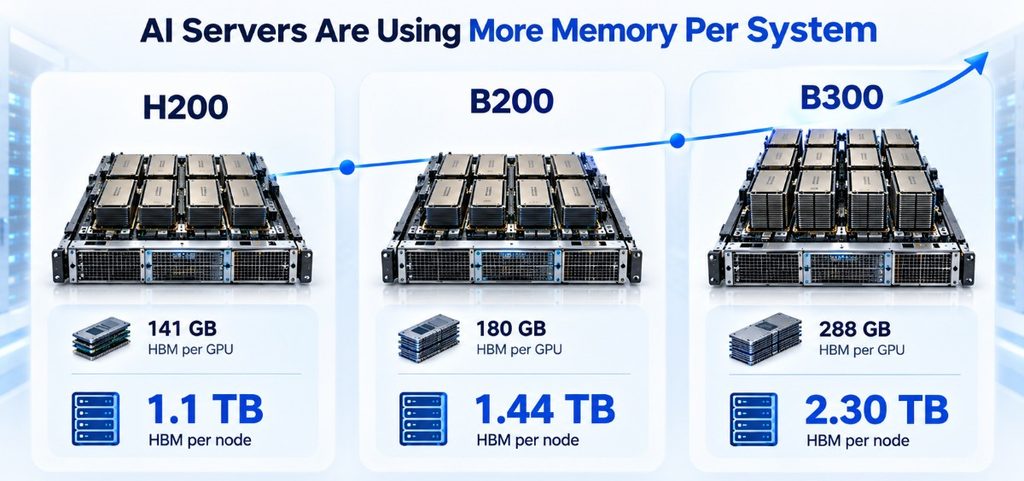
AI servers are not only becoming more powerful. They are becoming more memory-dense.
NVIDIA’s enterprise architecture documentation shows the direction clearly:
| Eight-GPU HGX platform | HBM per GPU | HBM per node |
| H200 | 141 GB | 1.1 TB |
| B200 | 180 GB | 1.44 TB |
| B300 | 288 GB | 2.30 TB |
That table covers GPU memory only.
The surrounding server still needs system memory for operating systems, data preparation, CPU-side processing, databases, orchestration, preprocessing, RAG services, schedulers, and other tasks.
That is why simply comparing GPU generations can produce an incomplete infrastructure plan. Teams making an enterprise GPU buying assessment should size CPU memory, storage, networking, power, and future capacity at the same time.
Higher memory density also changes the procurement risk. A project that requires hundreds of identical high-capacity RDIMMs has a different supply problem from a project that needs a few common modules.
What Is Happening to DDR5 and RDIMM Pricing?
Server DRAM prices are rising because demand remains strong while available supply is tight.
TrendForce forecast 13%–18% quarter-over-quarter growth in server DRAM contract prices during Q3 2026. The firm also expects server DRAM prices to continue rising through the second half of 2026 and into 2027, although the rate of increase may slow.
Its forecast includes another important procurement signal: total RDIMM bit supply may grow only 15%–20% year over year in 2027, which TrendForce expects to lag growth in server CPU shipments.
Buyers are already changing configurations in response.
TrendForce says some CSPs and OEMs have shifted part of their purchasing mix from 96 GB and 128 GB RDIMMs toward 32 GB and 64 GB modules as they balance memory needs, CPU availability, and cost.
That does not mean smaller modules are always the better choice. More DIMMs can increase slot use and may limit future expansion.
The right question is:
Which configuration meets the workload requirement while preserving enough capacity, bandwidth, availability, and upgrade room?
Memory Procurement Is Becoming a Platform Decision
Memory purchasing used to be relatively simple for many enterprise projects: identify the supported module, confirm quantity, obtain a quote, and place the order.
AI infrastructure makes that process more sensitive.
A memory decision can now affect:
- Server deployment dates
- CPU memory bandwidth
- Maximum future capacity
- Number of free DIMM slots
- NUMA balance
- Support eligibility
- Spare-part planning
- Firmware compatibility
- Cost per server
- Future expansion options
Platform-specific rules matter as well. A documented HPE ProLiant memory and storage upgrade plan can reduce errors caused by treating capacity as the only memory requirement.
What we would verify before substituting a memory SKU
A substitute module should not be approved simply because its label says “64 GB DDR5.”
A real compatibility review should confirm:
- Exact server model and generation
- CPU model and number of installed processors
- DDR generation
- Population order
- Existing memory configuration
- OEM qualification requirements
- Firmware or BIOS requirements
- Warranty and support effect
- Available quantity
- Condition and testing history
- Spare availability for the expected service life
For standardized HPE environments, DL360 Gen11 and Gen12 configuration planning shows why CPU, memory, storage, and workload choices need to be reviewed together.
Planning a memory SKU substitution? Validate compatibility, performance, availability, and lifecycle risk first with expert guidance from Catalyst Data Solutions Inc.
When Does Secondary or Server-Pull Memory Make Sense?
Secondary memory can be useful, but “secondary” should never be treated as a single condition grade.
Used, server-pull, refurbished, recertified, OEM-surplus, and new-open-box inventory can have different histories and support terms.
Secondary RDIMMs may make sense when:
- The exact OEM part number is unavailable through normal channels.
- A legacy server requires a discontinued module.
- A large installed fleet needs matching spare parts.
- New OEM supply has a lead time that puts the deployment date at risk.
- A tested equivalent has been fully validated for the target platform.
The diligence requirement becomes more important as capacity and project size rise.
Buyers should ask for evidence covering condition, testing, provenance, labeling, part numbers, firmware requirements where relevant, warranty, and return terms.
A lower purchase price is not useful if the module causes reduced memory speed, an unsupported population pattern, boot failures, support problems, or a delayed deployment.
What Should Buyers Stock, and What Can Stay Just-in-Time?
Not every memory SKU deserves the same procurement strategy.
| Memory situation | Suggested approach | Why |
| Critical exact SKU with long lead time | Consider securing supply early | One missing module type can delay deployment |
| Common qualified DDR5 RDIMM | Maintain approved alternatives | More sourcing flexibility |
| Rare legacy memory | Hold planned spares | Replacement supply may shrink |
| High-density AI server memory | Forecast early and confirm quantities | Large projects can exceed normal channel inventory |
The decision should depend on failure impact, replacement time, installed base, project schedule, and the number of qualified alternatives.
Holding every possible spare wastes capital. Holding no spares can expose a production environment to avoidable downtime.
A 90-Day and 180-Day Server Memory Procurement Plan
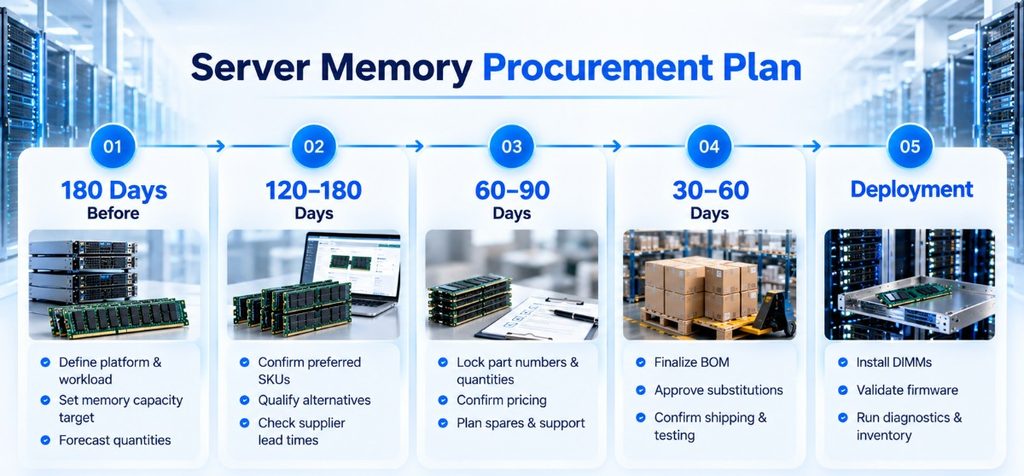
AI infrastructure teams should forecast memory before purchase orders are due.
| Time horizon | What to confirm |
| 180 days before deployment | Server platform, workload, target memory capacity, expected growth, module class, projected quantities |
| 120–180 days | Preferred SKUs, qualified alternatives, OEM rules, supplier availability, expected lead times |
| 60–90 days | Current quotations, exact part numbers, project quantities, spare requirements, firmware and support status |
| 30–60 days | Final BOM, shipping schedule, substitution approvals, receiving and testing plan |
| Deployment period | DIMM population, firmware, diagnostics, inventory records and spare allocation |
The goal is not to predict the memory market perfectly. It is to reduce the number of decisions that must be made after availability has already changed.
Why Samsung, SK hynix and Micron Matter to Enterprise Buyers
Enterprise IT teams may never purchase memory wafers directly, but upstream supplier decisions still affect them.
Samsung, SK hynix, and Micron decide how much manufacturing capacity goes toward products such as HBM, server DRAM, mobile memory, and other DRAM categories.
When AI products earn priority, conventional memory availability can change downstream.
TrendForce’s August 2026 research continues to describe AI-related demand and HBM capacity allocation as major reasons the DRAM market is expected to remain tight in 2027.
That makes supplier roadmaps relevant to infrastructure planning even when an enterprise ultimately buys an OEM-qualified HPE, Dell, Lenovo, Samsung, Micron, or SK hynix module through another channel.
Server Memory Planning in 2026 Is About More Than Price
The server memory supercycle changes the buying question.
Instead of asking only:
“What does this RDIMM cost today?”
Infrastructure teams should also ask:
- Is the required quantity actually available?
- Does the module match the exact server configuration?
- Can another SKU be qualified before the project starts?
- Will the selected capacity leave enough expansion room?
- Does the workload need capacity, bandwidth, or both?
- How much spare inventory is reasonable?
- What happens if the preferred module disappears from supply?
- Is a new, OEM-surplus, or tested secondary option appropriate?
- Who owns warranty and support after substitution?
AI has made memory a strategic infrastructure resource. HBM receives much of the attention because it sits beside the GPU, but DDR5 and RDIMMs remain essential to the servers, databases, agents, storage pipelines, and CPU workloads around those accelerators.
The strongest procurement plan therefore does not assume that HBM growth means “buy any DDR5 you can find.” It maps the workload first, validates the platform, creates qualified alternatives, tracks current supply, and preserves enough flexibility to react when the market changes.
Frequently Asked Questions
1. How does ECC memory help protect AI and enterprise servers?
ECC memory detects and corrects certain memory errors, helping improve server stability and reliability.
2. Can mixing different DDR5 RDIMM capacities reduce server performance?
Yes. Mixed capacities, ranks, or speeds can affect performance and memory balance if the platform does not support the configuration well.
3. What is MRDIMM, and how is it different from a standard DDR5 RDIMM?
MRDIMM is designed for higher memory bandwidth, but it only works on server platforms that specifically support it.
4. Could CXL change how enterprises plan server memory capacity?
Yes. CXL can expand or pool memory beyond traditional DIMM slots on supported systems.
5. How often should enterprises review their server memory procurement plan?
Review it whenever pricing, supply, workloads, server platforms, or deployment timelines change significantly.